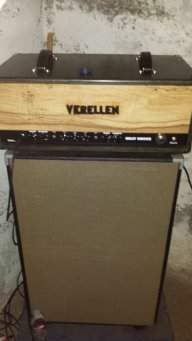
Alright I'm trying to wake up, the Benadryl is not wearing off, it's raining like crazy I'm looking for a plastic bag to put my camera in
I know you're tired, so just remember.. camera in bag, not your head.

TalkBass has been independent since 1998. Add your voice.
Create a free account to reply to discussions, view embedded media, and browse with fewer display ads.
Join free Log in
Want zero display ads or expanded classifieds tools? Compare plans.
Alright I'm trying to wake up, the Benadryl is not wearing off, it's raining like crazy I'm looking for a plastic bag to put my camera in

Mike, my deepest condolences.Just took my 16 year old pit to get put to sleep, hopefully things will improve this afternoon. The basset hound and duck retriever are pretty down too.


TLDR; School me on materials and methods to make instrument (and I assume speaker with heavier gauge) cables as a gateway to eventually making my own effects and what not.
Thanks!
Ok, thanks! Didn't know the only difference b/w speaker and instrument cables were gauge. Good to know. So any two pole, copper cored and unshielded cable should work? By plug do you mean metal end? I assume you mean the interior part, that is physically connected to the cable, and not the screwed on outer part? Sorry if it's a dumb question. And thanks for the help!Instrument cables are a copper cored sheilded then insulated cable. Exact construction varies per manufacturer. Speaker cables are copper cored and unshielded. If you use an instrument as a speaker cable the wattage can jump the the shield and short your transformer causing it to burn out.
I would get shrink wrap but you can use a bic lighter instead of a heat gun. Heat guns work well, but the lighter will work.
Youll need two ends per cable, generally you heatshrink the plug onto the cable for extra strength around the solder.
A really easy place to get started is lavas soldered pedal board kits. Im unafiliated with lava, but I use their stuff because theyre less the 30 miles from my house.
Invalid Link Removed
Ok, thanks! Didn't know the only difference b/w speaker and instrument cables were gauge. Good to know. So any two pole, copper cored and unshielded cable should work? By plug do you mean metal end? I assume you mean the interior part, that is physically connected to the cable, and not the screwed on outer part? Sorry if it's a dumb question. And thanks for the help!
I'm using mono connections. I had thought since there was a tip and a sleeve I would need to solder two things per cable end. Is this not the case? Should I only be soldering one thing per end? The "poles" as i called them would be the two things I solder. Maybe I got confused by my 4 pole Speakon for my GK HMS.The biggest difference between speaker and instrument cables is that instrument are shielded and speaker cables are not.
Cables 101: Instrument vs. Speaker Cables
When i said plug i mean as a whole the end peice. Where the shrink wrap should go depends kind of on your plug construction. On a pancake plug it actually goes inside the plug to fill space inside the plug, where as on a standard straight quarter inch plug it may go inside or outside ive seen it both ways.
As far as cable just single conductor shielded cable is what most people use. I think by two pole you mean two conductors? I would think youd only need that if you are using stereo (TRS) connectors. Theres lots of arguments on how much of a difference higher quality low oxygen copper etc makes on tonal quality.
Lava Cable - Magma
I'm using mono connections. I had thought since there was a tip and a sleeve I would need to solder two things per cable end. Is this not the case? Should I only be soldering one thing per end? The "poles" as i called them would be the two things I solder. Maybe I got confused by my 4 pole Speakon for my GK HMS.
Got it. So I was counting the shield as a pole. Only one pole in a standard cable, and one shield. Meaning I still solder two things per end. Thanks for your patience.Instrument cables use the shield as the ground. So when you open one up youll have to split the shield to expose the conductor. Youll twist the shield and solder it to the sleeve and solder the center conductor to the tip.
Got it. So I was counting the shield as a pole. Only one pole in a standard cable, and one shield. Meaning I still solder two things per end. Thanks for your patience.
So, two different and separate wires in separate sheaths inside a larger, single sheath. Like @dcarwin was saying. Thanks to both of you!Yeah, thats it. Speaker cables are a bit different since they arent shielded they will have a seperate ground wire
Generally speaking you want your wires to be as low resistance as possible. Larger guage wires tend to have lower resistance. But they are also less flexible, youve got to hit it somewhere in the middle. Im a big fan of mogami cable, very reliable and flexible. Seems like really good cable goes for between .90 usd and 1.20 usd per foot. Not an expert though. Ends and stuff i havent bought any in awhile.So, two different and separate wires in separate sheaths inside a larger, single sheath. Like @dcarwin was saying. Thanks to both of you!
Smaller details - Does gauge matter much? And any idea as to a fair price for the materials (cable and plugs themselves, as well as heat shrink and/or heat gun)?

Precisely why I'm starting with cables! Would love to get decent at soldering, but so far I'm pretty terrible! Figure a cable can't be that hard, and I need a few anyway.These questions remind me I need to get some kind of kit for patch cables. My soldering is terrible.