
Enjoy the benefits of a premium membership!
Upgrade Account
-
TalkBass has been independent since 1998. Add your voice.
Create a free account to reply to discussions, view embedded media, and browse with fewer display ads.
Join free Log in
Want zero display ads or expanded classifieds tools? Compare plans.
You are using an out of date browser. It may not display this or other websites correctly.
You should upgrade or use an alternative browser.
You should upgrade or use an alternative browser.
Stretching left hand over four frets? Really?
- Thread starter wemmick
- Start date
More options
Who Replied?
i have never seen any proof of ofpf causing injury...because it doesn't exist.
I'm here to post to the contrary but I might be a special case since I have chronic neck back and shoulder injuries. (Same reason why I can't play a heavy bass, it hurts and my hand goes numb) Playing one finger per fret in first position kills my wrist and gives me pain. I developed my own technique similar to simandl. Instead of fretting 1-2-4 I do 1-2-3-3/4 where I use my pinky and ring finger together to fret the string. My wrist doesn't bend and I don't get pain. As I travel up the neck I start doing the one finger per fret thing as the frets get smaller. I can reach from the 6th fret to the 11th with ease and not bend my wrist, but generally everything above the 6/7th fret I'm using my version of simandl.

From my own experience, in playing both instruments for 32 years (wow! I should be better!  I can say that when playing electric bass, my left wrist is much more relaxed when I play 1-2-4 fingering near the nut. That's why I make sure my students have this fingering choice in their playing.
A third fingering choice that I use regularly up high on the fingerboard is 1234, but with a whole tone between my 1st and 2nd fingers. This allows my a major third in one position.
I can say that when playing electric bass, my left wrist is much more relaxed when I play 1-2-4 fingering near the nut. That's why I make sure my students have this fingering choice in their playing.A third fingering choice that I use regularly up high on the fingerboard is 1234, but with a whole tone between my 1st and 2nd fingers. This allows my a major third in one position.

No biggie for the man
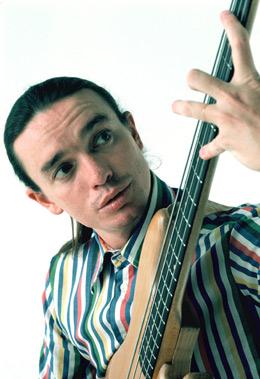
Thats how his intonation was so perfect. He'd just go up and down the neck playing on top of the frets. Meh, "Jaco-Method"... I use it


Just play whatever is comfortable. I don't get all this bad technique. If it isn't causing pain, it isn't causing harm.
I completely disagree with OFPF. I teach 1,2,4 - similar to upright fingering. I believe Ed Freidland does in his books as well. OFPF is a recipe for tension, pain and injury. I know loots of people do it and say it's fine, but I think that 1,2,4 is a smarter way to finger. Now, once you get higher up, OFPF is fine, I do it as well - especially above the 12th fret.
I agree with this. Many basslines involve only 1 and 4. No need to contort your hand!
a lot of you simaldl folks say this, but i have seen zero evidence of it being true. i would really appreciate it when you and other people say stuff like this, they would provide proof. for example, when i get into pick technique arguments, i have plenty of proof that bad pick technique causes injury. that proof is me and the pain i get when i use bad technique, as well as the countless pick bassists i've seen struggle with cts, wearing wrist braces, etc. i have never seen any proof of ofpf causing injury...because it doesn't exist.
In principle I would agree with stevec. Optimal use of the fingers would be in line with the fingers natural range of motion.
However, electric bass isnt too hard compared to traditional contrabasses - the strings are much lower and easier to deflect. I have met a few old orchestral players with near crippled hands because of a lifetime playing brutally difficult instruments, so there is always a risk with any player.
So my approach is to just tell the students exactly what I have written here. I get them to move their hands into a position that allows them to use their fingers in a natural way without straining at odd angles, and usually I put their string heights down.
Its about minimising risk to the player, that is all.
PS, to me that picture does look like a strain.

Thanks for all the hints. Things I'll definitely try:
On a related note, then... BG for Dummies has an early exercise with root-3rd-5th. Using OFPF, he has 2nd finger on the 3rd fret on the A string (to play a C for the root), 1st finger on the 2nd fret of the D string for the third and 4th finger on the 5th fret of the D string for the fifth.
G --------------
D ----1--4------
A -2------------
E --------------
How does one accomplish this with 124 fingering? Do you move the hand so that you still hit the fifth with the fourth finger? (In C, I can play an open G string, but this method doesn't translate to other keys.)
- One finger per fret (OFPF, I now know) for the higher notes
- Practice OFPF on one fret lower than I can comfortably go and work on stretching from there
- Using 124 otherwise
- Finding a teacher to view what I'm doing in real life (and perhaps to adjust the action on my bass)
On a related note, then... BG for Dummies has an early exercise with root-3rd-5th. Using OFPF, he has 2nd finger on the 3rd fret on the A string (to play a C for the root), 1st finger on the 2nd fret of the D string for the third and 4th finger on the 5th fret of the D string for the fifth.
G --------------
D ----1--4------
A -2------------
E --------------
How does one accomplish this with 124 fingering? Do you move the hand so that you still hit the fifth with the fourth finger? (In C, I can play an open G string, but this method doesn't translate to other keys.)

On a related note, then... BG for Dummies has an early exercise with root-3rd-5th. Using OFPF, he has 2 on the C on the A string (3rd fret), 1 on the 2nd fret of the D string for the 3rd and 4 on 5th fret for the fifth.
G --------------
D ----1--4------
A -2------------
E --------------
How does one accomplish this with 124 fingering? Do you move the hand so that you still hit the fifth with the fourth finger? (In C, I can play an open G string, but this method doesn't translate to other keys.)
Using a traditional Simandl-style 124 fingering, yup, you'd shift up to hit that 4, then back down for the 1.

Rickett Customs
Commercial User
Sweet Jeebus......... Look at the height of the E string, I'd get injured falling from that highwire.....

back in '91 my first teacher had me learn on a fretless lol...ouch! and im a little guy at 5'5 with small hands too.

On a related note, then... BG for Dummies has an early exercise with root-3rd-5th. Using OFPF, he has 2nd finger on the 3rd fret on the A string (to play a C for the root), 1st finger on the 2nd fret of the D string for the third and 4th finger on the 5th fret of the D string for the fifth.
G --------------
D ----1--4------
A -2------------
E --------------
How does one accomplish this with 124 fingering? Do you move the hand so that you still hit the fifth with the fourth finger? (In C, I can play an open G string, but this method doesn't translate to other keys.)
Use your thumb as a pivot. Take a look at this clip at 06.38.
I have very small hands. My first bass was a Fender Jazz fretless, which thinking in retrospect, made the stretch even more critical than on a fretted bass. I have NEVER had a problem or hint of a problem in 15 years of playing.
A.) Rome wasn't built in a day. If you can't turn around and comfortably OFPF tomorrow, then it's NOT failure. Your hand will open up in time. Do not rush this.
B.) If you feel pain, tingling, numbness, etc... in your fretting hand for OFPF, STOP PLAYING. Do NOT play through the pain.
I like this, not only in terms of OFPF, but also angle the bass is held, and that you can see up close, plus the back of the neck, his playing, sound, etc... @6:33
It's John Lee on bass.
I'm sure others can offer interesting and relevant examples as well.
A.) Rome wasn't built in a day. If you can't turn around and comfortably OFPF tomorrow, then it's NOT failure. Your hand will open up in time. Do not rush this.
B.) If you feel pain, tingling, numbness, etc... in your fretting hand for OFPF, STOP PLAYING. Do NOT play through the pain.
I like this, not only in terms of OFPF, but also angle the bass is held, and that you can see up close, plus the back of the neck, his playing, sound, etc... @6:33
It's John Lee on bass.
I'm sure others can offer interesting and relevant examples as well.
From my own experience, in playing both instruments for 32 years (wow! I should be better!
A third fingering choice that I use regularly up high on the fingerboard is 1234, but with a whole tone between my 1st and 2nd fingers. This allows my a major third in one position.
About 20 years ago I took some lessons with Kim Clark, who had me work things out in a similar fasion. She wanted me to work lines out using 124, OFPF and an extended system like yours which also extended on the pinky side - thus making a six-fret-position in the higher registers.
That last technique, if my memory serves, is something she picked up from Rael Wesley Grant who has huge hands. Kim's hands are pretty big, too, as are mine, but I could see this being useful even to smaller-handed players up the neck where the reach isn't so bad. It gives a lot of options.
At the time I asked her "how do I know where to use which technique?" and she answered "Just learn all three and then your hands will figure it out". Sure enough, 20 years later I shift between those techniques all the time and I'm barely aware of it. I'm usually in 124 in the first three positions for comfort, but my hands basically do what they need to to get it done. 112344 definitely has it's place for tricky passages.
Thanks for all the hints. Things I'll definitely try:
- One finger per fret (OFPF, I now know) for the higher notes
- Practice OFPF on one fret lower than I can comfortably go and work on stretching from there
- Using 124 otherwise
- Finding a teacher to view what I'm doing in real life (and perhaps to adjust the action on my bass)
On a related note, then... BG for Dummies has an early exercise with root-3rd-5th. Using OFPF, he has 2nd finger on the 3rd fret on the A string (to play a C for the root), 1st finger on the 2nd fret of the D string for the third and 4th finger on the 5th fret of the D string for the fifth.
G --------------
D ----1--4------
A -2------------
E --------------
How does one accomplish this with 124 fingering? Do you move the hand so that you still hit the fifth with the fourth finger? (In C, I can play an open G string, but this method doesn't translate to other keys.)
For traditional 1-2-4 one needs to learn how to incorporate all the open strings in as many manners as possible. (ie. Bb major and C major use different "patterns". Open strings whenever possible, intelligent position shifts whenever needed. These shifts are to prepare for the future not the past and therefore are often different going up than coming down.
1-Open string G. fingers 2 (C), 1 (E), open G
2-Open string G fingers 4 (C), 2 (E), open G
3- on the A string, 1st finger for C, 4th for E; on the D string 1st finger for G. (movable pattern) back down in the same way.
4- On A string, 2nd finger on C; on D string, 1st finger on E, 1st on G; on A string coming down, 4th finger on E. (movable pattern)
5- reverse of #3 (movable pattern)
6- On the A string 2nd finger plays C; on the D string 1st finger plays E, 4th finger plays G, back down same way. (movable pattern)
Combine those options with 1-2-3-4 patters higher up the neck, ie.E string C with 2nd finger or with 4th finger, as well as the above 1-2-4 patters on the E string's C (1st fingerand you've got quite a few choices at your disposal.
Each fingering will sound different, and so pick the one that sounds best in the musical situation you're in.
a lot of you simaldl folks say this, but i have seen zero evidence of it being true. i would really appreciate it when you and other people say stuff like this, they would provide proof. for example, when i get into pick technique arguments, i have plenty of proof that bad pick technique causes injury. that proof is me and the pain i get when i use bad technique, as well as the countless pick bassists i've seen struggle with cts, wearing wrist braces, etc. i have never seen any proof of ofpf causing injury...because it doesn't exist.
I'm also a victim of 1FPF, unfortunately. Not too long ago I finally traced my left wrist injuries to using 1FPF exclusively everywhere on the neck, particularly up in half position. I've since adopted 1-4/1-2-4 down in half position and the injuries have finally stopped progressing. I do continue to use 1FPF once I get up into about the 5th fret position, but further down that technique is a recipe for murder for my left hand/wrist.
So it's definitely something to pay attention to, to see if 1FPF is hurting you. If it is, than it's the wrong technique for you and you should look at an alternative like Simandle....
LS

I'm here to post to the contrary but I might be a special case since I have chronic neck back and shoulder injuries. (Same reason why I can't play a heavy bass, it hurts and my hand goes numb) Playing one finger per fret in first position kills my wrist and gives me pain. I developed my own technique similar to simandl. Instead of fretting 1-2-4 I do 1-2-3-3/4 where I use my pinky and ring finger together to fret the string. My wrist doesn't bend and I don't get pain. As I travel up the neck I start doing the one finger per fret thing as the frets get smaller. I can reach from the 6th fret to the 11th with ease and not bend my wrist, but generally everything above the 6/7th fret I'm using my version of simandl.
If you are also keeping your thumb behind the neck and pivoting some, your "own technique" is very similar to what Carol Kaye teaches, IIRC, it's 1-2-3/4- 3/4 her way( it may be exactly like your way 1-2-3-3/4).Of course if the music demands you deviate from it some, so it's not a hard-fast rule, but since I've been trying to use 3/4 together more and pivoting on my thumb, it makes things so much easier...whether or not it prevents injury, IDK.

sorry to hear that, but i must admit i think there was something else going on with your technique that made ofpf difficult. oh well, hard to say without seeing you play back then, so fair enough. i still think if you have good thumb placement, it shouldn't be damaging at all, but i can't argue with you at this point. glad you're feeling better, though.I'm also a victim of 1FPF, unfortunately. Not too long ago I finally traced my left wrist injuries to using 1FPF exclusively everywhere on the neck, particularly up in half position. I've since adopted 1-4/1-2-4 down in half position and the injuries have finally stopped progressing. I do continue to use 1FPF once I get up into about the 5th fret position, but further down that technique is a recipe for murder for my left hand/wrist.
So it's definitely something to pay attention to, to see if 1FPF is hurting you. If it is, than it's the wrong technique for you and you should look at an alternative like Simandle....
LS


