I still don't get these witness points though. What the f is that all about? Some nerdy expression that is really called something else?

Enjoy the benefits of a premium membership!
Upgrade Account
-
TalkBass has been independent since 1998. Add your voice.
Create a free account to reply to discussions, view embedded media, and browse with fewer display ads.
Join free Log in
Want zero display ads or expanded classifieds tools? Compare plans.
You are using an out of date browser. It may not display this or other websites correctly.
You should upgrade or use an alternative browser.
You should upgrade or use an alternative browser.
Stringing, Tuning, Intonation and Witnesses
- Thread starter Turnaround
- Start date
More options
Who Replied?

I still don't get these witness points though. What the f is that all about? Some nerdy expression that is really called something else?
The "witness point" is the spot on the bridge saddle or nut where the string makes contact.
It is a nerdy expression for, where a curved surface touches something else.
Ok thanks, by other means, and correct phrase: A tangent, then.
I think, "point of tangency" would be more apropriate as we are discussing the spot where they touch and not the line itself.

Intonation is a really tricky thing. To start, a fretted instrument won't be intonated exactly at each fret. If you search you will find frets on instruments that make all kinds of bends across the fingerboard in an attempt to get exact intonation on each note. However, that can only work if your frets are accurately crowned so that the string is making contact dead centre of the fret. A bit of fret wear will throw this off. Next problem is that you have to be entirely consistent about the force you apply to the string when fretting a note. A bit more force and the note will be pulled sharp. Thirdly, your strings need to be really fresh. As sweat and gunk builds up in the string windings the distribution of mass along the speaking length of the string becomes uneven. This will affect the exactness of the intonation along the length of the string. Then there's the problem of tapered or exposed-core strings. They may offer a cleaner sound on the thicker strings, but it will be at the expense of intonation. That's because the mass of the string is not evenly distributed along it's vibrating length - there is less mass from the 12th fret to the saddle than from the 12th to the nut. That makes for an intonation nightmare. Sure you can get the 12th fret right, but everything else will be off by a bit.
And there are a few other things you can add to this problematic soup. If your nut is a bit high, your intonation on the first few frets will be sharp compared to the open string. If you do not have good witness points at the nut and the saddles, you will have intonation inadequacies. If the pickups are too close... ditto.
And if you intonate your bass while it's laying flat, like on a table top, it will be off when you put it in playing position. Likewise, if you move around a lot while playing, your intonation is probably moving around too.
Kinda makes you wonder why we bother, doesn't it?
And there are a few other things you can add to this problematic soup. If your nut is a bit high, your intonation on the first few frets will be sharp compared to the open string. If you do not have good witness points at the nut and the saddles, you will have intonation inadequacies. If the pickups are too close... ditto.
And if you intonate your bass while it's laying flat, like on a table top, it will be off when you put it in playing position. Likewise, if you move around a lot while playing, your intonation is probably moving around too.
Kinda makes you wonder why we bother, doesn't it?
Last edited:
Besides playing bass my other hobby is as an amateur machinist, in my small but well-equipped machine shop at my house. I can tell you that the term " witness point" is entirely accurate and appropriate for the subject of a string passing over a nut or bridge saddle. Sometimes I'll cut a piece of steel rod on my lathe, creating a compound cylindrical surface kind of like a camshaft. The point on the surface where the two cylinder diameters coincide is called the "witness point".
Last edited:
Whatever, it is a lot better than "witness point".
I've always called it the "take off point", but "witness point" is so common around here, that I use it now.
-
Here is an example of the term "witness point" as applied to metal machining, which I use all the time in clock repair. In the photos below, I'm making a replacement locking cam for a worn-beyond-repair part in my watchmaker's lathe. The piece of steel rod began life as a single diameter (0.250") but I cut a small section to a smaller diameter but off-center in such a way that a little strip became common to both diameters. The little strip is called the "witness point". I agree that it has little in common with a string passing over a nut or bridge saddle - until you realize that the diameters are just two separate entities that meet at a common point.
The first picture shows the piece of steel rod with the finished witness point facing the camera, and the second picture shows a side view of my final piece showing the compound diameters.
I have no idea if the musician's use of the term "witness point" derives from the machinist's use of the same term, but it's descriptive to me but only because of my machining background.
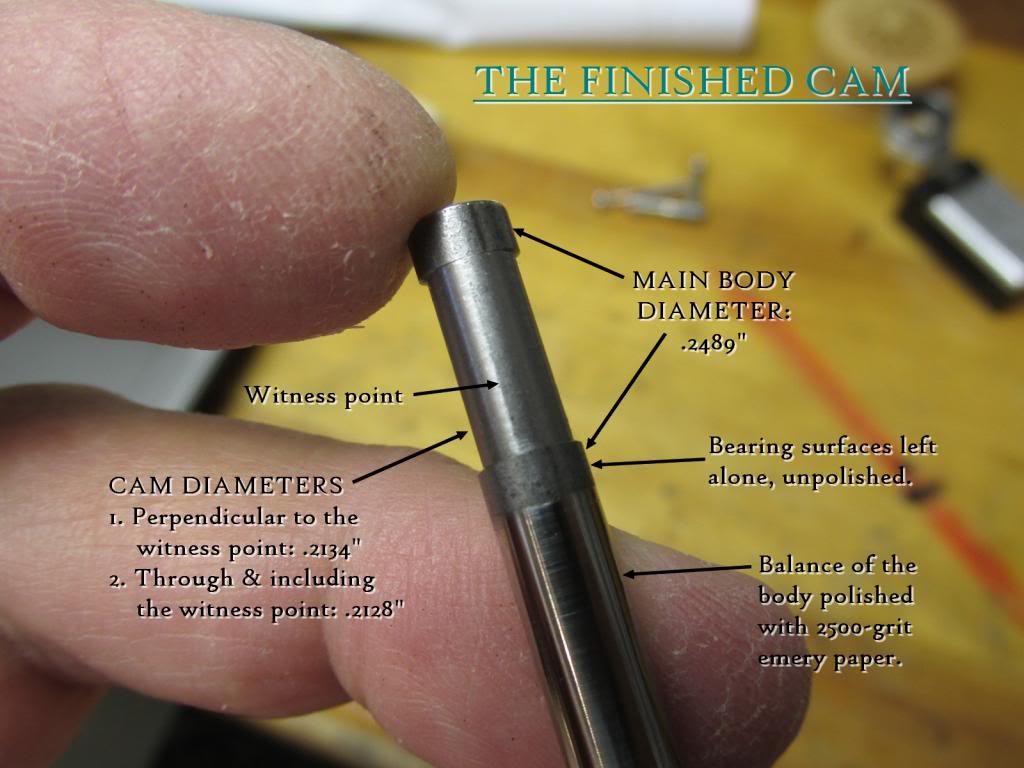

The first picture shows the piece of steel rod with the finished witness point facing the camera, and the second picture shows a side view of my final piece showing the compound diameters.
I have no idea if the musician's use of the term "witness point" derives from the machinist's use of the same term, but it's descriptive to me but only because of my machining background.
No, the line is NOT the string.The line is the string.
You said it yourself in your first post: "Where a curved surface touches something else". Just as it is explained at the wikipedia site explaining tangent.
Strings are round, so the point it contacts the bridge, saddle or fret is the point of tangency. The bridge, saddle or fret is the line.
PS. Thanks to Turnaround for keeping us from going off on a tangent. I've really learned a lot reading his posts over the years.

PS. Thanks to Turnaround for keeping us from going off on a tangent.

(and +1 to @Turnaround's wisdom being a valued resource around here)
anyway "witness point" makes sense to me too; i think "tangent" implies a line kissing a curve at a single geometric point, and the saddle isn't always a curve.
"unseated" vs "seated" strings:


(even here you'll see i forgot to hit the spot where the string enters the tailpiece, that should have been straightened out too.)
Last edited:
@cazclocker if you're hand-machining tiny metal clock parts then you know this kind of crap better than we do Invalid Link Removed
No, the line is NOT the string.
Strings are round, so the point it contacts the bridge, saddle or fret is the point of tangency. The bridge, saddle or fret is the line.
PS. Thanks to Turnaround for keeping us from going off on a tangent. I've really learned a lot reading his posts over the years.
If the actual frets are round crowned then, then what? You make the assumption that "witness points" exists solely at the nut or the bridge. I've heard and seen many bridge saddles that are just as "round" as the strings, if not even more. Remove the nut, and install a zero fret instead. Round crowned. Many luthiers wants round crowned so the ... tangent-witness point is a precis and sharp as possible. The "get off" point.
No matter what you say, most bridges on Fender J and P basses and the likes, looks like this, and it's nothing more than a circle. I can't see anything but a circle in there. The string is tensioned at a straight line over it, the string is not a circle, like it's coiled up like in the package they come with.
- - - - -
While I agree totally what Turnaround says, intonation is too tricky, and if you want to skip all this conundrum of elusive and catch-22 mojo, go fretless! All problems solved. On guitars though, with their chords and strings that all of a sudden turns from wound to plain strings this is another matter.
why did you jump in now?I think all points brought up here is ... futile, and of no use. So, once I buy a headed bass without zero fret, and with the old way of headstock and tuners, and no locking tuners at that, I'll might jump into the thread again.
Intonation is a really tricky thing. To start, a fretted instrument won't be intonated exactly at each fret. If you search you will find frets on instruments that make all kinds of bends across the fingerboard in an attempt to get exact intonation on each note. However, that can only work if your frets are accurately crowned so that the string is making contact dead centre of the fret. A bit of fret wear will throw this off.
Yes, they're called TrueTemperament frets, and they're - expecting lot of flak now - totally useless invention on bass. Don't get me started on guitar. If you use SS frets, they will last longer, but as fast you get the smallest DENT on your strings underneath, the string is uneven, the action changes and intonation is thrown off. Instead of fret wear you can as well have string wear, and the POINT (avoiding calling it either tangent or witness point by now) were the fret wears down the string and compress it, will both affect the intonation as well as action height. You have to - after a while - press longer down before the string makes contact. I e it's when you have to change out strings, to a fresh one. Stainless Steel frets on Stainless Steel string, will take a while too, but the string will wear down faster anyway. I e small dents will occur faster than on any SS fret.
Next problem is that you have to be entirely consistent about the force you apply to the string when fretting a note. A bit more force and the note will be pulled sharp. Thirdly, your strings need to be really fresh. As sweat and gunk builds up in the string windings the distribution of mass along the speaking length of the string becomes uneven. This will affect the exactness of the intonation along the length of the string. [/quote]
Yes, but that's why I recommend people checking out this, even before they start to intonate with pressing down any fret. If the 12th fret harmonic (halfway of string) is not exactly the same reading as an open string, in a tuner, do not proceed. Change strings out. If it still shows like that when putting new strings on, it's the magnetic string pull from the pups. If it still show differences like that, it's a poor cheap brand of strings you've bought. It can occur on some DR strings where there is a round core on the strings, and the brand new strings have started to unravel, or uncoil, due to that you've not been vigilant enough when putting them on. They require some method with bending with pliers first and so on. If round cores (or hex for that matter) have started to "unwind" or "uncoil" the intonation is going south.
Then there's the problem of tapered or exposed-core strings. They may offer a cleaner sound on the thicker strings, but it will be at the expense of intonation. That's because the mass of the string is not evenly distributed along it's vibrating length - there is less mass from the 12th fret to the saddle than from the 12th to the nut. That makes for an intonation nightmare. Sure you can get the 12th fret right, but everything else will be off by a bit.
Finally, someone said this too. Not too many out there agreeing with this. I do. If the intonation point of the bridge saddle happens to occur just at the borderline where a) another wrap is occuring b) the open core meets the wound, it's totally impossible to intonate accurately. It all depends on where the ball end is anchored behind the bridge, and that distance can vary a great deal. People misinterprets this as coming from piano string design, where you always play an open string, and no fretting occurs. It's a different ballgame, and can be just as detrimental to intonation, as it can be good. One thing's for sure though, not better in any way. Find it peculiar that companies like Jim Dunlop has a signature 5 string set of "Truijillo" strings. Now get this: D, A, E are tapered. G and low B are ...not! Wonder which bridges can take that amount of heigth difference in action. Is it one string that should be tapered it's the low B. But ... hey, there you go.
And there are a few other things you can add to this problematic soup. If your nut is a bit high, your intonation on the first few frets will be sharp compared to the open string. If you do not have good witness points at the nut and the saddles, you will have intonation inadequacies. If the pickups are too close... ditto.
But this I find quite "comme il faux" or what they say. Easily remedied with a zero fret, preferably of Stainless steel so it wont wear down. My finding is that zero frets have zero intonation problem at the first fret. The strings resides on "same level" just as anywhere else up the neck, and thus, have the same distance down to first fret.
And if you intonate your bass while it's laying flat, like on a table top, it will be off when you put it in playing position. Likewise, if you move around a lot while playing, your intonation is probably moving around too.
Yes, but it's mostly on poorly done necks, and depends on how heavy and high density the neck is. You can detect this too with fret buzz. If the fret buzz gets louder while putting it on a table top compared to playing position, the bass or necks "own weight" has pulled it back, or down. Old Rickenbackers and SG designed basses suffers from this particularly. But it's an easy test. Just compare the tuner reading when you hold it in playing position, and compare it to while having it on table top. If it doesn't change in reading at all, you're all set to go. Then it doesn't matter which. If it has difference in reading, stay tuned in the playing position, and intonated.
Kinda makes you wonder why we bother, doesn't it?
I think basses are way more easier too keep in tune, and intonate, mainly because all strings are wounded. On top of that, you play - mostly - one note at a time, especially at the first few frets, and don't do any chording until you go high up. On guitar, or most guitars are a nightmare, and you just have to live with it. My take on it all, is that all these nitpicking and anal retentive intonation solutions out there (Buzz Feiten, Earvana, True Temperament) doesn't take into account that a player may change strings during the course of life. One intonation system (say TT frets) may be perfect for ONE GAUGE of strings. And as fast as you change gauge, the intonation goes so much south that you can't do anything about it anymore. I'd rather have these intonation idiosyncrasies left from the traditional basses, frets, bridges, nuts and be able to adjust them for myself whenever changing gauges, than having to pay up major dough, to hand it over to a luthier who resets the nut, frets, or whatever. Not to think of the second hand value of a bass. Say, you have it for sale, and the guy's who's interested uses 055-120 on a 4er (?!). Then you go "No, this has bl bla bla and have been plekked for 035-90" and goes on and on, and you end up very few being able to buy it. I'd rather live with these intonation idiosyncrasies of regular basses, and press my finger up and get the pitches sharper whenever I hear there's a gnarl in intonation. You can always press sharp, that's why I intonate slightly flat. Or do fretless. Which remedies most things. THe only problem with intonation then is... you.
One thing I would love to see, is a bass or bridge, with different anchor points for ball end strings. One that has body through, BUT with the alternative, of anchoring them back at the bridge. Then the "dent spot" or "witness point" of the string wearing down due to fret, will change the spot along the string to were it makes the dent on the string. Then you change out that occasionally. You "spread" out the spot, and gets a little more longevity.
The intent of 'setting the witness point' is NOT to have a curved string over the contact point, but for the string at the point of contact to have as sharp a break as possible so that the string in play is in a straight line from contact point to contact point. This is from ball anchor to saddle contact (not all are round barrels), from saddle contact to fingerboard edge of nut, and from nut to tuner post- NO lazy loop-overs.
So really, despite common (here on TB) terminology, the point of contact is just that- 'contact point' in most everyone's terminology.
So really, despite common (here on TB) terminology, the point of contact is just that- 'contact point' in most everyone's terminology.
why did you jump in now?
The stretching of strings like in the video, has been... closed. And the other points in the list are taken into account. If it was ALL about the stretch this thread could be dead by now. All of the points listed by Turnaround should really be one thread (topic) each. Because there's too much that's risking to be OT, and very easy to go off on a .. tangent.
While they're all related in some ways, there's difference in all of them, and too much detail to into, so it will be hard to keep track of which part of the list we are discussing. We've left the stretching bit by now, I've reckoned.


