• TalkBass has been independent since 1998. Add your voice.
    Create a free account to reply to discussions, view embedded media, and browse with fewer display ads.
    Join freeLog in
    Want zero display ads or expanded classifieds tools? Compare plans.

Stringing, Tuning, Intonation and Witnesses

He seems to stretch his strings ... until he c*m*s. Sorry, I couldn't help myself. But the way he stretches strings seems to have come from the fine noble art of self-abuse ... or...satisf... well, you know. I don't need to be that graphic...;)

If you do that to ROUND CORE bass strings, I would be interested to see the turn out of that...;)
 
If we can get away from the video, how do folks feel about brass nuts? I think they were sold as a way to improve sound, tone and sustain which are all dubious. But I think that since brass is "slippery" then it reduces or eliminates the difference in tension between peg and nut and nut and bridge. I only have my own experience here but mine has been good.

Thoughts?
 
  • Like
Reactions: djmay
Thanks, turnaround, for an extremely valuable thread. I just fear that the extreme stupidity of the dumbass slacker in the video will overwhelm the original thread's intention - to discuss the 14 points proposed by Mr. Turnaround.

I would add #15: Composition of the string's core material. I point this out because Thomastik-Infeld's Jazz Flats have a silk core, as opposed to the hex-shaped or round cores of most other strings.

Let's discuss Mr. Turnaround's proposed points! I know I could sure learn a thing or two. I'll start:

#7: Intonation...I've noticed that on my "cheapo" Squier P-bass Special I have to adjust my saddles in kind of a weird way to get my intonation dead-on. I'm finding that the E-saddle is pulled back the farthest (away from the nut, yielding a longer string length). Then, my A-saddle is pulled back a little less. Here's the weird part: Then my D-saddle is pushed forward quite a bit - maybe 3/32" ahead of the A-saddle. Lastly, my G-saddle is pulled back behind the A-saddle just a little bit.
On a properly intonated electric bass, I thought the saddle adjustments should be staggered in all the same direction, with E being the longest and G being the shortest? What am I doing wrong? Am I doing anything wrong at all? Does it matter? Why would my D-saddle be so far forward? Just FYI, I adjust my intonation using a good-quality Korg tuner, and I go for agreement between open string, fretted 12th note, and unfretted 12th harmonic. Then lastly I listen to agreement between 5th-fret-harmonic on E and 7th-fret-harmonic on A.....repeat between A and D, then D and G.
 
Last edited:
  • Like
Reactions: Matthew_84
Sorry, as I use - these days - almost exclusively headless basses with double ball end strings, and on top of that, a ZERO FRET which is made of stainless steel (never see a dent or groove in there) I think all points brought up here is ... futile, and of no use. So, once I buy a headed bass without zero fret, and with the old way of headstock and tuners, and no locking tuners at that, I'll might jump into the thread again.;)

Double ball end strings just needs to be tuned up. Once. And then they stay there. No need to stretch at all ever, never. That's what I discovered when tuning down to drop D, and back again. The E-strings STAYS at D, for hours, and when brought up again, it stays at E. No need to fine adjust after a while. On any headstocked bass (or guitar) sure thing, you have to adjust and fight it for half an hour before it settles. Zero fret makes it not catch up or get caught, and besided this, zero fret of metal (stainless steel) is timbre wise like a brass nut. So there goes most of those points out.... see ya'. Thanks for amusing vid anyway.
 
On a properly intonated electric bass, I thought the saddle adjustments should be staggered in all the same direction, with E being the longest and G being the shortest?

No not necessarily. If it shows up good in the tuner in the first place, and second to your ears, it doesn't matter. Normally it does so on a bass. But is should be NOT used as a general rule of thumb. Strings can vary.

What am I doing wrong? Am I doing anything wrong at all?

Nothing. If everything SOUNDS intonated perfectly (or really, optimal) to you ears, and on top of that into any tuner, then why worry about the looks of it?

Does it matter? Why would my D-saddle be so far forward? Just FYI, I adjust my intonation using a good-quality Korg tuner, and I go for agreement between open string, fretted 12th note, and unfretted 12th harmonic. Then lastly I listen to agreement between 5th-fret-harmonic on E and 7th-fret-harmonic on A.....repeat between A and D, then D and G.

It doesn't matter,
Skip the last one. The 5th fret, and 7th fret harmonic. They're always meant to be slightly askew by a few cents. Do not tune or intonate to that. Keep it to the 12th fret harmonic, and 12th fret pressed down. You may have ended up using very old strings, or of very bad quality, and they have started to vary in gauge ALONG the strings length. Then you have to - all of a sudden - adjust some saddles WAY askew, from normal. But if it sounds intonated all along the string, it's no big deal. Check notes into tuner ALL ALONG the string. If there's one that all of a sudden sticks out like a sore thumb, and now we're talking TWO DIGITS off (like at least -10 cent or +10 cent) then maybe the string is uneven, or has too much fret dents in it to be properly at an even gauge across its length. I e all frets can be dead on, spot on, but if there's one or two that's way off, it's time to change strings for brand new ones. Do not boil them. Boiling will not ever bring back the even gauge, and remove dents.

One far fetched idea, and this is going out on a limb, is that sometimes, the string has accidentally been twisted around itself. This may be hard to explain but try to imagine you have taken the string off, and hold it firmly with some other gear (tweezers) in the one end that doesn't have the ball. Now at the ball end side, stick a small allen wrench key through the ball end hole and just twist it as much as you can. You can't really see anything happen along the string, but it means that you're ... well .. pardon the pun, but, screwing around... ;) It can mean a great deal on tension and intonation but also break the string prematurely when tuned up. The risk of this happening when putting on new strings is virtually non-existent, but if you have done a lot of maintenance on you bass requiring loosing you strings from the tuners and back again all of the time, the string will "coil" up, or twist around itself in the long run, and can play maverick tricks on both tuning and intonation.

You can do an eye observation on the string. If it does not oscillate evenly, like in a round circle kind of manner, but have these under-current waves and oscillations, you see it immediately. Then it's the string that's too old, OR can be the magnetic string pull from the pickups that attracts the string towards the pickup magnest and causes wild intonation problems. But as it is not this, you don't worry about that for now. I e the pickups are a bit too close to the strings. If you turn the down with at screwdriver, you can see this effect disappear. And then screw them back up again if you'd like. Don't except excellent intonation then.

EDIT: It is VERY unusual to have magnetic string pull from bass pickups. The strings are a bit too thick. On guitars it's a problem with thinner gauge strings and some pickups. Maybe the latest rare earth or neodymium pickups have too strong magnets, that can pull the thick bass strings towards the pickup shell.
 
When I put on the new strings, I tune them a bit tight while installing for seating and stretching. By the time I get back into my studio, I can pretty much tune them down to pitch. Then I set the intonation and witness the strings over the bridge and nut.

And YES - the magnets do pull on the strings. It may be possible to demonstrate this if one had the proper test jig and a variable strobe flash.
My genius engineer believes that the reason for the pickup cover on early P and J basses was not for shielding (They are not grounded) but to reflect some of the magnetic energy back down to even out the pull on the strings.
Our ears are extremely sensitive to any asymmetry in a waveform - we can surely detect this. However, this may be part of the "character" of a bass.

I also agree that the string can get internally twisted. Because of their layered construction, this can cause all kinds of problems. Be careful about this. Make sure the ball is free to rotate as you tighten the tuner.
 
  • Like
Reactions: megafiddle
WOW! I've never stretched bass strings ever! Umm, maybe put on new strings and tune up one half step but nothing more radical than that.

When I put on new strings, while I am winding them onto the post, slowly...............I every now and then pinch the string around the nut area and tug & slide down the string toward the ball end to release any twisting and continue to wind always making sure the string is not twist. This allows the string to vibrate in a correct manner.

Also, I take off the old strings and replace, one at a time. So the neck always has tension. Remove the G string, replace the G string. Remove the D string, replace the D string............etc.

Anytime the strings are lowered or raised at the saddles, the pickups need to be re-adjusted.

If the pickups are too close to the strings, the magnets WILL pull the strings down and diminish sustain. I always use Fender's and Musicman's (the only basses I play) recommendations for pickup height.
 
I stretch my strings gently by hooking a finger under them after bringing them up to pitch one at a time and pulling up a little to stretch them.
That dude looked like he was playing paddle ball with his bass. Lol

Also I don't know if this is a bad idea or not but where the string passes over the bridge, I give it a a little bend. I do this by pressing down on the string just after the saddles.
 
This is a good example of how myths get started. A simple protocol becomes exaggerated. The exaggeration is built upon. Eventually it reaches absurdity.

In the days before computers the problem was restricted to word of mouth. A guy in a music store or a bandmate would talk about it to one person at a time. Newsgroups made word of mouth a much larger issue. Now hundreds of people would read the opinion of an undocumented "expert" quickly. Newsgroups morphed into forums that were easy to find and use. Now thousands of people could read it because they didn't have to subscribe to a news reader service. Youtube allows anyone with a cell phone to broadcast absurdity to millions. Expert Village? You're better off at Youtube. At least there is enough there so you can wade through the garbage.

Anyone that has worked with their hands knows in an instant that this is not how to do it.

Here's the thing. The idea behind the video is correct. The danger is that someone who uses this method will break off a piece of the nut. They will think they did it wrong, but they will continue using the method while refining the "technique".

Another part of the problem is language. Even experienced techs refer to this as "stretching" the strings. While it may be true that at some small level the string itself is being stretched, what you are really doing is removing slack stored at the tuner and reseating the ball end at the bridge. It should probably be called "reseating" or "removing slack". But since we call it "stretching" some will go to absurd lengths to attempt to actually stretch the string. The result is method shown in the video.
 
Back when I worked in a music shop I used to insert the string through the peg's slot, then bend the end backwards (opposite of how the string will wind) and then wind the string over the end. This was thought to keep the string from slipping ...

Back in the 60's, all the guitar strings seemed to be installed like that. I was taught that way back then, and the guitar method books also instructed that way. In many cases, I still install them like that on a guitar, if it has any history of slipping.

Back in the early 70's, when I started bass, I believe I may have also installed bass strings that way. Later on, I just installed them as they all commonly seem to be now.

... This was thought to keep the string from slipping but I do not see anyone doing this anymore. Now everyone inserts the end into the hole in the middle of the slot and wind as normal. Thought?
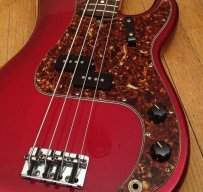
On guitar also, the strings are now installed by simply running the end through the hole and winding it up. With the string post hole running transverse through the post, the loose end is then either clipped off, or bent back and forth until it breaks.

On guitar at least, this doesn't always work. I have seen strings installed like this slip so badly that a note played twice in a row had a noticebly different pitch. The tuner was the problem in that case (very low cost guitar), combined with too few wraps.

I believe the simpler installation relies on three things:

1) the strings needs to have a sharp enough bend where it begins winding, so that it act's as a hook. Too sharp could weaken the string though.

2) the post needs to have a small enough radius at the hole (or slot) edge, so that the string has something to hook onto. This also helps provide the required bend in the string.

3) enough friction beween post and string to minimize the force right at the hole (or slot).
This is helped by more wraps.

It seems to work well with even halfway decent tuners.

-
 
these are the two details folks tend to not know about:
"Seating" is likely a better term for what "stretching" is supposed to accomplish.

I find I need to do very little other than set the witness points at the ends.
pushing on the string right around where it hits nut, saddle and keys to eliminate any curving, creating sharp defined angles, is key to stable tuning without wrecking them by yanking on them.
I also agree that the string can get internally twisted. Because of their layered construction, this can cause all kinds of problems. Be careful about this. Make sure the ball is free to rotate as you tighten the tuner.

the trick there is when you're winding, just before you get tight enough to make the slack disappear push the ball end out through the hole in the bridge so that it's free to spin; you'll usually see it do at least one full rotation at the string untwists itself.
 
#7: Intonation...I've noticed that on my "cheapo" Squier P-bass Special I have to adjust my saddles in kind of a weird way to get my intonation dead-on. I'm finding that the E-saddle is pulled back the farthest (away from the nut, yielding a longer string length). Then, my A-saddle is pulled back a little less. Here's the weird part: Then my D-saddle is pushed forward quite a bit - maybe 3/32" ahead of the A-saddle. Lastly, my G-saddle is pulled back behind the A-saddle just a little bit.
On a properly intonated electric bass, I thought the saddle adjustments should be staggered in all the same direction, with E being the longest and G being the shortest? What am I doing wrong?
not unusual at all; a roundwound G often has a single layer of wraps on it while the others have two layers, and that can change the intonation behavior, as intonation offsets are influenced by flexibility vs. thickness. you can get that "zig-zag" between the single layered G and double-layered D, just like you get a zig-zag in the saddle pattern on a guitar between the last plain string and the first wound string.

normally it's the G slightly behind or maybe parallel with the D, and the rest staggering back by increasing amounts as they get thicker; if your tuner is steering you towards a weird pattern, chances are you haven't seated the string properly or you have a slightly "off" string.
I go for agreement between open string, fretted 12th note, and unfretted 12th harmonic. Then lastly I listen to agreement between 5th-fret-harmonic on E and 7th-fret-harmonic on A.....repeat between A and D, then D and G.
don't do any of that last bit!

the 12th harmonic is pointless unless you or your tuner can't hear the open note, and the 5th-7th stuff is actually wrong by about 2 cents, as @Honch pointed out.

i know i'm in for a bad night of music as soon as i witness anybody on stage plucking 5th-7th harmonics to check their tuning Invalid Link Removed

now just to throw a further monkey wrench into the "expected saddle pattern" works, if you have taper-core strings they will intonate quite a bit forward of where you expect, i.e., shorter, as the string is way more flexible at the witness point and needs less compensation (thanks @Zooberwerx for shining the light on this phenomenon).
 
...the trick there is when you're winding, just before you get tight enough to make the slack disappear push the ball end out through the hole in the bridge so that it's free to spin; you'll usually see it do at least one full rotation at the string untwists itself.

Also, a major cause of string twisting is wrapping the string around the post instead of winding it up with the tuning key. You get a full revolution of twist for every wrap you make around the post. So you want the ball end to remain free enough to untwist as you wrap.

-
 
tangenting off the "don't bother playing around with harmonics" rule, you should intonate the way you play!

set the instrument in your lap normal-like, and pluck the open and the 12th fret notes like you mean it.

otherwise, you'll find yourself going sharp when you're actually playing (as opposed to carefully and delicately checking your intonation).

hell, for that matter there's nothing special about the 12th fret note other than that you didn't have to reach up and change the pitch on your old mechanical strobe every time!

tune open, then play like 9 through 14, seeing where they all come in (annoyingly, they probably won't all be consistent); intonate so that most of the fretted notes are mostly in tune, or at least so that they're not all flat or all sharp.
 
Last edited:
  • Like
Reactions: JustForSport

Latest posts