• TalkBass has been independent since 1998. Add your voice.
    Create a free account to reply to discussions, view embedded media, and browse with fewer display ads.
    Join freeLog in
    Want zero display ads or expanded classifieds tools? Compare plans.

Testing the PA Speaker as Backline Hypothesis

bucephylus

Supporting Member
Aug 18, 2002
12,458
18,918
Central Ohio
The short answer for TL;DR challenged is that PA speakers don't quite get what backline cabs deliver for me. Yet.

For the past year, I've been gigging fairly large outdoor stages and animal club stages using a QSC K10.2 for both bass monitor and vocal monitor. I have finally accepted the idea that the PA is now my amplifier. So, I have been evolving my pedal board preamps to produce both a sound I prefer in the PA mains, and a close facsimile in the monitor. That way I hear pretty much what the audience hears.

Last summer, I had a road trip reunion gig, and acquired a QSC K12.2 with the concept that I could put the same sound on a backline. The sound system when I left home was a bit of an unknown; and I was trying to create options. The pair of .2's was stacked on the backline as things went, and seemed to perform well enough. Except the sound person who eventually turned up asked me to reduce the level to monitor level (as usual these days); so, it wasn't much of a test.

Back on the home front, my primary backline capability has been a pair of Mesa 112/115 stacks. They don't leave home much any more; I dislike the 2 hand carry down the basement stairs; and I've been toying with the idea of a second K10.2/K12.2 stack as a direct substitute.

So, I put the two stacks side by side this morning while the wife factor was at breakfast with a friend.
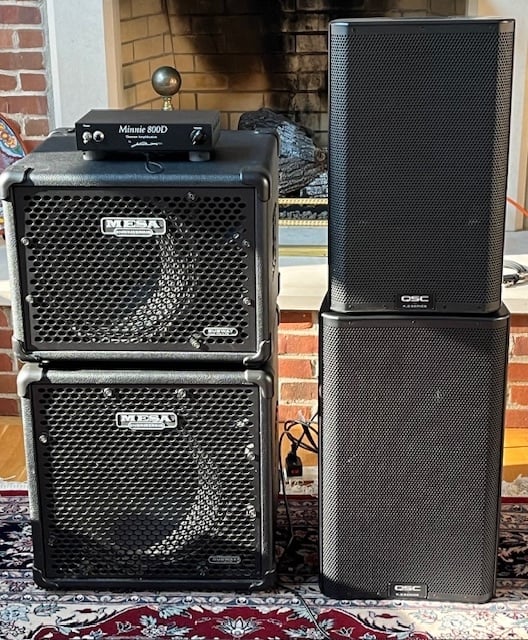
IMG_1764.jpeg


The comparison was interesting. Volume differences were almost negligible. But, the main thing was that the Mesa stack sounded like the massive sound was coming from deep within the cabs, while the .2 stack sounds more like the sound is coming directly off the front. So, kind of 3D vs 2D. From a bedroom, or living room in this case, cork sniffing perspective, the Mesa stack sounds altogether more bass.

Now, I will admit that I am still learning how to use the .2 speakers. A year ago, I still hadn't figured out the volume aspect. Is it possible to recreate the voicing aspect to give the projection more depth? Quite possibly. But, that is not in my kit of tools ATM. So, for the moment, the unchecked box for the PA speakers as backline is depth of sound, not volume.

I'll keep trying. One thing for those who like to condemn people for age related afflictions, is that while the weight of Mesa cabs on the schlep is NOT my problem; carrying those cabs with a two hand carry down basement stairs, where I can't see the stair treads challenges my balance. This is not a small factor at 2AM coming home from a gig. The .2 cabs are both one handers going down the stairs. FWIW.
 
The short answer for TL;DR challenged is that PA speakers don't quite get what backline cabs deliver for me. Yet.

For the past year, I've been gigging fairly large outdoor stages and animal club stages using a QSC K10.2 for both bass monitor and vocal monitor. I have finally accepted the idea that the PA is now my amplifier. So, I have been evolving my pedal board preamps to produce both a sound I prefer in the PA mains, and a close facsimile in the monitor. That way I hear pretty much what the audience hears.

Last summer, I had a road trip reunion gig, and acquired a QSC K12.2 with the concept that I could put the same sound on a backline. The sound system when I left home was a bit of an unknown; and I was trying to create options. The pair of .2's was stacked on the backline as things went, and seemed to perform well enough. Except the sound person who eventually turned up asked me to reduce the level to monitor level (as usual these days); so, it wasn't much of a test.

Back on the home front, my primary backline capability has been a pair of Mesa 112/115 stacks. They don't leave home much any more; I dislike the 2 hand carry down the basement stairs; and I've been toying with the idea of a second K10.2/K12.2 stack as a direct substitute.

So, I put the two stacks side by side this morning while the wife factor was at breakfast with a friend.

View attachment 7429502

The comparison was interesting. Volume differences were almost negligible. But, the main thing was that the Mesa stack sounded like the massive sound was coming from deep within the cabs, while the .2 stack sounds more like the sound is coming directly off the front. So, kind of 3D vs 2D. From a bedroom, or living room in this case, cork sniffing perspective, the Mesa stack sounds altogether more bass.

Now, I will admit that I am still learning how to use the .2 speakers. A year ago, I still hadn't figured out the volume aspect. Is it possible to recreate the voicing aspect to give the projection more depth? Quite possibly. But, that is not in my kit of tools ATM. So, for the moment, the unchecked box for the PA speakers as backline is depth of sound, not volume.

I'll keep trying. One thing for those who like to condemn people for age related afflictions, is that while the weight of Mesa cabs on the schlep is NOT my problem; carrying those cabs with a two hand carry down basement stairs, where I can't see the stair treads challenges my balance. This is not a small factor at 2AM coming home from a gig. The .2 cabs are both one handers going down the stairs. FWIW.
Interesting experience.

I was curious about it, because many of us are tempted to substitude bass amps & cabs by PA monitors for the same reasons as you. I'm not surprised to hear that a system designed specifically for bass guitar sounds deeper than a general purpose monitor.

FWIW my Barefaced 1x12 has one only handle, and it's super easy to take it down the stairs (it's also lighter than the Subway 1x12)

Another option would be to use lightweight bass powered cabs, like the GR Bass Active Cabs, like this one (1 handle and only 7 Kg - 14,4 lbs)
 
Last edited:
I can't quickly find the specs for the Mesa 1x15 (sorry, the Gibson version of the Mesa web pages is :poop:) but I seem to remember that the Mesa 1x15 has F3 in the 40s and F10 below 40 Hz. The QSC K12.2 web page says its F10 is 45 Hz and response is falling like a rock below 50 Hz.

So the result does not surprise me. I'd expect the K12.2 to make a fine monitor (or coffeehouse rig), but not fill a room with authoritative bass. I'd also expect that a powered speaker that could act as a FRFR bass system would cost at least as much as (probably more than) a comparable bass-specific rig.
 
I can't quickly find the specs for the Mesa 1x15 (sorry, the Gibson version of the Mesa web pages is :poop:) but I seem to remember that the Mesa 1x15 has F3 in the 40s and F10 below 40 Hz. The QSC K12.2 web page says its F10 is 45 Hz and response is falling like a rock below 50 Hz.

So the result does not surprise me. I'd expect the K12.2 to make a fine monitor (or coffeehouse rig), but not fill a room with authoritative bass. I'd also expect that a powered speaker that could act as a FRFR bass system would cost at least as much as (probably more than) a comparable bass-specific rig.
One interesting point regarding low end, I had to engage the HPF only with the .2 stack to keep the decorations from rattling. Not so for the Mesa stack. So, the .2's were not lacking low end. If anything, they seemed heavier in the lows (the decorations and my upright agreed).
 
  • Like
Reactions: dbflats and gtirard
One interesting point regarding low end, I had to engage the HPF only with the .2 stack to keep the decorations from rattling. Not so for the Mesa stack. So, the .2's were not lacking low end. If anything, they seemed heavier in the lows (the decorations and my upright agreed).
Just curious: were you running the QSCs on the bass amp preset?
 
  • Like
Reactions: gtirard
Just curious: were you running the QSCs on the bass amp preset?
Here are the settings, which I have found most useful for using the .2 cabs as monitors. My recollection when testing different settings was that the "Bass Amp" setting was kind of lame. IIRC, the intent for that input setting was for use plugging the instrument directly into the input. I used a Sushi Box PMLE in front of the .2's for this test. But, I would need to revisit. I'll check the next few days, and post up the result.

IMG_6560.jpeg

IMG_6559.jpeg
 
Last edited:
One interesting point regarding low end, I had to engage the HPF only with the .2 stack to keep the decorations from rattling. Not so for the Mesa stack. So, the .2's were not lacking low end. If anything, they seemed heavier in the lows (the decorations and my upright agreed).
IMHO you are drawing a false conclusion here. The rattle is being generated from energy within the pass band of K12.2, so it's most likely not from sub bass. Rather it's what one might call mid-bass. Much of our perception of fat comes from the mid-bass range. Mid-bass also tends to induce strong sympathetic vibrations.

The 3D LF quality you attribute to the Subway stack is most likely related to superior LF extension.

In order to do a more valid comparison, I suggest using only one K12.2 and pairing it with whichever KS series sub is the closest match to the Subway. The KS212 should be most similar in response and max SPL to one of the Subway cabs. The KS118 is a closer performance match to the pair.

Of course the problem is the subs are heavy. A single KS118 is about 104lbs.

Something about the K12.2 LF response. The specs suggest these cabs play lower than the typical 12" PA box in this price range. My assumption is the frequency response specs are based on digitally corrected response. In other words, EQ is used to extend the frequency response artificially beyond what the cab design supports. While this sort of correction can extend the LF frequency response a bit, what it can't do is make the cab play louder in the lower part of the pass band. So basically -10dB at 50hz and -6dB at 45hz is not necessarily valid when pushing the cab close to it's SPL limits. The specs appear to be based off the red curve which has a huge peak in the mid-80hz range.
1770746455871.png
 
Last edited:
IMHO you are drawing a false conclusion here. The rattle is being generated from energy within the pass band of K12.2, so it's most likely not from sub bass. Rather it's what one might call mid-bass. Much of our perception of fat comes from the mid-bass range. Mid-bass also tends to induce strong sympathetic vibrations.
I will hold to my interpretation of what I heard; based on the fact that the HPF, which is rather surgical for the pass point, completely eliminated what I interpreted to be lows. I am unfamiliar with HPF's removing mid-bass frequencies above the pass point.
 
IMHO you are drawing a false conclusion here. The rattle is being generated from energy within the pass band of K12.2, so it's most likely not from sub bass. Rather it's what one might call mid-bass. Much of our perception of fat comes from the mid-bass range. Mid-bass also tends to induce strong sympathetic vibrations.

The 3D LF quality you attribute to the Subway stack is most likely related to superior LF extension.

In order to do a more valid comparison, I suggest using only one K12.2 and pairing it with whichever KS series sub is the closest match to the Subway. The KS212 should be most similar in response and max SPL to one of the Subway cabs. The KS118 is a closer performance match to the pair.

Of course the problem is the subs are heavy. A single KS118 is about 104lbs.

Something about the K12.2 LF response. The specs suggest these cabs play lower than the typical 12" PA box in this price range. My assumption is the frequency response specs are based on digitally corrected response. In other words, EQ is used to extend the frequency response artificially beyond what the cab design supports. While this sort of correction can extend the LF frequency response a bit, what it can't do is make the cab play louder in the lower part of the pass band. So basically -10dB at 50hz and -6dB at 45hz is not necessarily valid when pushing the cab close to it's SPL limits. The specs appear to be based off the red curve which has a huge peak in the mid-80hz range.
View attachment 7429596

This is kind of where I'm at with my K series. I have the older K12s, not the 12.2, but then underwhelm as a standalone compared to a bass head/112 cab when I've done some comparisons. With the added K sub I'm happy. I use some HPF on my Mesa and on my anagram so it's not like a ton of sub content is there, but it just feels bigger into the amp/cab comparing to the K12 without the sub. Needing to drag out the sub kind of would negate the point of using the K12s for me.
 
I will hold to my interpretation of what I heard

I am not saying you shouldn't. I am saying it's not really a fair comparison. The K12.2 is designed to excel at a different frequency range than the Subway line. So I don't find your observations surprising or unexpected.

As sort of an absurd thought experiment, put the Subway stack up on a tripod and see how well it does in the intended roll of the K12.2. Pretty sure most would conclude the K12.2 works better as a PA cab.
 
I went down this route a few years back and was also unsatisfied. There's a reason PAs have subwoofers. I'm totally fine going direct to a proper PA with subs. No subs? I'm bringing the big bass stack.

For lightweight cabs with a single handle design, check out MarkBass. My 1x12 combo amp is one-handed and 300 watts and can keep up with everything but the loudest rock bands. For the loudest rock bands, I bring a Mesa 1x15 as an extension cab and the combo does 500 watts into both speakers. Haven't found a band where this wasn't enough volume.

1770757404732.png
 
Last edited:
I had an idea one time a few years ago to run my Alembic Series bass power supply stereo out to the inputs of a pair of powered speakers. Never tried it.
 
  • Like
Reactions: DJ Bebop
Off the top, this test is flawed because the Subway cabs are designed to sound like bass cabs, whereas the QSCs are designed to not sound like anything.
The Subways have a natural HPF & a LPF that's a LOT lower than the QSCs.
Are you running any amp or cab sims?
I'd look there first. Find a cab sim you like then run that through the QSCs, see how that strikes you.
If nothing else, trying adding a HPF & LPF when running the QSC, that might be enough.

As for the low end extension from PA speakers, you can work around that.
Put the high pass at 80Hz or so and turn up the bass knob on your pre. It'll allow you to push more low end but not to where your speaker will blow. At least, it's worked for me before, but i also have a HPF set anywhere between 45Hz & 60Hz
 
Last edited:
This is what we found out in the rack/PA bin days in the 80's. This was the 'in-between' at the last days of the so-so bass amps we had in the 60's and 70's and just prior to the advent of dedicated bass amp companies like SWR and Trace Eliott.

Gang up your rack mount preamp of choice to a stereo power amp and PA bins, and the sound could get really sterile fast, as everything past the preamp was designed to be color-less and cover every instrument you could possibly run through them. So often, the preamp would be the only 'grit' you could ease into this setup.

Not surprising at all these many years later that great (now internally powered) PA bins or monitors are still very good full range bins, and really good, dedicated bass amp/cabinet combinations sound better for reproducing bass guitar only.
 
They don't leave home much any more; I dislike the 2 hand carry down the basement stairs
Is it possible to change out one of the handles to a "fixed" type, and not the flip-up? That way you should be able to carry it with one hand.

Regards,
Wayne A. Pflughaupt

Make Your Own Cables: A How-To Guide Unique Arrangements of Hymns, P&W Standards, and Original Tunes
Official Pedulla Club #45
Administrator, Official Heartfield Club #36
Administrator, Official Tobias Club #133
Administrator, Official Pre-Gibson Tobias Owners Club
Administrator, Fretless Club #943
Big Cabs Club #23
My Basses
My Rig: Stage and FOH Friendly
Make Your Own Cables: A How-To Guide
 
The short answer for TL;DR challenged is that PA speakers don't quite get what backline cabs deliver for me. Yet.

For the past year, I've been gigging fairly large outdoor stages and animal club stages using a QSC K10.2 for both bass monitor and vocal monitor. I have finally accepted the idea that the PA is now my amplifier. So, I have been evolving my pedal board preamps to produce both a sound I prefer in the PA mains, and a close facsimile in the monitor. That way I hear pretty much what the audience hears.

Last summer, I had a road trip reunion gig, and acquired a QSC K12.2 with the concept that I could put the same sound on a backline. The sound system when I left home was a bit of an unknown; and I was trying to create options. The pair of .2's was stacked on the backline as things went, and seemed to perform well enough. Except the sound person who eventually turned up asked me to reduce the level to monitor level (as usual these days); so, it wasn't much of a test.

Back on the home front, my primary backline capability has been a pair of Mesa 112/115 stacks. They don't leave home much any more; I dislike the 2 hand carry down the basement stairs; and I've been toying with the idea of a second K10.2/K12.2 stack as a direct substitute.

So, I put the two stacks side by side this morning while the wife factor was at breakfast with a friend.

View attachment 7429502

The comparison was interesting. Volume differences were almost negligible. But, the main thing was that the Mesa stack sounded like the massive sound was coming from deep within the cabs, while the .2 stack sounds more like the sound is coming directly off the front. So, kind of 3D vs 2D. From a bedroom, or living room in this case, cork sniffing perspective, the Mesa stack sounds altogether more bass.

Now, I will admit that I am still learning how to use the .2 speakers. A year ago, I still hadn't figured out the volume aspect. Is it possible to recreate the voicing aspect to give the projection more depth? Quite possibly. But, that is not in my kit of tools ATM. So, for the moment, the unchecked box for the PA speakers as backline is depth of sound, not volume.

I'll keep trying. One thing for those who like to condemn people for age related afflictions, is that while the weight of Mesa cabs on the schlep is NOT my problem; carrying those cabs with a two hand carry down basement stairs, where I can't see the stair treads challenges my balance. This is not a small factor at 2AM coming home from a gig. The .2 cabs are both one handers going down the stairs. FWIW.
I don't know if my comment isn't a deep dive, or is perhaps the final analysis, but if I understand it right, this is affirmation of why I continue to GREATLY prefer a "real" bass amp in a traditional position, no matter what any soundperson or any other person will tell me about the volume, or EQ or any other thing about going ampless, whether with wedges and great, expensive, top-line PA support or in-ears or whatever. I continue to feel that whatever anyone else could offer me, my lowly 350 watt 2X10 bass amp at 38 pounds is something I would still never choose to be without, and it doesn't matter if the monitors or even the in-ears cost twice, or three times, or even four or more times the $650 new bass amp cost. I am happiest with whatever my live gigging paradigm is, and despite trying things (admittedly out of requirement, and sometimes almost as begrudging convenience), I continue to know and reaffirm what makes me happiest as a performer. Also, I am on stage far to often to not make sure I am happy with my bass-oriented performing environment.

I like what I like. That doesn't mean I can't or won't diverge from that as necessary.
 
It's cool what you're checking into there but if the goal is simply a safer and easier schlep, a large array of lightweight cabs exist now. A few years ago, I finally ditched my 2 really good-sounding Peavey 2x10s which were 85 pounders, and got a couple roughly equivalent lightweight units. I wouldn't say the new ones are better than the old boxes, just a bit different. But easy to carry.


Your mention of hauling down the steps to the basement, oh man that rings many bells. And for quite a while, it was 4x10s up and down our steep steps. Oof!

Final thought-I'm old now, have no live bass gig nor actively seeking at the moment, am winding down a duo act where I still haul my stuff around ( for guitar ), and record bass guitar direct. I could have kept the Peaveys!
 
Last edited:
The Subways have a natural HPF & a LPF that's a LOT lower than the QSCs.
Show me the measurements that back this up? The QSC specs are well defined and recorded, but the bass cabs certainly are not.
The PA cabs have a much stronger HF response, especially off axis relative to a bass cab, and because of this may sound more bass shy when they're not.