Frankly, I never grow tired of this discussion, and I hope a few of you feel the same and are willing to chime in.
My contention from my experience is that your chops and overall playing ability can actually be determined - at least in part - by the scale of bass you play. Not to be controversial - well yes, actually to be controversial - how many of you long scalers have played and actually spent some time woodshedding with a QUALITY medium scale bass? I don't mean just in a music store, where it's rare to find one and when you do the set up and strings are much less than ideal, and of course, not customized for you.
Most of you picked up a short scale in a music store back in your early formative bass days and made a quick evaluation about the sound or the "floppy" E string or how it just wasn't a fit. Or maybe it simply wasn't cool to play a short scale bass. Short scales for the most part - just simply don't feel good to me either.
So then you made an unfair and ridiculous assumption that all non 34" scale basses were not for you. I mean, does it really go to logic that if a 30" scale bass doesn't fit then a 32" medium scale bass won't work for you either? I think not.
I have to laugh and roll my eyes as I continually hear players on here spouting the merits to beginners of adapting and learning to get around the long scale dead spot 34" "standard" neck - even though the poster is usually very clear about their physical limitations. It's like there is some macho trophy reward in sticking with a bass that just doesn't fit you properly and on which you are constantly uncomfortable and straining. Let me tell you, I woodsheded on my long scale basses for years and years and it never got comfortable. In many cases they are looking for an alternative but are being told to keep with it - don't worry it's all about hand position and you will get better and it will get easier etc etc etc. Just keep woodshedding. Way to sell it but I think it is bad advice.
Until fairly recently medium scale production models simply were not readily available and frankly - they are still rather scarce. The lucky ones ran across one or two at one point and went WOW. The vast majority of them, after spending some time and getting the big blue bolt of realization - switch or at least add the medium scale to the arsenal. You can bet that when the CHOPS songs come up they switch to the medium scale. The only quality one that springs to mind until recent times was the original Fender Stu Hamm Urge I, of the early '90's which featured a full two octave 32" scale neck. But Fender is back into the hunt with several models and custom bass manufacturer's like BlastCult are selling medium scales which are not even OFFERED in long scale. How about that?
So here is the question - if you knew for a fact that after a few serious weeks on a QUALITY medium scale - your chops would improve 10-20% - would you consider switching? Passages you are now playing as fast as you can are suddenly faster, cleaner and have better articulation on the medium scale. I suppose you HUGE handed guys might be an exception to this - although Stanley Clarke has HUGE hands and he loves medium scales and piccolo basses as well.
Hey maybe you work in projects like blues or country that don't require any serious chops. God bless you. My band, requires a ridiculous amount of chops just to keep up. For the rest of us - you would be wise to pick up a medium scale for your own sake, AND also for the sake of your band!
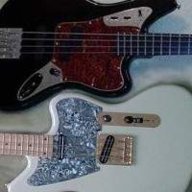
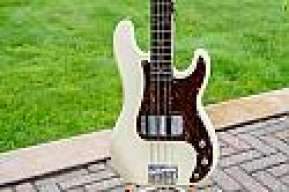
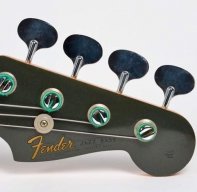
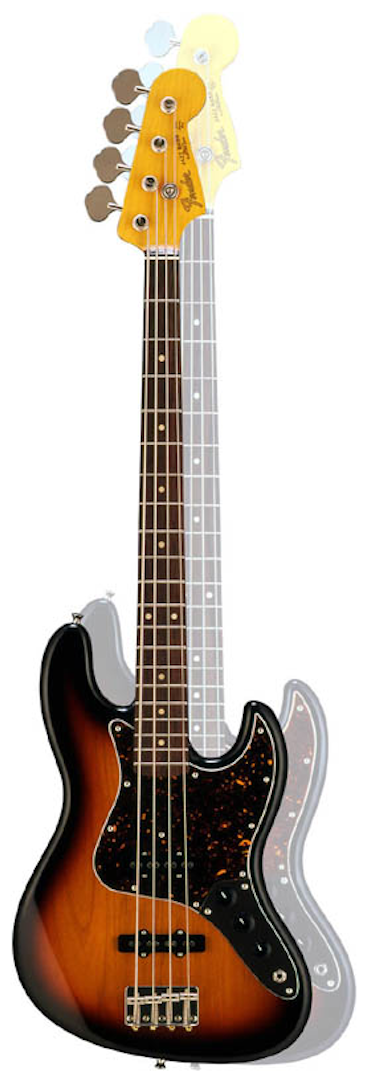
So you know, the fingerboard is close to only an inch shorter, as the other inch is compensated for by the body and the bridge - and playing a medium scale bass is like having a capo on a long scale at the first fret. Photo by Fender Japan of the actual basses:
Mythbusting - your friendly medium scale bass activist,
BassHappy
www.innertainment.net
My contention from my experience is that your chops and overall playing ability can actually be determined - at least in part - by the scale of bass you play. Not to be controversial - well yes, actually to be controversial - how many of you long scalers have played and actually spent some time woodshedding with a QUALITY medium scale bass? I don't mean just in a music store, where it's rare to find one and when you do the set up and strings are much less than ideal, and of course, not customized for you.
Most of you picked up a short scale in a music store back in your early formative bass days and made a quick evaluation about the sound or the "floppy" E string or how it just wasn't a fit. Or maybe it simply wasn't cool to play a short scale bass. Short scales for the most part - just simply don't feel good to me either.
So then you made an unfair and ridiculous assumption that all non 34" scale basses were not for you. I mean, does it really go to logic that if a 30" scale bass doesn't fit then a 32" medium scale bass won't work for you either? I think not.
I have to laugh and roll my eyes as I continually hear players on here spouting the merits to beginners of adapting and learning to get around the long scale dead spot 34" "standard" neck - even though the poster is usually very clear about their physical limitations. It's like there is some macho trophy reward in sticking with a bass that just doesn't fit you properly and on which you are constantly uncomfortable and straining. Let me tell you, I woodsheded on my long scale basses for years and years and it never got comfortable. In many cases they are looking for an alternative but are being told to keep with it - don't worry it's all about hand position and you will get better and it will get easier etc etc etc. Just keep woodshedding. Way to sell it but I think it is bad advice.
Until fairly recently medium scale production models simply were not readily available and frankly - they are still rather scarce. The lucky ones ran across one or two at one point and went WOW. The vast majority of them, after spending some time and getting the big blue bolt of realization - switch or at least add the medium scale to the arsenal. You can bet that when the CHOPS songs come up they switch to the medium scale. The only quality one that springs to mind until recent times was the original Fender Stu Hamm Urge I, of the early '90's which featured a full two octave 32" scale neck. But Fender is back into the hunt with several models and custom bass manufacturer's like BlastCult are selling medium scales which are not even OFFERED in long scale. How about that?
So here is the question - if you knew for a fact that after a few serious weeks on a QUALITY medium scale - your chops would improve 10-20% - would you consider switching? Passages you are now playing as fast as you can are suddenly faster, cleaner and have better articulation on the medium scale. I suppose you HUGE handed guys might be an exception to this - although Stanley Clarke has HUGE hands and he loves medium scales and piccolo basses as well.
Hey maybe you work in projects like blues or country that don't require any serious chops. God bless you. My band, requires a ridiculous amount of chops just to keep up. For the rest of us - you would be wise to pick up a medium scale for your own sake, AND also for the sake of your band!
So you know, the fingerboard is close to only an inch shorter, as the other inch is compensated for by the body and the bridge - and playing a medium scale bass is like having a capo on a long scale at the first fret. Photo by Fender Japan of the actual basses:
Mythbusting - your friendly medium scale bass activist,
BassHappy
www.innertainment.net