• TalkBass has been independent since 1998. Add your voice.
    Create a free account to reply to discussions, view embedded media, and browse with fewer display ads.
    Join freeLog in
    Want zero display ads or expanded classifieds tools? Compare plans.

The Fifths Tuning Club

Quite a bit of this thread has become about strings in CGDA tuning. I'll continue that meme for one more post, but I do hope that at some point this thread gets back on playing/practicing/using fifths in a true musical context. :) For myself, I know I'll be doing my own posts on those topics in a few weeks because I need to practice and play more...

So, back to the topic of strings... :) I've been using (primarily) a custom Kalium set for most of my round wound basses. Timbre matches well across strings - much better than most commercially available 5 string sets. They sound great and last a good long while. I "think" I've finally settled on some Kalium string gauges that work well and I'll be ordering a significant stock in case they change formulas or gauges again.

But it's been flat wound strings that have been a hard one for me. Yes, I've found two manufacturers that will make custom flat wound strings, but both are a bit pricy. Currently I string three fifths basses with flats. All are five string sets, with the E string tossed. TI flats are on my Precision; Chromes are on my P/J fretless; But it has been my Breedlove fretless where I've been wrestling with strings for the longest time.

On my acoustic upright, I mix strings Spirocores & Dominants. Sounds great. Tension is fine. It's aged well with that string set for ~8 years now.

On the Breedlove, I've gone through a ton of regular flat wound five string sets trying to find that mix of volume, tone, tension and playability. Chromes, GHS, TI, D'Addario, Rotosound, etc. Now that I think about it, I'm not sure if this post belongs here, in an acoustic thread or maybe even over on the DB side. :)

Anyway, since I play an upright too, getting the balance of string tension and the top vibrating is always a delicate balance. Get it wrong and there is lower volume or it is much harder to play. You might think that high tension strings would get the top to vibrate more, but often the bass gets harder to play and it still doesn't speak well (tone gets choked a bit). Too soft of a string (low tension) and again no volume but it's easier to play.

Now if you're amplifying the bass, soft/low tension strings don't really matter as with an amp, there is a volume knob. :) But, "my" Breedlove is meant for couch practice - not gigging. It's not really a practice bass either - more noodle, play TV commercial jingles or just work out new riffs that are in my head. Oh, and I have played it at a few acoustic jam sessions over the years - so acoustic volume is important too.

So..In an acoustic only environment, getting an acoustic bass guitar to speak loudly in fifths tuning isn't exactly the easiest thing to do - heck it's even hard to do on a fourths bass. (And) As someone who really does play a bunch of acoustic stuff, getting great tone, while being easy to play, hasn't been the easiest rabbit hole to navigate.

Anyway, long-story-short, a while back I began mixing strings - heck I do it on my upright, why not on my ABG. I do like the heavier Chromes C & G string (B & A string) - they speak easy, have great tone & produce good/great volume on "my" bass. However it has always been a compromise for the D & A string. There's where I've been mixing and matching. I ran GHS' Precision Flats on the D&A for a while - tried various gauges of LaBella's too. The GHS "D" string has always been great, but the "A" string didn't ever really speak like I though it should. Oh and I never really liked the Chromes "D" string on my Breedlove - it was always just a bit too tight and the bass didn't like it.

So, now I'm back to the .040 Chromes "G" string for my "A" string. So far so good. Bass speaks easier, has good volume in the upper register and is quick and not flabby at all. For now, I'll keep the Chromes C, G & A (Chromes) and the GHS D (Precision Flats). It's a newer string so it's still pretty bright, but it should settle in over the coming weeks.

While I'm somewhat musing here, it is a bit odd that with most solid body instruments we aim for tone and feel and don't give two $hits about the acoustic properties of strings. It is those "couch" instruments where we practice instrument intimacy and note articulation, and seek really fantastic tone with the acoustic properties of an instrument. I know that I went through a similar journey to find the right strings for my acoustic upright - until I settled on the Spirocore/Dominant mix that I have now. Since I really don't care how loud I can get plugged in with the Breedlove, the journey continues - and that ain't a such a bad thing...

John
 
Quite a bit of this thread has become about strings in CGDA tuning.
Hmm ... i do find it disappointing and unusual how CGDA is so dominant as a fifths tuning in this thread.
It is not often that the player is a cello player.
If someone wants to retain the depth of a 5 string bass then BF#C#G#(D#) makes more sense.
Choosing CGDA 'because it has nice memorable natural notes' is silly, as is choosing it just because a few upright players use it or because Joel Quarrington is such an over-linked reference (it only makes sense in an orchestral context, being an octave below a cello). I get tired with how Joel Quarrington is linked so often in bass guitar fifths discussions =) Upright bass is irrelevant to most bass guitar players.

I have experimented with every possible transposition of fifths.
So i encourage fifths newbies here to break out of 'CGDA thinking/assumption' caused by everyone talking about that tuning so much.
 
Hmm ... i do find it disappointing and unusual how CGDA is so dominant as a fifths tuning in this thread.
It is not often that the player is a cello player.
If someone wants to retain the depth of a 5 string bass then BF#C#G#(D#) makes more sense.
Choosing CGDA 'because it has nice memorable natural notes' is silly, as is choosing it just because a few upright players use it or because Joel Quarrington is such an over-linked reference (it only makes sense in an orchestral context, being an octave below a cello). I get tired with how Joel Quarrington is linked so often in bass guitar fifths discussions =) Upright bass is irrelevant to most bass guitar players.

I have experimented with every possible transposition of fifths.
So i encourage fifths newbies here to break out of 'CGDA thinking/assumption' caused by everyone talking about that tuning so much.
In principle, I agree. But, two reasons CGDA is nice is (1) it's good to have open strings that are roots in more commonly played keys - but ymmv depending on the music you play, and (2) there is a lot of cello music out there for reading and skill-building material. If neither of those matter to you, then yeah, tune it down a half step if you want.
 
  • Like
Reactions: jharms80439
Perhaps it isn't explicit but one of the underlying principles behind this thread is that you should tune as you like, whether that is fifths or something else besides the 800 pound BEADGC gorilla. Those who congregate here tune in fifths and any fifths tuning is welcome. Go back a few years and a common criticism of the fifths tuning was that the reach to the thirds was just too large to be practical. Many of us were put off of the tuning because of the obvious truth of that statement. You could go short scale to help with that (and I have, different story) but clearly the fifths tuning is just impractical at 34 inches. And then we learned about Red Mitchell and his followers who do it at a 43 inch scale and can easily keep up with the rest of the orchestra/band. That opened our eyes.

So, yeah, the CGDA tuned double bass crowd gets a lot of favorable press here. They deserve it. They pioneered the concept. The CGDA tuning also works very, very well for a great many of us. It may not get me a low B but my Hipshot does and I only rarely use it. But if you do frequently need that low B then you tune to it with our full and unconditional blessing. Talk about it here all you want. You need to relearn three strings instead of only one (or none if you are coming from BEADGC) but that is easily within the capabilities of the human mind. You don't have to be a slave to CGDA. We didn't come here to be slaves, we came here to be free men and women and we do not judge our peers when their freedom takes them in a different direction than ours takes us.
 
Also, I believe something that made me respond strongly to CGDA - and why I now have instruments tuned to CGDA in three octaves - is my personal affective response of keys and root pitches. Like I used to tune the B string on my fives string down to A, and I preferred guitar tunings without B or sharps, just because it was more pleasing to have the more stable pitches as the open strings. I love playing in B, as I associate that root with very active, frenetic, and edgy music ... but I don't want it on an open string on my instrument. CGDA, to me is like the four most positive, stable and pleasing roots.

Obviously, that's a very individual experience, and I know many musicians don't notice this kind of thing at all, but I know others have similar responses to pitch and tuning.
 
  • Like
Reactions: lucas303
(So here is the strings part for Fifths tuning but not in CGDA - and I'm including some DB info here because I play both).

FWIW, I tried DAEB and BF#C#G# (the only two other tunings I tried besides CGDA).

On BG's DAEB actually was very good sounding with custom rounds - though the timbre of the B string was just okay for me and how/what I play. Heavier gauges tamed the tone, but destroyed the feel. To get good tension on the B string, the tone was always too bright for my tastes (yes, even with the tone knob turned down) - we are "bass" players after all.

On upright the DAEB tuning is nigh impossible as there are no real custom string options available - E's down to D were okay. (Starks/Heavies) were best for the low D string. 5 string high C's (for upright are available but there aren't a whole bunch of them available). Oh and D strings tuned up to E were ALWAYS too tight on commercial sets - especially on my upright.

With flatwounds on BG, I was using a high C tuned down to B and it worked well. IMHO, high "C" strings usually sounded better tuned to B than they did when tuned to high C (in general, the tone was a bit darker but still had good articulation & punch). It was always the E string that gave me fits in this tuning.

BF#C#G# on BG was fine with commercial flatwound strings. Depending on the strings, I tried tuning up an E string to F# or down tuning the A to F# - note that I really didn't break that many E strings either. Light E's worked fine as did really heavy gauge A strings. Most "medium" sets weren't great so I tended towards heavy or light sets for the F# string. Yep, it was the string used for F# that always gave me fits with this tuning.

(And now the "not so much" strings section)

I really did like BF#C#G# tuning (as for what I play), the big(ger) stretches in CGDA just weren't there. To me it was like having a shorter scale instrument with extra notes available if I wanted to stretch - and because I tend not to use open strings much, playing (for me) is/was actually easier than when tuning in CGDA.

The BF#C#G# tuning also sort of stayed in the "bass" instrument region and didn't go into the Tenor tone region like the DAEB tuning did - at least to my ears.

The DAEB tuning (both on upright and on BG), seemed to exacerbate the big stretch issue. Seemed all the notes I played were near the nut - to me is was big stretches everywhere - which (again to me) made the instrument overall harder to play.

Ultimately stayed with CGDA as a "best" compromise on DB and BG. Though BF#C#G# is pretty darn good too. I just wish the Low B sounded as good as the low C on my upright - and really wish the low C sounded as good as a low D on my upright!

While I really don't use the low C & C# notes on the low C string much (upright or BG), I'm used to the fingerings available. But truly, if the low B sounded any good on my upright that F# wasn't so darn tight using an E string for the F# or so loose when using an A string (this goes for on both my upright or with flats on a 34" scale BG), I'd probably go BF#C#G# and call it a day.

With CGDA, the near nut stretches can sometimes be a difficult, but the available upright and flatwound strings ultimately led me to stay there.

Just my $0.02.

John

P.S. Now if I didn't play upright and if I didn't want the tone of flatwounds on three of my BG's, then that would open up MANY more options. Custom gauge roundwounds would be just the ticket and I'd tune in BF#C#G# and really call it a day!

P.P.S. Of course, this is all my opinion/experience and YMMV!

P.P.P.S One more item. I was recently looking at the most popular song keys. G Maj, CMaj, DMaj & A Maj comprised over 36% all the ~30 million songs on Spotify. For those that like open strings, CGDA tuning might make sense. For those of us that don't like open strings, CGDA might be the worst tuning to use. :) To keep the big stretches down a bit, BF#C#G# might just be the best Fifths tuning out there... (Article link: A Chart Of The Most Commonly Used Keys Shows Our Actual Musical Tastes)
 
Last edited:
I haven't finished reading through this entire thread, so maybe this has already been addressed, but...

I've gotten interested in playing cello repertoire at pitch, so I'm thinking of not only tuning a 4-string in fifths, but stringing it piccolo: maybe 65, 50, 35, 22p. Something like that?

Comments? Catcalls? Suggestions?

B.
 
Oscar Pettiford tuned in 5ths. Story I read was he had a back injury and was bedridden for a year. Someone gave him a cello to play while convalescing and he stuck to that tuning when he recovered. For some reason, it made for an interesting style. Either way, he was a fantastic bass player

 
I haven't finished reading through this entire thread, so maybe this has already been addressed, but...

I've gotten interested in playing cello repertoire at pitch, so I'm thinking of not only tuning a 4-string in fifths, but stringing it piccolo: maybe 65, 50, 35, 22p. Something like that?

Comments? Catcalls? Suggestions?

B.
I'd use a short scale, or a Mikro, sounds fun I have plans to make an octave mando-cello so I'm interested In hearing how yours turns out.
 
65, 50, 35, 22 for C2, G2, D3, A3?
Might feel a little tight if that's the tuning you mean, well at least it would for me.
Just using a string tension calculator for that tuning. The brand is Kalium, but similar gauges in your preferred brand will work
Screenshot_2020-03-11-08-29-51.png
 
I haven't finished reading through this entire thread, so maybe this has already been addressed, but...

I've gotten interested in playing cello repertoire at pitch, so I'm thinking of not only tuning a 4-string in fifths, but stringing it piccolo: maybe 65, 50, 35, 22p. Something like that?

Comments? Catcalls? Suggestions?

B.
I got this cheap guitar scale acoustic bass guitar, to practice on at the office, and string it like a cello at pitch, flatwound D and G bass strings and flatwound D and G guitar strings. I play cello rep on it, it really sings in this tuning.
20200214_151616.jpg
 
  • Like
Reactions: jharms80439
D'Addario Chromes are available in a good variety of gauges as single strings, no need to use a standard 5 string set.
I've gotten interested in playing cello repertoire at pitch, so I'm thinking of not only tuning a 4-string in fifths, but stringing it piccolo: maybe 65, 50, 35, 22p
That's insanely tight, and very unbalanced, the 35 D will probably break, that is the D above standard C, even a .025 is tight at that D.
Thinner strings also feel tighter for the same tension, so you may prefer a lower tension than a standard bass guitar.
Remember the rough rule: For fifths tuning, adjacent gauges should be roughly in the ratio 3:2.
I suggest .060 .040 .025 .016p as a starting point. The .016p can be a D'Addario 'Loop End' plain steel (they are extremely long, and cheap) but it will need an improvised ferrule (M6 x 5mm long set screw works well).
 
Being a player that tunes in fifths myself, I have always wanted to have a place on TalkBass where everyone can discuss the stuff needed to successfully move on to this tuning.
Fingerings, chords, exercises, strings, song tabs and anything else that is of interest.

In my opinion, creating a club for this purpose not only presents the opportunity to talk all things fifths, but also a friendly environment that you can always return to and ask for more.

So, let's begin! Numbers will be given to anyone that has at least one bass tuned this way. One number per bassist.

=== USEFUL LINKS ===
Isnt fifths standard tuning?
 
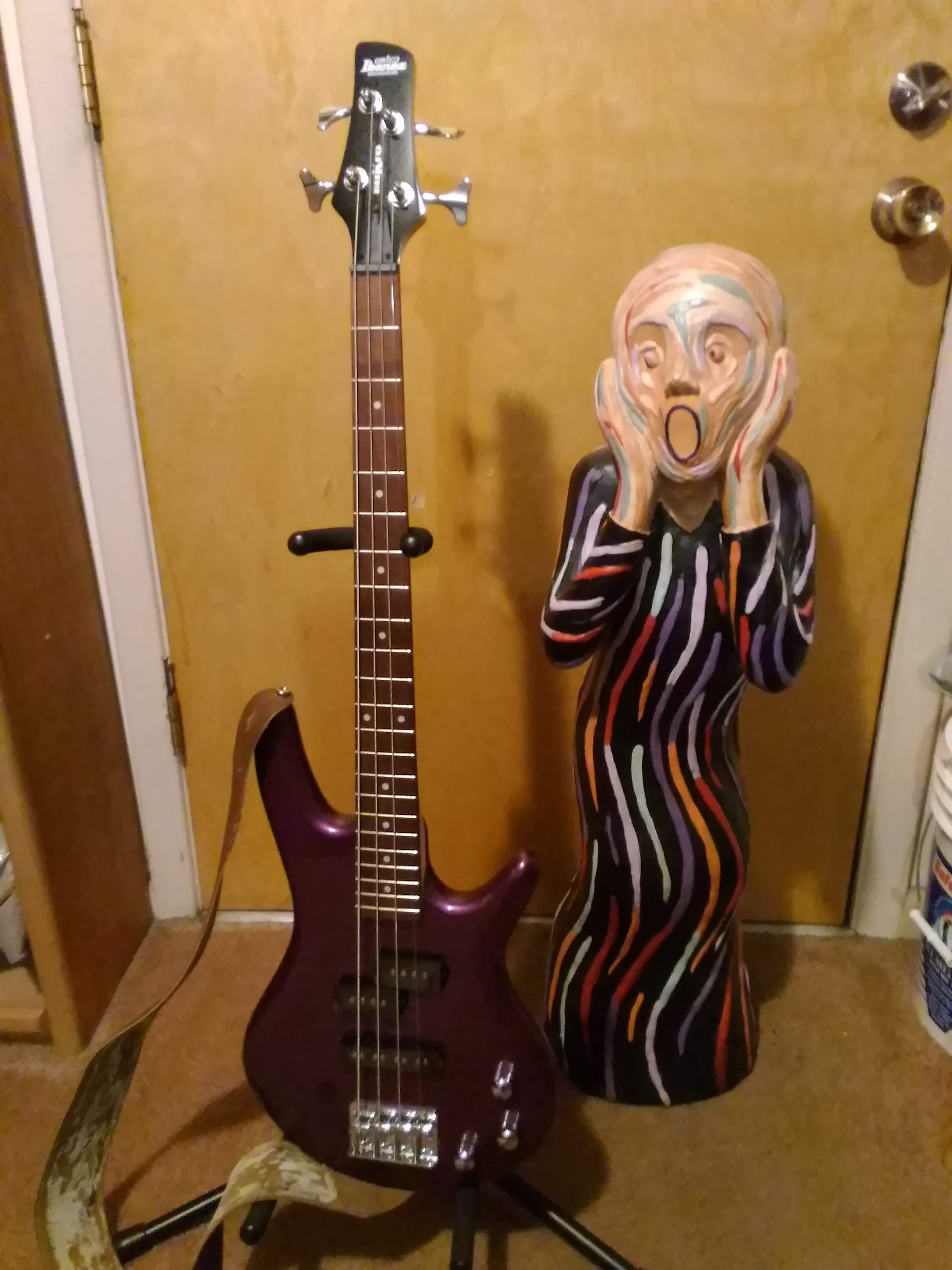
OK, so I picked up an Ibanez Mikro, strung it CGDA in piccolo (65, 40, 30, 20p), and am starting to explore the bass guitar/cello.

Regardless, the Mikro (the purple was the last one) has a very high cute factor.


B.
I highly recommend the Bach cello suites and a mandolin chord chart to get yourself started!
 
I highly recommend the Bach cello suites and a mandolin chord chart to get yourself started!
Already there. I learned the prelude to #1 weeks ago on piccolo bass tuned in 4ths and since I know how it goes, I've been working through it on the MikroCello tuned in 5ths. It's interesting to ser how the fingering patterns change and a delight to see how Bach made the intricate music fall so nicely onto the cello's strings.

OTOH, gavotte #2 from suite #5 works better in 4ths tuning. Practically transcribes itself. Makes me wonder if the Master originally wrote it for gamba (which is tuned in 4ths with a 3rd in the middle).

B.
 
  • Like
Reactions: BarfanyShart
Already there. I learned the prelude to #1 weeks ago on piccolo bass tuned in 4ths and since I know how it goes, I've been working through it on the MikroCello tuned in 5ths. It's interesting to ser how the fingering patterns change and a delight to see how Bach made the intricate music fall so nicely onto the cello's strings.

OTOH, gavotte #2 from suite #5 works better in 4ths tuning. Practically transcribes itself. Makes me wonder if the Master originally wrote it for gamba (which is tuned in 4ths with a 3rd in the middle).

B.
Yeah, I played #2 and #3 on DB back in the day. My bass was usually tune to "drop D" for solo rep, that's "drop E" in solo tuning. Playing it now on a little cello guitar, I'm surprised how hard most of #2 is, but #3 really lays on the instrument in a beautiful and clever way. #3 is a good one all around for learning the fifths tuning, but like all the suite, I work them from the middle out (learn movements 3 and 4, then 2 and 5, then 1 and 6).
 
Isnt fifths standard tuning?

The standard tuning for bass guitars is fourths. The standard tuning for guitars is also fourths except that one string is tuned to a third from the one below. Of course this depends on your perspective. When people say that they tune in fifths they mean that starting from their lowest frequency string each successive string is tuned up in an ascending sequence of fifths. Commonly, but not exclusively, fifths tuned bassists will tune CGDA(E). If you are in the habit of specifying your strings starting on the highest pitched string then you would say that you are tuned in descending fourths, (E)ADGC.

By the same token the standard tuning for bass guitars would be ascending fourths if you start on the low frequency string (B)EADG or descending fifths if you start from the high frequency string GDAE(B). It is confusing because while a whole lot of people describe their tuning as an ascending sequence of pitches some do describe their tuning as a descending sequence of pitches and it sounds like you may belong to the descending pitch tribe.
 
  • Like
Reactions: lucas303
The standard tuning for bass guitars is fourths. The standard tuning for guitars is also fourths except that one string is tuned to a third from the one below. Of course this depends on your perspective. When people say that they tune in fifths they mean that starting from their lowest frequency string each successive string is tuned up in an ascending sequence of fifths. Commonly, but not exclusively, fifths tuned bassists will tune CGDA(E). If you are in the habit of specifying your strings starting on the highest pitched string then you would say that you are tuned in descending fourths, (E)ADGC.

By the same token the standard tuning for bass guitars would be ascending fourths if you start on the low frequency string (B)EADG or descending fifths if you start from the high frequency string GDAE(B). It is confusing because while a whole lot of people describe their tuning as an ascending sequence of pitches some do describe their tuning as a descending sequence of pitches and it sounds like you may belong to the descending pitch tribe.
You're wrong. String 1 is the G string. 1234. Same as it's written. Why do you think tabs are upside down? Guitars are tuned EBGDAE. Basses are tuned GDAE. Not the other way around. They're fifths.