Oily tropical woods should have their glued faces wiped down with solvent before glueup. This ensures good adhesion.Trolling for a little advice on fingerboard selection....
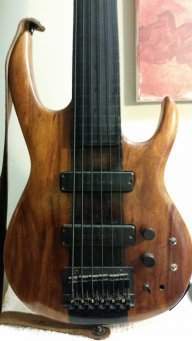
I was going to buy a 3/8" thick Bubinga fingerboard blank, ship it to LMI, and have them fret slot it, but the cost of this project is getting a little high, so I thought I'd just go with a stock 5/16" LMI fingerboard. That means I'll lose the strip of exposed fingerboard wood along the neck edge below the binding, but it allows for more thickness of rock maple neck vs. fingerboard, so I think it's a good trade. The R fingerboards have varied a lot over the years, but tend to reddish-brown or even orangey tones (see photo in previous post above). the LMI Padauk is too pink/orange. Based on the LMI images, I think I have it narrowed down to Bloodwood, Macacauba, machiche, and Panama Rosewood, all in the redddish-brown color spectrum. The cocobolo rosewood is gorgeous, but I've heard it's hard to glue. Any opinions or suggestions appreciated.
Fingerboards

Enjoy the benefits of a premium membership!
Upgrade Account
-
TalkBass has been independent since 1998. Add your voice.
Create a free account to reply to discussions, view embedded media, and browse with fewer display ads.
Join free Log in
Want zero display ads or expanded classifieds tools? Compare plans.
You are using an out of date browser. It may not display this or other websites correctly.
You should upgrade or use an alternative browser.
You should upgrade or use an alternative browser.
The Hossenfeffer Bass Build
- Thread starter Gilmourisgod
- Start date
More options
Who Replied?
It's an LMI board, looks like it had some finish on it, maybe shellac? Is naphtha ok to use as a wipe down with plastic faux mop and binding?
It's an LMI board, looks like it had some finish on it, maybe shellac? Is naphtha ok to use as a wipe down with plastic faux mop and binding?
Plastic shouldn't be an issue as you are only de-oiling the wood surface to be glued. Even if the wood is being glued to binding, or other plastics, the solvent should have been wiped/dried before the glue was applied to bond to the plastic. I would not use a solvent on plastic or nitrates.
Too late for the top then! The binding is 1/8" above the bottom of FB, should be safe to use naphtha to de-oil the bottom face before gluing down. I'll have to sand off that thin layer of shellac too.

Rôckhewer
Commercial User
- Feb 28, 2015
- 2,922
- 9,028
- Disclosures
- Owner/Builder- RockHewer Custom Guitars LLC
Whilst I totally agree with this on species as oily as say...Teak, and similar. ....Oily tropical woods should have their glued faces wiped down with solvent before glueup. This ensures good adhesion.
Bubinga is really not that oily. I use a crapload of bubinga at my day job, and it is prevalent in all my bass builds, (pretty much my favorite wood)
And I have never felt the need to treat it like an "oily" wood (wipeing down with acetone ) when gluing. And have not had any glue joints fail.
(Knock on WOOD)

Last edited:


Yeah, I've seen that video. I don't care for the method. Good CA isn't cheap, and that accelerator stuff isn't either. The tape I use I got from amazon, and it's pretty affordable. It's also a lot more forgiving in terms of re-positioning templates than the super glue method. I do put masking tape on the radius sanding block before I attach the sanding belt with the double-sided tape, so that I can get the stuff off more easily.

Hopkins
Commercial User
Another cheap alternative to double sided tape....
(Which can be kind of a pain, sometimes depending on the dbl sided tape you use...if it is the thick and really sticky kind that is hard to remove etc...)
Is....a trick I saw on a Crimson Guitars video....
(great tutorials BTW ...he builds guitars mostly but alot of the same principles apply to bass)
Put down an even layer of masking tape on your block and then several small drops of thin liquid super glue dispersed evenly, maybe 1" apart, then lay down another layer of tape sticky side up......voila....double side tape! That is flatter and not spongy like some dbl ST can be. & comes off easily, especially if you use painters tape.
And it works on templates etc. As well
That is a much to labor intensive process, a better product is available if you know where to look. Golf club grip tape is what you want, it is just double sided masking tape and is perfect for this type of job.
Invalid Link Removed
I've just been using "carpet tape" I get at Aubuchon Hardware. Its just thin paper with no foam, works fine. You can't leave it on for too long though, or it gets hard to remove.
Hope everybody on the east coast got through "snow-mageddon", or whatever the hysterical weathermen are calling it this year. Got 12" on Cape Cod, about to go shovel out. My back aches already thinking about it.
Hope everybody on the east coast got through "snow-mageddon", or whatever the hysterical weathermen are calling it this year. Got 12" on Cape Cod, about to go shovel out. My back aches already thinking about it.
Last edited:
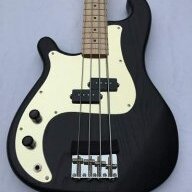
I've been using carpet tape from lowes. It's a bit thicker but not cushiony. It holds like of a son of a gun after you push it hard to set it, but it has some ability to reposition if you place the pieces together lightly.
I think about 6-8" of snow up my way, but i haven't gone out yet to check!
I think about 6-8" of snow up my way, but i haven't gone out yet to check!
Hopkins
Commercial User
I think about 6-8" of snow up my way, but i haven't gone out yet to check!
Almost makes the 105+ degree summers here worth it.

Almost makes the 105+ degree summers here worth it.
Hah! You can keep those summers! I can deal with the snow but that heat you just can't escape, it would kill me.

I find it's a lot easier to shovel sunshine than snow, especially at my age 
In those fearful, terrible hours before the snow ended civilization as we know it, I managed to polish the fingerboard up to 1000 grit. I used the radius block up to 220 grit, then switched to a rubber eraser wrapped in sandpaper for the rest of it. Hard to see in the photos, but it's getting pretty shiny. I have some 1200 grit, then micromesh pads up to 8000, overkill for the wood, but should make the inlays a little sparkly. This Constantines faux MOp is pretty good for plastic, best I've seen anyway.


Hopkins
Commercial User
In those fearful, terrible hours before the snow ended civilization as we know it, I managed to polish the fingerboard up to 1000 grit. I used the radius block up to 220 grit, then switched to a rubber eraser wrapped in sandpaper for the rest of it. Hard to see in the photos, but it's getting pretty shiny. I have some 1200 grit, then micromesh pads up to 8000, overkill for the wood, but should make the inlays a little sparkly. This Constantines faux MOp is pretty good for plastic, best I've seen anyway.


I am not sure if you are aware of this, but if sand to 1200 grit sand paper, do not go to the next number size with micro mesh. Micro Mesh grits are labeled differently than regular sand paper. What they call 1500 grit is equivalent to 400 grit sand paper. 8000 grit Micro Mesh is equivalent to 2000 grit sand paper and the 12000 grit is equivalent to 3000 grit. I think the way they label their abrasives is a bit of a scam personally, they lead you to believe that their abrasives are extremely fine, but are no different than what was already on the market. Personally, I have never been all that impressed with the stuff. Sanding up to 2000 grit and thin using a 3000 grit Trizact pad does just as good of a job for less cost.
Hopkins
Commercial User
Thanks Hopkins, didn't know that. I'll use the 1200 grit paper, then 8000 and up on micromesh.
No problem, Micro Mesh does not do a good enough job of making this information known.
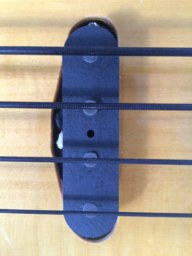
Fingerboard polished up to 12000 micro-mesh. Good enough for Government Work.

Half-ass jig for flattening back of headstock. It's ridiculous how long it takes me to put together even something this stupid-simple, but it works. Routers scare me hand-held.

Half-ass jig for flattening back of headstock. It's ridiculous how long it takes me to put together even something this stupid-simple, but it works. Routers scare me hand-held.


