• TalkBass has been independent since 1998. Add your voice.
    Create a free account to reply to discussions, view embedded media, and browse with fewer display ads.
    Join freeLog in
    Want zero display ads or expanded classifieds tools? Compare plans.

The Hossenfeffer II Build

hereitis.jpg
 
There’s no fooling you observant wise guys! Yeah, little bobble cutting the binding channel where it runs up onto the neck, Maple’s arrow points to the patch I glued in, spent a good bit of time finding a color and grain match, such is life with routers. Once the glue hardens up, I’ll recut it, using a better jig this time. Looks very good so far, but I’ll always know......
 
Ugggghhh....
The search for materials resumes. I ordered some faux MOP from Constantines three years ago for the Hossenfeffer I, looked great.
N4ydcxd.jpg


Just got this in from them, same model number, but obviously a different lot. The small strip is the old stuff, the bigger piece is the new stuff. Looks like pearloid alligator skin! Lot's of places sell pearloid, but it's all pretty thin, usually 1/16", which I'd burn through at the edges radius sanding it. This Constantines stuff is 1/8" thick, main reason I bought it. Maybe I can arrange the triangular inlays to make it look OK, maybe not. Any sources known out there for 1/8" thick Pearloid? I can't use pickguard material, same problem, it's usually a thin veneer of pearloid over another plastic substrate. I'd rather not deal with real MOP if I can avoid it. Also, given the more "woody" palette, and cream binding, should I lean towards something more yellowish for the faux MOP?
3uCTHt0.jpg
 
There’s no fooling you observant wise guys! Yeah, little bobble cutting the binding channel where it runs up onto the neck, Maple’s arrow points to the patch I glued in, spent a good bit of time finding a color and grain match, such is life with routers. Once the glue hardens up, I’ll recut it, using a better jig this time. Looks very good so far, but I’ll always know......
Yeah... I saw that too... but I wasn't gonna say anything.
Cuz I'm a "good" friend :angel: :rolleyes:
 
  • Like
Reactions: Gilmourisgod
That pearloid stuf IS kinda creepy looking.

Have you considered laminated sheet?
Yeah the stuff's expensive... but you get a
9.5"x 5.5" sheet that's made from real shell that you can sand into, because it is several layers of real shell veneer, tighly epoxied together.
Pretty much any thickness you would desire, from 1/32" up to 1/4"

Invalid Link Removed
 
Can the inlay follow the radius? Something like:

1. Radius fingerboard
2. Slot fingerboard
3. Route for inlays, following radius curvature
4. Epoxy inlays, following radius curvature, clamping with radiused caul
5. Final sand
6. Install frets
 
Can the inlay follow the radius? Something like:

1. Radius fingerboard
2. Slot fingerboard
3. Route for inlays, following radius curvature
4. Epoxy inlays, following radius curvature, clamping with radiused caul
5. Final sand
6. Install frets
I did think of that on the HF I, I thought it would be tough to get a consistent inlay pocket depth trying to follow the radius with a dremel base, but that may be the best option if I can't find any decent thickness MOP. Average seems to be 1/16" or less. I'll check out Rock's link. Another option might be to try the crushed pearl poured inlay, I still have an old mahogany test piece I used to practice making triangle routed recesses, it'd make a good test bed for that. Hmmmmm.....
 
At one tome RIC used MOP in sheets that were fit into routes in the fretboard, then radiused. however, due to the relative thinness of 4001 necks and the depth of the routing required, this weakened the neck. This is why the full width inlays were discontinued in favor of the triangular ones used from mid-'73 on. Luthiers who do full width MOP pear inlays nowadays pour a mixture of MOP and epoxy into the route, let it set, then radius the board.
 
  • Like
Reactions: Gilmourisgod
I looked into the poured inlays a while back. I’m not sure why a 1/8” rout in a 3/8” thick fingerboard raised structural issues for Ric, most fingerboards are 1/4” thick. Ric boards are unusually thick by most standards, but there’s less meat in the neck beam to compensate. I checked out the Duke of Pearl site, pricey! $46 for a batch of crushed pearl, but the gold flake looks very nice. Wheels turning...
 
Found this stuff called Kirinite, available in 1/8" thickness. They advertise it for knife scales and pistol grips. I was planning on back painting the fingerboard recesses, or coloring the epoxy a cream color, all this stuff is a little transluscent. Cheesy, Nice? Waddya think?
White Pearl
View attachment 3033558
Much more natural looking than the "pattern-quilt" look of the other stuff.
The question would be, can you sand it & readily polish it back up to the same look...?
 
Any sources known out there for 1/8" thick Pearloid? I can't use pickguard material, same problem, it's usually a thin veneer of pearloid over another plastic substrate. I'd rather not deal with real MOP if I can avoid it. Also, given the more "woody" palette, and cream binding, should I lean towards something more yellowish for the faux MOP?
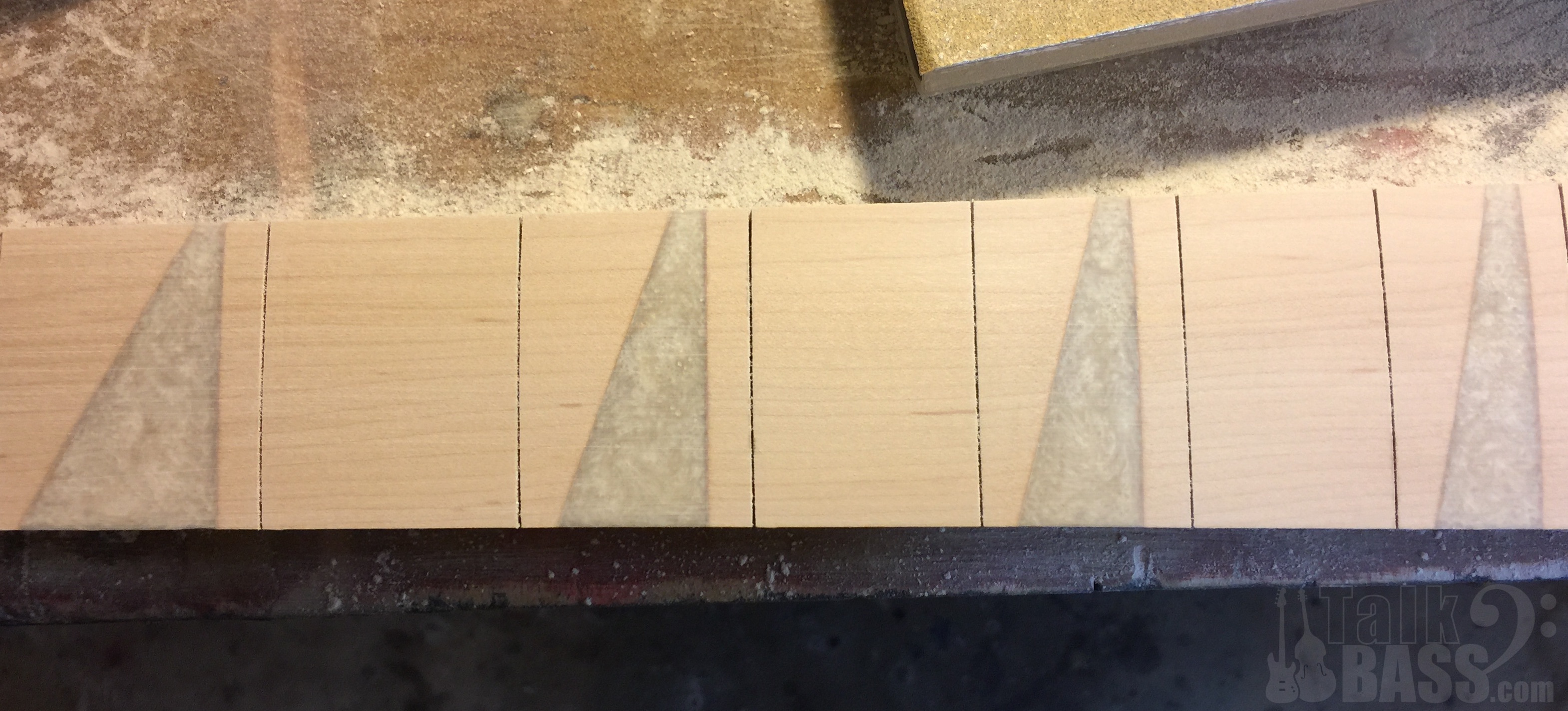
There are a couple of options from straight out the Rickenbacker camp. Some of their inlay work was done with a poured epoxy with white lacquer rippled through it. You could also find some sort of ethical Abalone substitute, grind that down, and copy the crushed pearl look? In both cases you could tint the substrate slightly to give it a warmer more amber look?
 
  • Like
Reactions: Gilmourisgod
Eff-Up fixed (almost) invisibly. It may pop out like a sore thumb when the Tru-Oil goes on....
SslmwLb.jpg


This headstock binding is going to be a challenge. I saw Erlewine do this on the Stewmac site, though I'd give it a try, just a closely fitting negative cutout of the headstock wrapped around my template to create a bending form. Pretty straightforward except for the "hook", that's going to be the b*tch-kitty. I tried to heat and bend a piece for that twice, both failures. Hot enough to take the bend = distortion. The radius may just be too tight for a single piece of .060" binding, might have to use layers of .020", but I think it would show on the edge. The hook diameter is 3/4", maybe I'll try bending around a section of 3/4" pipe or dowel. I'm not giving up on this yet!
LRxuEHK.jpg