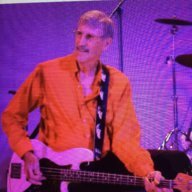
That's why I stay out of the Jam Scene. Various tunings, various skill levels, various chords. I feel fortunate, at my age to be still playing in a steady band. Any down time, I am content playing along with youtube

Enjoy the benefits of a premium membership!
Upgrade Account
-
TalkBass has been independent since 1998. Add your voice.
Create a free account to reply to discussions, view embedded media, and browse with fewer display ads.
Join free Log in
Want zero display ads or expanded classifieds tools? Compare plans.
You are using an out of date browser. It may not display this or other websites correctly.
You should upgrade or use an alternative browser.
You should upgrade or use an alternative browser.
The host band ruined the jam.
- Thread starter Paulabass
- Start date
More options
Who Replied?

I went to a newish jam where the host band is also fronted by the venue owner.
The host band-not bad- tuned to E flat. Why? Because when they play by themselves that's what they do.
I got up and tuned down. Everybody else was out of tune all night, two piano players couldn't play at all because the band leader called all the keys wrong (When you're tuned down, it isn't E anymore moron) Everybody scrambled to get in tune.
I mentioned it in passing to the BL, but it wasn't my jam. Everybody left (bad sound didn't help things.)
When his jam dies, it will be nobody's fault but him.
You're absolutely right. Using anything but standard tuning is not done at jams. It literally defeats the purpose of it being a jam where people are supposed to play with each other for the first time.
This isn't calling things in odd keys to weed out the noobs, its calling things in a different key than what you're playing.
There are a lot of intellectually lazy people who don't refer to things in concert pitch when they're using different tunings, and that's fine as long as everyone on stage knows that's what's going on. But calling someone up on stage, telling them the next song is in G and then playing it in F# is a jerk move.
I don't care what anyone is tuned to, a song in E is in E even if you are tuned to Open D, Eb or some weird Big Joe Williams tuning.
If we all agreed to tune down and call the keys according to the guitar chord shape, fine, but you still need to give the jammers a head's up.
It makes no difference if you know how to play in Eb if you're told it's in the key of E.
If we all agreed to tune down and call the keys according to the guitar chord shape, fine, but you still need to give the jammers a head's up.
It makes no difference if you know how to play in Eb if you're told it's in the key of E.
This isn't calling things in odd keys to weed out the noobs, its calling things in a different key than what you're playing.
There are a lot of intellectually lazy people who don't refer to things in concert pitch when they're using different tunings, and that's fine as long as everyone on stage knows that's what's going on. But calling someone up on stage, telling them the next song is in G and then playing it in F# is a jerk move.
Exactly
I always figured SRV tuned down a half step to keep the damned harmonica players away
When I was playing harmonica I had 12 diatonics to cover all keys plus a couple of minor tuned...
If the band in question is always tuned a half step down while using standard tuning note location and chord shape names, I can perhaps see this as an oversight.This practice is quite typical among guitarists and bass players and it is basically done to simplify things. For a lot of people it's just easier to think in terms of standard tuning note location and chord shapes. Of course, this only works if everybody is tuned accordingly. However, if they were fully aware of it and did't inform the other musicians, then of course, it is a sh**y move on their part. Nevertheless, if one has enough practice and experience, one should be able to determine the right key after a couple of measures and at least 'wing it'. If you play long enough, you'll eventually encounter a situation like this sooner or later. Let it be a learning experience.
Last edited:

I'm glad y'all can play in any key. So can I. The issue at hand is that the BL called
E, when the actual key was Eb. Let's just say that was a very inconsiderate thing to do, especially at an open mic.
E, when the actual key was Eb. Let's just say that was a very inconsiderate thing to do, especially at an open mic.
Bands with good horn players play in all keys.Bands with horns quite often play a lot in flat keys
.
Exactly! This is as bad as when the guitarist puts a capo at the third fret, plays a G chord form and calls a G. Do you not know what key the song is actually in now? And we have the easiest instrument to transpose, but it's not so easy for everyone else.I'm glad y'all can play in any key. So can I. The issue at hand is that the BL called
E, when the actual key was Eb. Let's just say that was a very inconsiderate thing to do, especially at an open mic.

It sounds like a pretty bad Jam session on all counts. Due to bad communication skills.
How hard would it have been to simply communicate the tuning situation to the players as they were taking the stage?(and before taking the stage as well)
I know I would have been telling everyone with a guitar exactly that.
I think it's more of a representation of peoples lack of communication skills......
Your Cell phone isn't going to help you in this situation. Maybe put it down, turn it off or leave it in the car.
People are so distracted these days. I almost can't believe someone could sit through watching a song and not realize that alternate tuning is being used.
How hard would it have been to simply communicate the tuning situation to the players as they were taking the stage?(and before taking the stage as well)
I know I would have been telling everyone with a guitar exactly that.
I think it's more of a representation of peoples lack of communication skills......
Your Cell phone isn't going to help you in this situation. Maybe put it down, turn it off or leave it in the car.
People are so distracted these days. I almost can't believe someone could sit through watching a song and not realize that alternate tuning is being used.
This is as bad as when the guitarist puts a capo at the third fret, plays a G chord form and calls a G.
Calling that chord "G" is 100% standard operating procedure. I always carry a capo in my gig bag. Bassists need to understand capos and alternate tunings, if they want to play with guitarists.
Not 100%. When I'm playing guitar and choose to use a capo, I make sure to call actual key for the rest of the band. In fact, when I'm singing Gin Smoke and Lies and playing Banjo I make a point to call the song in key "Gm" so the bass player knows where to be, then let the guitar player know that the song will be easier and sound more correct if he capo's 5 and plays Dm and C open chords instead of playing Gm and F barre chords.Calling that chord "G" is 100% standard operating procedure. I always carry a capo in my gig bag. Bassists need to understand capos and alternate tunings, if they want to play with guitarists.
If you tell your band it is "in G" do you at least have the courtesy to tell them what fret you've capoed on so they don't have to strain to look across a dark stage, possibly through your back to figure it out for themselves?
Last edited:
That must have changed since I started out, because I worked with guitarists who used capos and with classically trained guitarists who didn't, on the same songs. The songs were always called in concert tuning and the capo people just did what they needed to do to play in those keys. Or maybe my early experiences were unusual (the longer I hang out on this forum the more I think that's true.)Calling that chord "G" is 100% standard operating procedure. I always carry a capo in my gig bag. Bassists need to understand capos and alternate tunings, if they want to play with guitarists.
But, in any case, I think you might be right, because with the advent of tab on the internet I'm seeing a lot of charts with chord forms labeled and not actual key, because the music community nowadays is very guitar-centric.

Yeah I sat in with a band they asked me to join them on a Eric Clapton song even gave me the name of the song a few days ahead, so I learned it from the record. I go to the show and they ask me up.
The guitar player jumps into the intro an I hear it different right away, now this is a song that the bass needs that open E note to make it sound right not only aren't they playing it in E they are playing it in C. never mentioned to me once they do it in a different key. I transposed it on the fly, but all of the sweet low end notes that really makes the song were gone. When we were done everyone thanked me for sitting in. I pulled over the guy who asked me to come up I said why didn't you mention you do it in a different key? He said to me "come on Rob I knew you wouldn't have any trouble your rtslinger for Christ sakes", I just shook my head and sat down.
The guitar player jumps into the intro an I hear it different right away, now this is a song that the bass needs that open E note to make it sound right not only aren't they playing it in E they are playing it in C. never mentioned to me once they do it in a different key. I transposed it on the fly, but all of the sweet low end notes that really makes the song were gone. When we were done everyone thanked me for sitting in. I pulled over the guy who asked me to come up I said why didn't you mention you do it in a different key? He said to me "come on Rob I knew you wouldn't have any trouble your rtslinger for Christ sakes", I just shook my head and sat down.
Why host a jam and then assume everyone that shows up is a seasoned pro? The entire point of a jam is to drive attendance to the venue by allowing people who just want to play for a night to come up and play. We're complaining that the audience and potential players can't change keys on the fly, yet the host band who apparently can't play or sing unless they use a special tuning gets a pass? And musicians wonder why audiences and venues just use an iPod for entertainment.
At jams around here, 99 times out of 100, Superstition is played in E for that exact reason. It's just easier that way.I can easily play in Eb, so practice is irrelevant. It's all about the availability, or lack thereof, of notes that you can play. In Eb the lowest root you can play is pretty high in pitch. It can be done, but for certain songs (Superstition, for example) it leaves something to be desired.
Last edited:
Hahahahah! I could never stand when cover bands want to tune down a half step, but now I see that there's a legitimate benefit to it!I always figured SRV tuned down a half step to keep the damned harmonica players away
-Y
If you tell your band it is "in G" do you at least have the courtesy to tell them what fret you've capoed on so they don't have to strain to look across a dark stage, possibly through your back to figure it out for themselves?
Bingo.
Common Courtesy.

i'm sure this is true but didn't all the players know Jimmy and John were tuned down a 1/2 step. Seems to me the issue was the host band didn't tell anyone they were tuned down a half step.The guitarist is "correct" to call that chord E instead of F#.
I take it you don't work much with horn players? When John Coltrane played Bb on his saxophone, he called it C. When Jimi Hendrix played Eb on his guitar, he called it E. Same difference.


