
Enjoy the benefits of a premium membership!
Upgrade Account
-
TalkBass has been independent since 1998. Add your voice.
Create a free account to reply to discussions, view embedded media, and browse with fewer display ads.
Join free Log in
Want zero display ads or expanded classifieds tools? Compare plans.
You are using an out of date browser. It may not display this or other websites correctly.
You should upgrade or use an alternative browser.
You should upgrade or use an alternative browser.
The Most Bizarre Thing
- Thread starter Almuzura
- Start date
More options
Who Replied?

Here is something interesting I learned about dead spots: If you press and hold the same note an octave lower, without playing it, and then play the 'dead' note, it will sound like a normal note. It has something to do with the sympathetic resonances that happen.
The second harmonic of the lower note (which is the same frequency as the fundamental of the note on the dead spot) will have relatively decent sustain, and help hide the fact that the dead spot is happening on the G string. If you tune the A string down to G, that won't work as well, because that harmonic will now be swallowed up by the fact that it's now being played on the same position on the neck - you'll have a dead second harmonic.


All of my basses have one, but it’s not as bad on my 2 + 2 headstock basses, and it’s not all at exactly the same note/fret.
On my Fender Jazz it is bad at the 7th fret D on the G string, but worse at the 5th fret C.
I find for faster notes, even quarter notes, it doesn’t really matter. But for sustained notes, or when using an analog octaver, it’s really bad.
In those cases I adjust my fingering to play those notes on frets 10 through 12 on the D string and that solves it. And now I know why, too. Thanks @micguy !
On my Fender Jazz it is bad at the 7th fret D on the G string, but worse at the 5th fret C.
I find for faster notes, even quarter notes, it doesn’t really matter. But for sustained notes, or when using an analog octaver, it’s really bad.
In those cases I adjust my fingering to play those notes on frets 10 through 12 on the D string and that solves it. And now I know why, too. Thanks @micguy !


Don't know what bass you are working with, but Fender Ps are famous for a dead spot around the 5th fret on the G.Thank for the answer. I had never experienced that on any of my previous basses (this is my fourth one). I didn't know dead spots were so extreme as to almost mute the string altoghether. I thought it was a problem of the string. I will try adding weight. Thank you

Its this one of the reasons why some basses have carbon fiber in the neck? To help reduce resonance and allow for the strings to retain more energy when vibrating?

I would love to hear from someone who has fitted to a bass with a prominent dead spot a G string with a double wrap construction (eg a GHS balanced nickel)

*Sometimes it helps to loosen the neck screws and allow the the neck heel to settle more firmly in the neck pocket.
*TimberTech "shaker tables" were the fad a few decades back. Secure the neck and/or body to the deck and let 'er rip. The vibrations purportedly "moved" the resonant frequency to a less-obvious location. Similar hardware is still used to stress components.
Riis
*TimberTech "shaker tables" were the fad a few decades back. Secure the neck and/or body to the deck and let 'er rip. The vibrations purportedly "moved" the resonant frequency to a less-obvious location. Similar hardware is still used to stress components.
Riis

Tried that, I went as up as the saddle allowed. It made zero difference. Thank you anyway.Ive never had a dead spot string issue.
I like it when my action is adjusted on the higher side. I’m not saying it would fix the dead spot for you because I don’t know if it would. It wouldn't hurt to try it and raise the action a little bit to see if it helps. You could always put it back.
I’m just saying I’ve never had the issue so maybe that is why? Maybe not. Just an idea.
Yes, I read that too and tried it. It didn't help. Thank you*Sometimes it helps to loosen the neck screws and allow the the neck heel to settle more firmly in the neck pocket.
*TimberTech "shaker tables" were the fad a few decades back. Secure the neck and/or body to the deck and let 'er rip. The vibrations purportedly "moved" the resonant frequency to a less-obvious location. Similar hardware is still used to stress components.
Riis
I tried just now. Played the D note on the bass unplugged and pressed my ear on the neck. Guess what I could hear, after a second or two of the actual note? The A superharmonic, which rings out way longer than the fundamental. So interesting.Are those notes dead when you are not playing through an amp? If they ring when your bass is not amplified, there is an acoustic issue in your room, speaker placement. and or EQ.
I
I decided not to try other stings, 2 sets are enough. Thank you fro the explaination, too. I can now clearly hear the A overtone when I play the 7th fret D.
@Almuzura DO NOT SPEND $$$$ ON TI FLATS.
This will do nothing.
Changing strings does not move a dead spot. (Actually a dead note, as others have pointed out.)
@mike buzzetti Here's my best attempt at a layman's explanation:
Think of the ruler as your bass neck. The frequency it will vibrate at depends primarily on the length, but also on the weight of the tuners and the construction of the neck.
When the string vibrates at this frequency, the neck starts vibrating along with it -- just like when the snares on your drummer's snare drum vibrate when someone plays a certain note. ("Resonance.")
Then, since there's no free lunch in physics, the string stops vibrating, because it's used up its energy making the neck vibrate.
This doesn't happen with other notes, because the neck has a set pitch it will vibrate at. You can't change that pitch by changing strings or tuning, because it's a property of the neck itself. You can change that pitch by adding or subtracting weight from the headstock: adding weight will lower that pitch, subtracting weight will raise it. Fender basses all tend to go dead at the 7th fret on the G string, in standard tuning, because that's the resonant frequency of a 34" bass neck with a Fender headstock and four big Fender tuners on it.
This is one advantage of a headless bass: by subtracting the weight of the tuners and the weight and length of the headstock, the dead note is usually shifted so high that it's no longer a note anyone plays except in passing. (Usually well up above the 12th fret on the G string, IIRC.)
Edit to add: this explanation is mildly oversimplified! As micguy points out, and the paper he linked above illustrates very well, necks resonate at multiple frequencies and in multiple modes, and "The dead spot occurs when the fret of a note is at an anti node of a resonant mode."
However, the one that generally falls in the range of "musical notes people frequently play" is the one that frequently seems to pop up near D3/146 Hz.
I decided not to try other stings, 2 sets are enough. Thank you fro the explaination, too. I can now clearly hear the A overtone when I play the 7th fret D.

I tried just now. Played the D note on the bass unplugged and pressed my ear on the neck. Guess what I could hear, after a second or two of the actual note? The A superharmonic, which rings out way longer than the fundamental. So interesting.
Yup, sound like a dead spot unfortunately.
Lol, I'll have to deal with it. But it's not so easy to just play the same note on the 12th fret of the D strings as many have suggested, when you are sightreading and you are already playing in a certain area of the fretboard. But I'll have to live with it for now.Yup, sound like a dead spot unfortunately.
Thank you everybody for the amazing comments and help you offered. Now please have a good laugh with me. This is how many times I will encounter that D note during this gig.


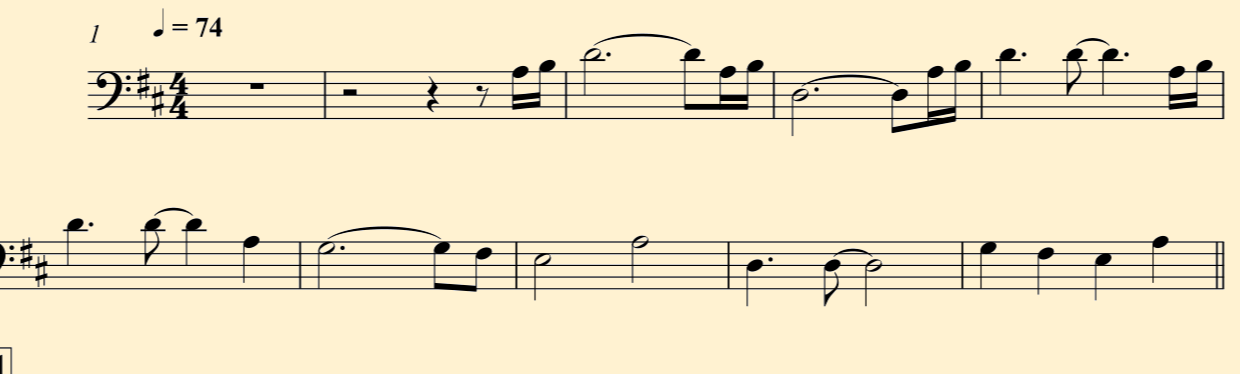
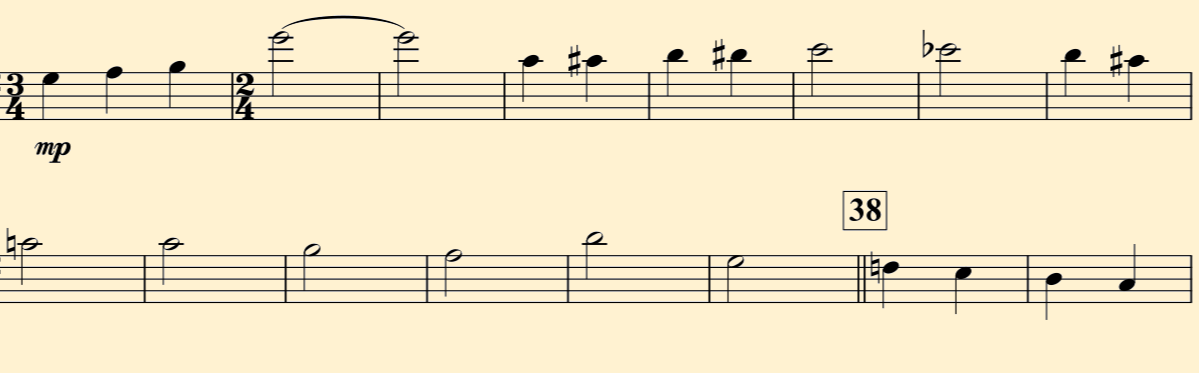
Thank goodness, the last example is in D Flat and the 6th fret works well. It would be impossible to play such long notes with the dead D. Lol
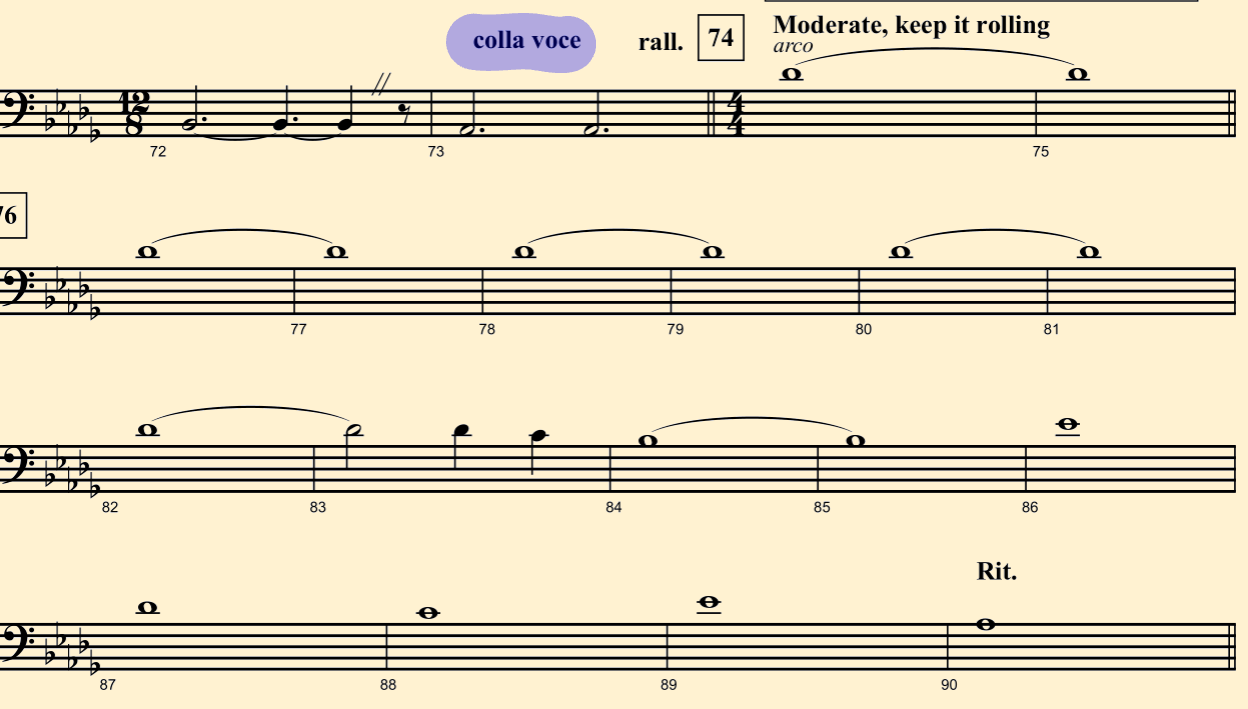
Bye now,
Cheers
Thank goodness, the last example is in D Flat and the 6th fret works well. It would be impossible to play such long notes with the dead D. Lol
Bye now,
Cheers

Contact the company and more than likely they send you a new string or 2 and some swag. Companies like happy customers and word of mouth can bring a tower down one brick at a time.
It tune down to drop D.Thank you everybody for the amazing comments and help you offered. Now please have a good laugh with me. This is how many times I will encounter that D note during this gig.
View attachment 4672927
View attachment 4672930
View attachment 4672932
View attachment 4672935
Thank goodness, the last example is in D Flat and the 6th fret works well. It would be impossible to play such long notes with the dead D. Lol
View attachment 4672938
Bye now,
Cheers

The tuning changes which means to play the same note you use a different fret. The same frequency is played in a different location. That means the frequency is the problem not the string. The dead spot is in the bass. It’s resonant frequency is the D note of that pitch wherever you play it. I’ve had the exact same problem with a G&L L2000 I used to own. D on the G string 7th fret. It’s common.Wait as you change tuning the dead spot moves ?? sounds like a bad string , If it is a dead spot on the neck it should stay put IMO ?? makes no sense even with a MASS argument. I could be wrong but ?? look for any defects/crimps/junk in that area of the string.
Last edited:

My Modern Player Telecaster definitely suffers from this problem. I've tried a lot of flats on it and with all of them I get a dead C on the G string. Some (TI & GHS) were slightly better than others. Thus far I haven't found a place to put a Fatfinger on that headstock to alleviate the problem much.Does the Fender Telecaster Bass neck with the smaller headstock also suffer this problem?
Latest posts
-

-

-
 Do the new Rickenbacker 4003s sound like the 4001s from the '70s?
- Latest: buldog5151bass
-

-