• TalkBass has been independent since 1998. Add your voice.
    Create a free account to reply to discussions, view embedded media, and browse with fewer display ads.
    Join freeLog in
    Want zero display ads or expanded classifieds tools? Compare plans.

The Rickenbacker Club Part Six

Status
Not open for further replies.
Where are you buying $50 Ric strings? I seem to remember them being no more then a set of Roto's.

I have not seen them in Canada so the only place I have ever bought them from is on Ebay. I guess Pick of the Ric have them for $35 but Slinkys and Rotosounds sell for $20-$24 here in Canada.

If you can point me in another direction for them that would be great.
 
I don't get this. Why are these features desirable? I think the mid-70's hi-gains were better pickups. And how do the checkerboard and inlays matter?

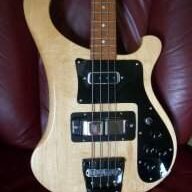
They're rare. They look cool. I have a '73 FG. Checkerboard binding, inlays, oh, and the sh1tty closed-back pewter Grovers that fell apart right after I bought it. THOSE weren't a desired feature.

Ric changes things from time to time. When I first got this bass I was actually a tad disappointed because it was a bit beat-up, and it didn't look like Geddy Lee or Chris Squires' basses (I was young, OK?), but after I started getting used to the sound, I really never looked back. It is one of the coolest sounding basses ever made, just hands down. Hard to beat.
 
The closed back Grovers are supposed to be quite easy to fix with a punch.
It was only some of them that fell apart after production switched to a certain factory, and they fixed the problem after a time apparently.

The ones on my 1981 Rick are pretty solid, and I like the wavy keys for some reason.
Unfortunaly replacements are next to impossible to find, and when you do collectors snap them up fast and at ridiculous prices!
 
Reposting in hopes of getting a few more answers..

I have a few questions for you Rickenrockers! (see what I did there )

I've always loved the Rick sound, specifically the high gain bridge pickup, but I already have 4 basses and can't see myself buying another one in the near future. That being said, I love tinkering and customizing what I do have, and I want to make them all as unique as possible.

My idea is to switch out the bridge positioned jazz pickup in one of my 4 strings to a high gain Rick pup. A little different maybe, sure, but I'm imagining the tonal possibilities when mixed and matched with the P-bass pickup in the neck!

I've been searching around the Rick website and can't seem to find any detailed info on their pickups. No dimensions, tech specs or anything like that.

So here are my questions (all referring to the high gain pickups):

1. What's the difference between the high gain neck and bridge pickups from a technical stand point? Are they wired to sound different? Or is the difference in sound due only to their positioning?

2. Does the whole mounting system for the bridge pickup have anything to do with the sound?

I ask these two questions first, because a neck pickup in the Rick boutique is 75$ whereas the bridge pickup is 150$. If I can get away with getting the neck pickup and getting the same results in the bridge position as a bridge pickup would, then all the better.

3. What are the dimensions of pickups themselves (both bridge and neck)? What string spacing do they allow for? What are the total dimensions including mounting holes/hardware?

4. Are the high gain pups active or passive? And what value of pot should I match them with?

Anything else besides this I should know about?

Thanks guys!
 
Here is my newest Ric. My JG 4003 was lonely and wanted a friend. Just picked it up on Monday. Used it last night at rehearsal and loved it. Been using my Stingrays lately just because. Once I started playing this last night I wondered why. Been playing Rics since the early 80s and I always come back to them.

Jetglos and Fireglos are my fave Ric colors. Had many JGs but this is my first Fireglo. Looks wayyyy better in person than in the pic. The pic is from the sale thread. Haven't had a chance to take new pics yet.

http://www.talkbass.com/forum/f126/2011-rickenbacker-fireglow-fs-856621/
 
1. What's the difference between the high gain neck and bridge pickups from a technical stand point? Are they wired to sound different? Or is the difference in sound due only to their positioning?

2. Does the whole mounting system for the bridge pickup have anything to do with the sound?

I ask these two questions first, because a neck pickup in the Rick boutique is 75$ whereas the bridge pickup is 150$. If I can get away with getting the neck pickup and getting the same results in the bridge position as a bridge pickup would, then all the better.

3. What are the dimensions of pickups themselves (both bridge and neck)? What string spacing do they allow for? What are the total dimensions including mounting holes/hardware?

4. Are the high gain pups active or passive? And what value of pot should I match them with?

Anything else besides this I should know about?

1 - The neck and bridge are the same pickup except the bridge pickup has a slightly bigger magnet.

2 - The bridge pickup surround was designed to house the Horseshoe pickup. When they switched to high gains in 1968 they kept this surround and put on a cover that resembled the horseshoe. This design does give you a nice way to raise and lower the pickup.

3 - Rick pickups are designed for a 2 1/16" string spacing. This is slightly narrower than a Fender bass. Rickenbackers are narrower at the bridge and wider at the nut when compared to a Fender bass.

4 - Rickenbacker pickups are all passive.

Rickenbacker pickups are all guitar pickups. The toaster is the same pickup used on guitar and bass. The high gains are the same except for the number of pole pieces. The humbuckers are also the same. Some of the pickups are made to attach to a plastic pickguard and some are made to attach to wood. The toasters are wound to about 6.7k ohms. The high gains are wound to about 11k ohms. The humbuckers are wound to about 15k ohms.

The old Rickenbackers came with 250k ohm volume pots and 500k ohm tone pots. Then in 1990 they awitched to all 250k ohm pots. Then about 2006 they awitched to all 330k ohm pots.

Also old 70s high gain pickups were wound to about 8k ohms.

Also about 2006 the high gains got adjustable pole pieces.
 
Here is my newest Ric. My JG 4003 was lonely and wanted a friend. Just picked it up on Monday. Used it last night at rehearsal and loved it. Been using my Stingrays lately just because. Once I started playing this last night I wondered why. Been playing Rics since the early 80s and I always come back to them.

Jetglos and Fireglos are my fave Ric colors. Had many JGs but this is my first Fireglo. Looks wayyyy better in person than in the pic. The pic is from the sale thread. Haven't had a chance to take new pics yet.

http://www.talkbass.com/forum/f126/2011-rickenbacker-fireglow-fs-856621/
Sweet! Congrats man. Once in a while business takes me to the 'Peg. I'll have to give you a shout out if I get out that way.
 
My idea is to switch out the bridge positioned jazz pickup in one of my 4 strings to a high gain Rick pup. A little different maybe, sure, but I'm imagining the tonal possibilities when mixed and matched with the P-bass pickup in the neck!

I've had my Ric for 25 years . . . played it quite a lot acoustically. Most of the "Ric" sound is just the wood and finish . . . the pickups capture that sound and they can magnify elements of it, but subtract the pickups and a Ric is a Ric is a Ric. It just has a certain sound.
 
1 - The neck and bridge are the same pickup except the bridge pickup has a slightly bigger magnet.

2 - The bridge pickup surround was designed to house the Horseshoe pickup. When they switched to high gains in 1968 they kept this surround and put on a cover that resembled the horseshoe. This design does give you a nice way to raise and lower the pickup.

3 - Rick pickups are designed for a 2 1/16" string spacing. This is slightly narrower than a Fender bass. Rickenbackers are narrower at the bridge and wider at the nut when compared to a Fender bass.

4 - Rickenbacker pickups are all passive.

Rickenbacker pickups are all guitar pickups. The toaster is the same pickup used on guitar and bass. The high gains are the same except for the number of pole pieces. The humbuckers are also the same. Some of the pickups are made to attach to a plastic pickguard and some are made to attach to wood. The toasters are wound to about 6.7k ohms. The high gains are wound to about 11k ohms. The humbuckers are wound to about 15k ohms.

The old Rickenbackers came with 250k ohm volume pots and 500k ohm tone pots. Then in 1990 they awitched to all 250k ohm pots. Then about 2006 they awitched to all 330k ohm pots.

Also old 70s high gain pickups were wound to about 8k ohms.

Also about 2006 the high gains got adjustable pole pieces.
1. The poles on the bridge pup has a little different spacing as the strings are more spread. If you try to drill one out to 1/4" holes for the poles, you will hit copper on one end one. Look at the placement of the two outside pole screws/nails and you will see one is closer to the edge, closer to the copper.

I've found 70s higains all measure around 8.4K and the current scatterwound toasters measure 7.4K.
 
1. The poles on the bridge pup has a little different spacing as the strings are more spread. If you try to drill one out to 1/4" holes for the poles, you will hit copper on one end one. Look at the placement of the two outside pole screws/nails and you will see one is closer to the edge, closer to the copper.

I've found 70s higains all measure around 8.4K and the current scatterwound toasters measure 7.4K.

I meant to type 7.6 and not 6.7 ...

Also I find Rickenbacker pickups tend to vary .3k ohm +/-
 
I'd like to join and get a number too!

Thanks!

Rick2.jpg
 
Status
Not open for further replies.