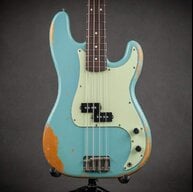
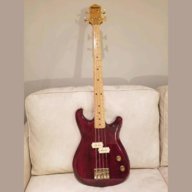
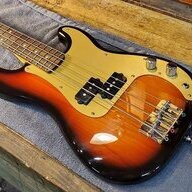
I find the Mini P too light and neck divey at 2.8kg. Also looks somewhat comical on stage even though I'm only 180cm. My Bronco is perfectly balanced at 3.6kg and looks less like a toy. Weight and balance matter more than looks to me but I've had complaints about the Mini not looking the part on camera and it makes sense.
~
I personally could not care less whether people behind a camera dislike the look of my bass, whatever bass it may be.
At MY age and back condition, the weight of the bass rules, and pretty much everything else is secondary to some degree or another.
I had moved from my long time
Ric 4001 to a
Hofner Ignition Club a handful of years ago, and that was a change from 9 or 10 pounds to slightly above 5.
There might be some
neck dive, but when it weighs so little, I do not notice it much, however keep in mind that the Ric 4001 is notorious for neck dive, and I had found a way to compensate for THAT at a very young age, and doing so had become second nature.
Just last week, our group began live gigs again, and I instead took another bass which was one of my
PPPs [
Pandemic Period Purchases], after rehearsing with it for one session.
It's a
Jay Turser JTB-40, which for all intents and purposes is also a Mini-P, but at 30" scale.
Its weight has been reported by others to be between 5 and 6 pounds [which feels about correct], and I expect that there is some neck dive too, but not enough that I explicitly noticed it.
One thing which I did notice is that the '
reach' for my fretting hand is shorter on the JT than on my Ric or a full scale Fender P, where the Hofner not as much so, and both are 30" scale basses.
This of course is due to how far '
South' the bridge is on each instrument, as the bridge saddle is where the scale begins.
And the overall location of the bridge can indirectly contribute to neck dive.
~


 Also - had some GHS PW’s which turned out to be rusty… just ordered some GHS flats