• TalkBass has been independent since 1998. Add your voice.
    Create a free account to reply to discussions, view embedded media, and browse with fewer display ads.
    Join freeLog in
    Want zero display ads or expanded classifieds tools? Compare plans.

The Sushi Box FX Secret Society

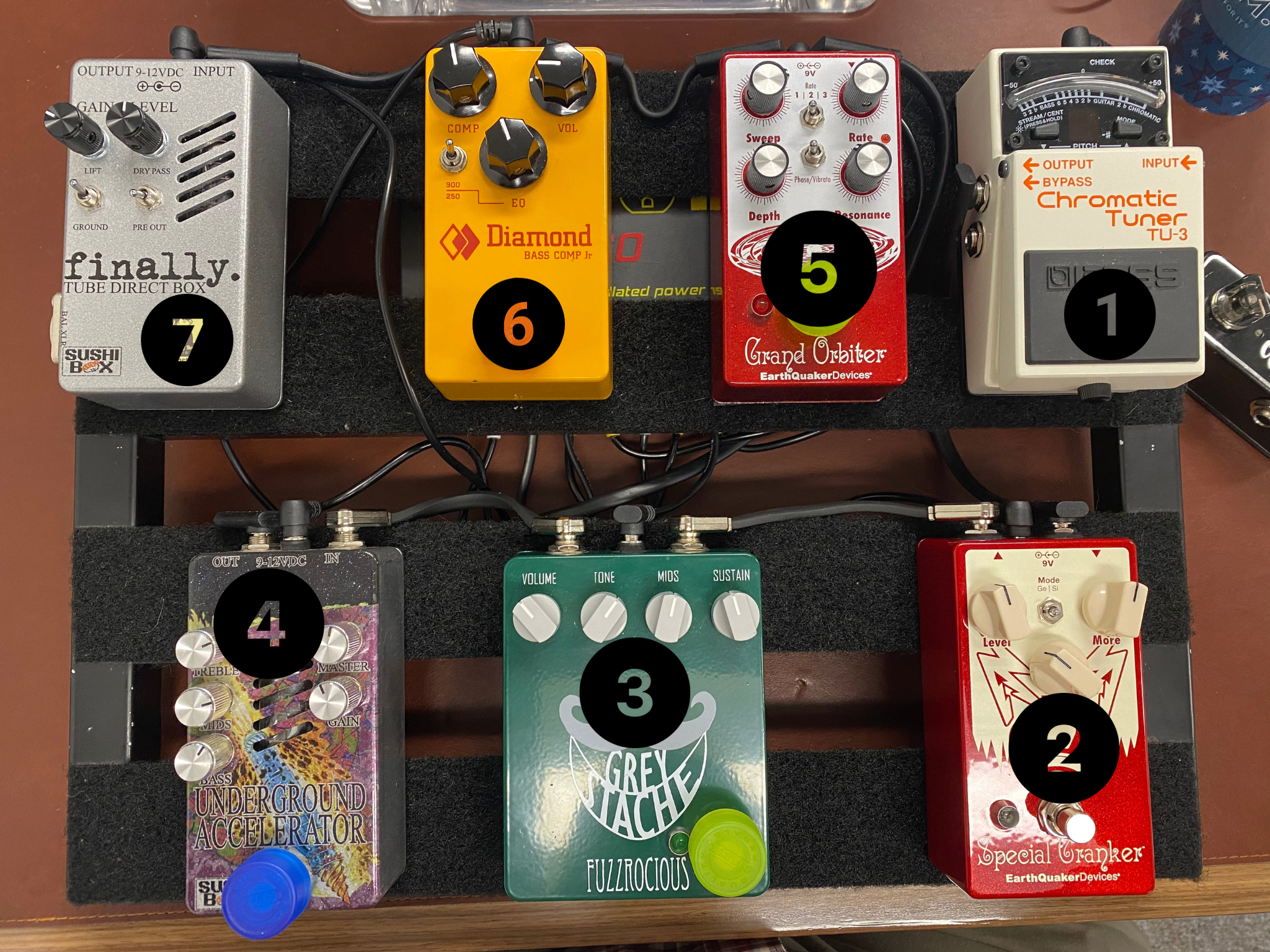
I've moved the Bass Comp Jr. from the beginning of the chain to next to last. Do y'all see any signal chain problems, otherwise?
I see some place their UA after the tuner, but I've got it in my head that it's a preamp and should go as dead last as possible, but the Grand Orbiter screwed things up--I'm tinkering with it's location--which is ultimately how you figure the signal chain out, but I wanted to solicit some opinions on the layout as well.
Thanks.


Bass board.png
 
I've moved the Bass Comp Jr. from the beginning of the chain to next to last. Do y'all see any signal chain problems, otherwise?
I see some place their UA after the tuner, but I've got it in my head that it's a preamp and should go as dead last as possible, but the Grand Orbiter screwed things up--I'm tinkering with it's location--which is ultimately how you figure the signal chain out, but I wanted to solicit some opinions on the layout as well.
Thanks.



View attachment 5305113

Like @bassbrad said, if you are happy, then that's the most important part. My UA (or LU) goes near the end, but not quite last. My envelope filter likes being fed a hot signal, which the Sushi provides, so goes afterwards. Likewise the compressor and HPF, which are always on, and more for signal sculpting than tone. But everything else goes in front of the Sushi, since, like you say, it's the "amp" in my rig (and likewise always on).

9326.jpg
 
Mike makes a brief mention of the Finally, I feel he had more to say but got distracted.
I was hoping he was going to play through it on camera :P For trivia's sake, Mike uses a 12AY7 in his Finally. 12AY7 has an amplification of 44, which makes it an interesting compromise between 12AT7 (60) and 12AU7 (20).


 
Sorry if this is a stupid question or not truly the correct thread, but do the tubes in these pedals act almost implicitly as a kind of high pass filter? I notice that through a MORE, my upright ends up missing a lot of the "thump". I felt that my Slampegg is a bit similar in some ways though not as pronounced. Is this something peculiar to the pedal's circuit, peculiar to tube amplification, or something else (is it just in my head)?
 
Sorry if this is a stupid question or not truly the correct thread, but do the tubes in these pedals act almost implicitly as a kind of high pass filter? I notice that through a MORE, my upright ends up missing a lot of the "thump". I felt that my Slampegg is a bit similar in some ways though not as pronounced. Is this something peculiar to the pedal's circuit, peculiar to tube amplification, or something else (is it just in my head)?
Tubes themselves do have a frequency response, but it's usually more dependent on the circuit. Obviously all the math I do is theoretical and doesn't account for manufacturing tolerances etc. But this is the theoretical frequency response of More. It obviously doesn't tell the whole story because anyone that has played through a More knows that there is something going on, but there will always be a certain degree of filtering inherent to tubes.

Capture.PNG
 
Sorry if this is a stupid question or not truly the correct thread, but do the tubes in these pedals act almost implicitly as a kind of high pass filter? I notice that through a MORE, my upright ends up missing a lot of the "thump". I felt that my Slampegg is a bit similar in some ways though not as pronounced. Is this something peculiar to the pedal's circuit, peculiar to tube amplification, or something else (is it just in my head)?
Not a stupid question but a valid observation. Keep in mind that many of these designs are based on vintage circuits from a very different era in recording, playback as well as sound production technologies. A certain amount of filtering was necessary to keep tape mediums, amplifiers and speakers from unwanted distortion, saturation or overload excursion. We have come to accept those qualities as pleasing [in most cases] but compared to current equipment performance they can sound limited in comparison. Especially in the case of reproducing the full audible range of an acoustic bass.
 
Tubes themselves do have a frequency response, but it's usually more dependent on the circuit. Obviously all the math I do is theoretical and doesn't account for manufacturing tolerances etc. But this is the theoretical frequency response of More. It obviously doesn't tell the whole story because anyone that has played through a More knows that there is something going on, but there will always be a certain degree of filtering inherent to tubes.

View attachment 5306086

Not a stupid question but a valid observation. Keep in mind that many of these designs are based on vintage circuits from a very different era in recording, playback as well as sound production technologies. A certain amount of filtering was necessary to keep tape mediums, amplifiers and speakers from unwanted distortion, saturation or overload excursion. We have come to accept those qualities as pleasing [in most cases] but compared to current equipment performance they can sound limited in comparison. Especially in the case of reproducing the full audible range of an acoustic bass.

Ok, both of those make sense. I hadn't really thought about it in depth (i.e., these pedals are indeed based on pre-existing circuits from eras past) but the low-low bass cut is definitely noticeable. I like the mid boosts (warmth) I seem to get from the pedals, so I'll try more experimentation with mixing the signals. The Slampegg is definitely a fixture in my electric sound now after some more road testing, but I do want that same warmth in the mids of the upright. Back to the lab (aka gigs).
 
  • Like
Reactions: havnjero
Ok, both of those make sense. I hadn't really thought about it in depth (i.e., these pedals are indeed based on pre-existing circuits from eras past) but the low-low bass cut is definitely noticeable. I like the mid boosts (warmth) I seem to get from the pedals, so I'll try more experimentation with mixing the signals. The Slampegg is definitely a fixture in my electric sound now after some more road testing, but I do want that same warmth in the mids of the upright. Back to the lab (aka gigs).
You might want to try a blend or mix pedal to get the best of both worlds. A Boss LS2 works well for this but there are more choices in this area now a daze.
 
  • Like
Reactions: LSM07
For trivia's sake, Mike uses a 12AY7 in his Finally. 12AY7 has an amplification of 44, which makes it an interesting compromise between 12AT7 (60) and 12AU7 (20).

And anecdotally, in all my tube-rolling experiments I've always preferred 5751 over the 12AT7 and the 12AY7 over the 12AV7 when looking for lower gain swaps...
I've never really liked an AT or AV swap in any bass or guitar circuit that I've tried; but 5751s and 12AY7s are almost always perfect to me.

Jack
 
Just throwing this out there...acquired a Space Heater recently and was skeptical about whether or not it could really excite my tone enough to keep it...after some rehearsals with my band (and lots of practice), this thing isn't getting turned off. Ever. It's so subtle but it's like it gets the electrons of my tone buzzing just a little bit. I'm really impressed.
 
It's All Elementary!!!
I received my new Elementary on Saturday and installed a triode balanced Muller 12AU7 in it, it sounds amazing.
It's the perfect clean bass preamp I was looking for.
The pedal is dead quiet, the EQ section is excellent and extremely effective.
The Low and Mid center frequencies are right where you want them to be and the Highs are smooth as silk, not exaggerated or shrill. Overall, the tone controls overlap is very pleasing and it's impossible to make it sound bad.
With the low gain AU7 tube, I get no distortion but a nice tube fatness and even harmonics.
This pedal joins the Slampegg, UA and Finally already on my board and gives me choices when playing multiple basses on a gig.
I set each pedal for a particular bass and when I mute to switch instruments, I click the appropriate pedal I've set for that bass. It keeps me from having to adjust tone and level the fly while working.
The Elementary would be your first choice if you want a clean and pristine tube preamp.
I'm thoroughly delighted with the Elementary,
 
It's All Elementary!!!
I received my new Elementary on Saturday and installed a triode balanced Muller 12AU7 in it, it sounds amazing.
It's the perfect clean bass preamp I was looking for.
The pedal is dead quiet, the EQ section is excellent and extremely effective.
The Low and Mid center frequencies are right where you want them to be and the Highs are smooth as silk, not exaggerated or shrill. Overall, the tone controls overlap is very pleasing and it's impossible to make it sound bad.
With the low gain AU7 tube, I get no distortion but a nice tube fatness and even harmonics.
This pedal joins the Slampegg, UA and Finally already on my board and gives me choices when playing multiple basses on a gig.
I set each pedal for a particular bass and when I mute to switch instruments, I click the appropriate pedal I've set for that bass. It keeps me from having to adjust tone and level the fly while working.
The Elementary would be your first choice if you want a clean and pristine tube preamp.
I'm thoroughly delighted with the Elementary,

As much as I love my Elementary, I've wanted to try an at7 and/or au7. With my active basses I find that I am driving the input a bit too much. But, with a passive bass, it sounds much better.

Gain staging is really a thing with multiple pedals and active basses with hot signals. I'm just say'n.
 
  • Like
Reactions: Sushi Box FX
As much as I love my Elementary, I've wanted to try an at7 and/or au7. With my active basses I find that I am driving the input a bit too much. But, with a passive bass, it sounds much better.

Gain staging is really a thing with multiple pedals and active basses with hot signals. I'm just say'n.

I'm using active basses and I'm having NO issues with overdriving the input on the Elementary using a 12AU7 tube. Master Full up and Gain at 12:00 and I'm getting plenty of level and that's my "unity" volume with the pedal engaged or not.
When I set the eq where I want it and then set them to be "unity" gain, I have no problems stacking them and using the UA, Slampegg and Elem in tandem with each other. I'm getting no weird interactions between the pedals either like some have said.
 
Last edited: