• TalkBass has been independent since 1998. Add your voice.
    Create a free account to reply to discussions, view embedded media, and browse with fewer display ads.
    Join freeLog in
    Want zero display ads or expanded classifieds tools? Compare plans.

The Trace Elliot V-type Club!!

He is the Fender authorised repair guy in his 70s and just about all the vintage amps that go through him he uses his gizmo,he explained it as “just silicone on (can be pulled out easily) and he can match up the valves exactly over a few days”
I am, now, even more curious ??
 
He is the Fender authorised repair guy in his 70s and just about all the vintage amps that go through him he uses his gizmo,he explained it as “just silicone on (can be pulled out easily) and he can match up the valves exactly over a few days”


A special type of silicone is used in amp repair. It's only function AFAIK is to hold components in place. A special type is used because the fumes from regular silicone is corrosive. I guess your tech is guarding his trade secrets which I can certainly respect.

The idea of matching the valves suggest he may be adding 1 ohm cathode resistors. The cathodes of the output tubes in the series 1, V-Types are tied directly to ground. If you insert a 1 ohm resistor between ground and the cathode, you can measure across the resistor to determine how much current each tube is pulling. This allows you to ensure all tubes are pulling about the same amount of current, which will make the amp operate better and produce a bit more power.

I call these cathode resistors "bias sense resistors." Many of my amps already have them installed from the factory. Some amps only use one resistor for multiple tubes. For example, vintage Ampeg SVTs use two bias sense resistors instead of six; one for each set of three tubes. So when you set the bias, you can't really balance the current between individual tubes, but you do balance the current in each half of the output transformer which is necessary for hum cancellation.

Rather than installing bias sense resistors in my amps that have the cathodes tied directly to ground, I bought a meter with four bias probes. The bias probes are basically tube sockets that are inserted between the amp and tubes. Some bias probes insert a 1 ohm resistor between the cathode and ground, and measure the voltage drop to determine the current. My bias probe inserts a milliammeter between the cathode and ground and measures the current directly. Basically the bias probes allow me to balance the current in the tubes without modding the amp.
 
I recently sold an early 60s blackface 15 inch vibroverb to my friend and it had the same component installed by my tech...he removed to keep it original,I have just asked if he can send me a picture...other than that I can phone my tech
 

Attachments

  • 2019-10-13 10.16.57.jpg
    2019-10-13 10.16.57.jpg
    1.3 MB · Views: 70
  • 2019-10-13 10.17.11.jpg
    2019-10-13 10.17.11.jpg
    1.5 MB · Views: 78
  • 2019-10-13 10.18.17.jpg
    2019-10-13 10.18.17.jpg
    1.2 MB · Views: 73
  • 2019-10-13 10.18.40.jpg
    2019-10-13 10.18.40.jpg
    1.3 MB · Views: 77
  • 2019-10-13 10.18.59.jpg
    2019-10-13 10.18.59.jpg
    1.5 MB · Views: 79
  • 2019-10-13 10.19.43.jpg
    2019-10-13 10.19.43.jpg
    1 MB · Views: 70
  • 2019-10-13 10.20.32.jpg
    2019-10-13 10.20.32.jpg
    1.8 MB · Views: 74
  • 2019-10-13 10.21.08.jpg
    2019-10-13 10.21.08.jpg
    1.4 MB · Views: 72
  • 2019-10-13 10.22.53.jpg
    2019-10-13 10.22.53.jpg
    1.5 MB · Views: 80
  • 2019-10-13 10.26.07.jpg
    2019-10-13 10.26.07.jpg
    1,022.3 KB · Views: 80
Okay your just teasing us now. What does this mean? I am not an engineer, but based on the voltages in the amp, I would expect it to work just fine with either tube. Perhaps your tech added plate resistors or ferrite beads to the tube sockets to suppress parasitic oscillations?

I am also surprised that 6550s produce more power in the amp. On average, KT88s have a higher dissipation rating than 6550s, so technically they should be capable of producing more power under the right circumstances.
FYI, generally the power supply and output transformer determine how much power the amp makes as much as the tube type.

The 6550 is sometimes described as a bit brighter and the KT88 more even with stronger bass. If the voicing is different, it could give the perception that the 6550 is louder, even though it doesn't make more power.

I compared Winged-C 6550s to JJ KT88 in my Aguilar DB359 and I couldn't tell the difference. Then again I also compared JJ KT88 to Rub KT88V-STR in my Matchless Thunderchief and there was a significant difference. Lot's of people say, there really is no electrical/operational difference between 6550 and KT88 with modern tubes as the tubes are no longer made to meet the original specs...I don't know if there is any truth to this.

Anyway, you have piqued my interest.
aren't winged 6550s supposed to be the best? Were the Ruby str's better than the jj's?
 
aren't winged 6550s supposed to be the best? Were the Ruby str's better than the jj's?

AFAIK the V-Types were designed for KT88.

Winged C made excellent tubes but they stopped production in 2012. Many of the last tubes sold were sub standard. I wouldn't buy a Winged C today. I do have a vintage quad of Winged C 6550s running in one of my amps and they sound great.

I have had really good luck with JJ KT88s. The quad of Ruby KT88V-STR I bought continue to drift. Very disappointing as this is a premium (expensive) tube.
 
  • Like
Reactions: Bigbri
AFAIK the V-Types were designed for KT88.

Winged C made excellent tubes but they stopped production in 2012. Many of the last tubes sold were sub standard. I wouldn't buy a Winged C today. I do have a vintage quad of Winged C 6550s running in one of my amps and they sound great.

I have had really good luck with JJ KT88s. The quad of Ruby KT88V-STR I bought continue to drift. Very disappointing as this is a premium (expensive) tube.
I have a v6 that still has TE tubes. Most likely original. But I picked up a cheap svt vr last week that's going to need tubes as well. So now I'm researching 6550s again.
 
I have a v6 that still has TE tubes. Most likely original. But I picked up a cheap svt vr last week that's going to need tubes as well. So now I'm researching 6550s again.

Luckily my 87 SVT is still running great on the original Sylvanias. If I had to retube it today I would probably try out a set of Sovtek 6550WEs or JJ KT88s.

I believe the Sovtek is a legacy product that originated before New Sensor came into existence. The seem to have a pretty good reputation for taking a pounding. The New Sensor KT88s and 6550 seem to get good reviews for tone, but there are lot of complaints about reliability in amps with high working voltage, so I tend to try and avoid them. Some people have reported good luck with Tung Sol 6550s in SVTs.

If you don't know, New Sensor bought up the exclusive rights to sell tubes in North America under the following defunct marquis: Mullard, Genalex, Tung Sol, and Svetlana. The company also makes and sells Electro Harmonix and Sovtek tubes. The also do limited third party sales for JJ and Shuguang. Here's a webpage that pretty much gives an overview of the available tube brands: Amplifier Tubes & Valves | Electro-Harmonix, EH Gold, Tung-Sol, Mullard, Genelex, Svetlana, Sovtek, JJ Electronic | Electro-Harmonix

The Svetlana 6550C is either an updated Sovtek 6550WE or may actually be the same tube. It's hard to get any good info on the Svetlanas as there is too much confounding info with Winged C, which were considered "the real" Svetlanas. The Cryllic S is a C. I believe Winged C came about when the English spelling of Svetlana was co-opted/hijacked. Basically you had C logo Svetlanas and S logo Svetlanas. And if I have not made myself clear these are different 6550C tubes made in different factories and sold by different companies...but note they both use the same exact Svetlana logo and graphic style:

JSC Svetlana, IE SED Winged C
images

New Sensor Svetlana
upload_2019-10-18_23-20-36.jpeg


I have read some threads where people claim to have ordered Sovteks and received Svetlanas and vice versa. The tube business is very tricky to navigate. Tubes For Amps sells both. When the time comes, I may give the a call. Or I may just call TC Tubes and have them match me up a set of Sovteks. I have bought several small signal tubes for TC and I always felt their customer service stood out as exceptional. Their description of how they test and match tubes also seems very good.
 
Hey gang! My big girl is all fixed! I was very blessed to find an incredible tech to do the job, mind you, I do live in a quite remote part of Australia and the quest for getting the big girl there and back is a large one lol. As stated the fault was exactly as listed and interestingly the tech was reasonably confident he located the source and the reason for the fault. He thinks that with dust build up in the v1 valve seat that is close to the screen of the heater that when humidity sets in the dust soaks up the moisture and with the huge voltages these things have caused an arc across to the screen and then the heater which causes the burn out. He advised me that in the highly tropical area i live keeping these things clean is really important and will hopefully prevent further issues. Anyway i am attaching a few of his repair pics for reference I know that this topic is well covered but hey why not a few more cool pics of a V8 beauty on this inside!! This tech's attention to detail is super awesome! 35 years in the business to boot. I want to be his apprentice.
73460550_680464425695777_1809981187985244160_n.jpg
73326798_2387690614798377_8860033231135703040_n.jpg
74936934_1070890736578476_5345626539822153728_n.jpg


Tech notes:
Repairs: Remove chassis / Verify fault burnt out heater fuse mount (no heater volts) / remove burnt fuse holders / no PA heaters fuses ok / replace fuse holders / repair track (PCB) damage / reconfigure & rewire fuse holders and heaters / replace heaters wire crimps / check HT cct ok (705vdc ok) / set bias (307mV and balance ok) / clean internals (dust) / arcing on PA valve V1 base (screen to heater) possible cause of burnt fuse holder / soak test 2 hrs. / check temps. At fuse holders ok / refit chassis / signal test ok

Anyway thanks again for the info sorry about large pics lol

cheers!
73460550_680464425695777_1809981187985244160_n.jpg
73326798_2387690614798377_8860033231135703040_n.jpg 74936934_1070890736578476_5345626539822153728_n.jpg
 
Okay your just teasing us now. What does this mean? I am not an engineer, but based on the voltages in the amp, I would expect it to work just fine with either tube. Perhaps your tech added plate resistors or ferrite beads to the tube sockets to suppress parasitic oscillations?

I am also surprised that 6550s produce more power in the amp. On average, KT88s have a higher dissipation rating than 6550s, so technically they should be capable of producing more power under the right circumstances.
FYI, generally the power supply and output transformer determine how much power the amp makes as much as the tube type.

The 6550 is sometimes described as a bit brighter and the KT88 more even with stronger bass. If the voicing is different, it could give the perception that the 6550 is louder, even though it doesn't make more power.

I compared Winged-C 6550s to JJ KT88 in my Aguilar DB359 and I couldn't tell the difference. Then again I also compared JJ KT88 to Rub KT88V-STR in my Matchless Thunderchief and there was a significant difference. Lot's of people say, there really is no electrical/operational difference between 6550 and KT88 with modern tubes as the tubes are no longer made to meet the original specs...I don't know if there is any truth to this.

Anyway, you have piqued my interest.
hey wasnex sounds like you collect some nice amps...what was the sig difference in the thunderchief...good or bad?
Thanks for all the tube info.
 
hey wasnex sounds like you collect some nice amps...what was the sig difference in the thunderchief...good or bad?
Thanks for all the tube info.

I bought the KT88V-STRs specially for the Thunderchief because it tends to eat tubes. These tubes have a 50W plate dissipation rating, so I was hoping they would work better in the amp than the JJ KT88s I pulled out. My opinion is the JJs were better, however I think one tube out of the quad of Rubys is gassy and may be loosing vacuum, so my assessment could be off.

Here's what happened to form my opinion. The bias drifted like crazy for a couple of weeks and I had to re sort the order of the tubes a couple of time to get a decent current match. After that they settled down and I was able to get them to match right at about 15%, which is not great. Three of tubes were very close and the fourth tube caused problems regardless of which position it is in. According to the test results it is supposed to be the coldest tube, but its the hottest.

If I don't play the amp for a couple of months, it runs hot for a couple of hours then the current starts going back down. I have been playing the amp recently and the current was up around 2.30A total at idle, but has settled back to around 2.16A when the amp is at operating temp. I set the amp up to pull 2.10 at idle, so I suspect the current is going up and the matching is probably getting worse. I wasn't having this sort of problem with the JJs.

Tonewise I think the JJs are more lively and harmonically rich. By messing around with the level of bias I was able to get the Rubys to open up a little bit, but I prefer the JJs. Tone is subjective, so a different person might prefer the sound of the Rubys. Overall I would still say the Thunderchief sounds fabulous, so I would be quite content if I did not pay a premium for the Rubys and get drifty tubes. I probably should have returned them.
 
  • Like
Reactions: BassikBrad
I bought the KT88V-STRs specially for the Thunderchief because it tends to eat tubes. These tubes have a 50W plate dissipation rating, so I was hoping they would work better in the amp than the JJ KT88s I pulled out. My opinion is the JJs were better, however I think one tube out of the quad of Rubys is gassy and may be loosing vacuum, so my assessment could be off.

Here's what happened to form my opinion. The bias drifted like crazy for a couple of weeks and I had to re sort the order of the tubes a couple of time to get a decent current match. After that they settled down and I was able to get them to match right at about 15%, which is not great. Three of tubes were very close and the fourth tube caused problems regardless of which position it is in. According to the test results it is supposed to be the coldest tube, but its the hottest.

If I don't play the amp for a couple of months, it runs hot for a couple of hours then the current starts going back down. I have been playing the amp recently and the current was up around 2.30A total at idle, but has settled back to around 2.16A when the amp is at operating temp. I set the amp up to pull 2.10 at idle, so I suspect the current is going up and the matching is probably getting worse. I wasn't having this sort of problem with the JJs.

Tonewise I think the JJs are more lively and harmonically rich. By messing around with the level of bias I was able to get the Rubys to open up a little bit, but I prefer the JJs. Tone is subjective, so a different person might prefer the sound of the Rubys. Overall I would still say the Thunderchief sounds fabulous, so I would be quite content if I did not pay a premium for the Rubys and get drifty tubes. I probably should have returned them.


I forget if you commented on the TAD KT88STR. What would be your assessment on the TAD vs JJs? Have you had a chance to compare them in the same amp? Thanks. Bob
 
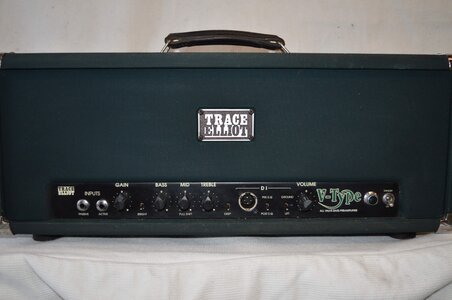
Hi guys, new to this forum and just wanted to share my love for the TE V-Type. I have one which I got yesterday. A friend of mine owns it and has had it for over 20 years. We have been playing for 2 years now and he had this thing behind a sofa, jamming with 60+ years old guys. I didn´t pay much attention to it at the time. We changed local and got in to my studio where he was using Custom Sound amp. Now, he was asked to get the V-Type because it took too much space. So I got it in my studio and tried it. What a beast of an amp! So clean sounding, no hiss or hum, got Billington Gold 5660 tubes in it. What I have read is this is the first version dating back to and starting from 1996 right? I can´t see the serial number or any other for that matter because it´s too faded. With it is a matching 4x12" cabinet. This thread is about the amp that came after this one. So what I want to know is the difference between this and the V4. And how many was made. And maybe how much love this amb and cab is getting.
Kind regards :)
 
  • Like
Reactions: Microbass