Phew, a lot of misconception and general foolishness in this thread (did we expect anything else?).
Before I get into my theory rant, here's a few asides...
Even in "rap" music, some type of theory is involved. If you have verses, choruses, bridges, beginings, endings, tempo, bass parts...well, you have "music theory".
Although you're trying to prove a point that I agree with, you're also belittling a genre of music that deserves very serious and intricate analysis. At least this music theory journal thinks so...
MTO 15.5: Adams, Flow in Rap Music
If you talk to MC's about their craft, they might not be able to speak this technically about it, but they are well aware about the intricate issues of prosody and rhythm in their music, and the multitudes of different approaches people have had.
I know that fans of technical metal love to feel superior in liking what they believe to be a complicated and deeply intellectual style of music, but if you want to have a "complexity"-off, it's kind of pointless, there's going to be stuff out there far more complicated and difficult to play and understand.
For example, the above link was spastic and technically demanding, but so are Frank Zappa tunes, which are even more spastic and technically demanding. The below, for example.
Invalid Link Removed
The "Spawn of Possession" tune you have there is fast with some odd metered stuff, sure, but it only ever has 1 line of counterpoint going on at one time (really, just a guitar solo, and beyond that, just a harmonized unison), has two key centers, zero dynamic range, never changes tempo, very little in the way of harmony (mostly synthetic scales over pedal point), and a very limited number of timbral textures.
Anyway.....
Back to the point at hand regarding theory in general...
The main point I have to make here isn't necessarily going to add too much to the argument "for" or "against" theory, because I think it's an argument that's not only worthless, it's also nonsensical. Like discussed on here so many times (it never seems to stick...sigh) Music theory is not a list of rules that you have to follow in order to make "correct" music. It is also not a "stifling" agent that stamps out creativity. Music theory is simply knowledge about music. If you argue against learning theory, you're arguing against knowing stuff about music. Don't believe me?
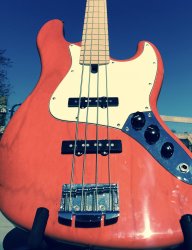
Say you're completely ignorant to all things bass guitar and you happen to get one as a gift for your birthday. You think you know absolutely nothing about music, but you decide to start messing around, putting your fingers on the strings in different places, and then plucking the strings. You quickly find out that the strings closer to the ground somehow sound "higher" than the strings closer to you, which sound "lower." If you put your fingers on the frets further on up the neck, the notes sound higher too.
Eventually you find that if you put your fingers on the fifth fret of a string and play the string above it, it sounds basically the same, with a slight difference. You might also find out some other things, like strumming the bass like a guitar sounds muddy. Eventually, you could find out that sometimes playing two notes together can sound nice, but sometimes they sound harsh (2nd fret on one string and open string below, nice! 4th fret on one string and open string above, harsh!)
Through all of this, which might have been an hour or two of experimentation, you've learned a hell of a lot of music theory. You first learned about the basic acoustical properties of pitch (through moving up and down on the neck), then you learned about timbre (two notes that have the same pitch, but sound different, on the 5th fret), acoustics (specifically, Lower Interval Limits and why strumming a bass sounds muddy), and even the basics of intervals and intervallic consonance/dissonance.
Of course, you don't know the technical terms for all of this, but that doesn't matter, you still have that knowledge in relationship to your limited experience on the bass, you just can't describe it. People who argue for ignorance of theory likely know a lot about music anyway, they just don't know what things are called in theoretical language. This brings up the point, why even have the theoretical language to describe musical phenomenon?
Communication. Theoretical language is a way to communicate to other human beings concepts of music in a very clear and unambiguous way that accurately describes what is happening in the music. Over a thousand years, this language has been codified and regulated in a way that anybody who learns in anywhere in the world can accurately describe what is happening in the music, why it sounds the way it does, and perhaps gives clues as to how to replicate the desired musical effects. All this theoretical language is is a means of communicating in English (or any other language, for that matter) musical ideas. Even improvising language like "that drum diddly you did with the fast snare beat" counts as a theoretical explanation. Even if its a crude and incomplete analysis of the music at hand, if it gets the point across, it's done it's purpose. That improvised theoretical description communicated a musical concept.
You see, I'm not arguing that everybody should go out and study fugal counterpoint, serial composition and worship at the heels of Allan Forte. Obviously in depth study of highly technical matters of advanced music theory is completely irrelevant to most all of our musical careers, and nobody should feel like they should.
If you an amateur hobbyist who simply likes playing bass because it's fun, of course you don't need any in-depth knowledge of the technical terms of what you're doing - just have fun with what you're learning for yourself! Even if you're a working bassist on the highest possible professional level doesn't mean you have any particularly in-depth knowledge of theory beyond what you need to communicate with your fellow musicians effectively.
What I have a problem with here isn't people who are willfully ignorant to the technical terms. Not having any desire or need to learn this intricate body of what can potentially be extremely dry knowledge is fine by me. Despite being absolutely essential to the careers of hundreds of thousands of people, I have little knowledge of calculus, and I don't have any particular desire to go out an learn more. It has no bearing on my professional or personal goals, so I am willfully ignorant of calculus, and I don't think anybody really cares, nor has the right to care, that I am.
What I have a problem with is the
pride that people take in their willful ignorance of the language. I don't know Japanese, but it would be really strange if I was
proud that I didn't know Japanese. Even stranger to suggest that because I didn't know Japanese, somehow I was more creative a thinker and communicator.



 Trust me...it ain't easy to even sell a hundred records, let alone 15 million.