
About halfway down here, Tom Petersson talks about Thunderbirds.
Tom Petersson | Vintage Guitar® magazine
Tom Petersson | Vintage Guitar® magazine

TalkBass has been independent since 1998. Add your voice.
Create a free account to reply to discussions, view embedded media, and browse with fewer display ads.
Join free Log in
Want zero display ads or expanded classifieds tools? Compare plans.

and that’s the crux right there…..250, tube, ss, Class D or whatever is still the same power into a speaker. traditionally, audio power measurements were/are done into a resistor (2, 4, 8, 16 or whatever amount of Ohm) which is not truly representative of how a speaker really behaves. for example, a 4 Ohm speaker may go up to over 20 Ohm at higher frequencies making the “pure resistor” test/characterization method lack in real world terms. the reason the Audio Engineering Society (AES) chose this way is because it’s quiet and cheap (no need for audio chanbers to test purely electrical performance of the amp), and gives you unbiased amp data.
now, you add speakers and those earlier measurements remain purely a benchmark reference that doesn’t really tell you much about how the particular amp/speaker combo will perform…..add to that the variable of the signal (type of instrument for example) to be used and the complexity just keep growing…..
magnetic materials have come a long way and the recent NEO type magnets, although making everything MUCH lighter and portable are also MUCH more inefficient necessitating substantially more power to attain the same Sound Pressure Levels (SPl) adding to the confusion…..now 800 Watts is commonplace but you have to be very careful when you use an amp like this with traditional non NEO speakers or you’ll quickly fry them……apologies for the verbosity, the issues can become pretty involved…..


Colour is awesome. All the cool colours of the 70s and 80 are coming back. As are the uncool colours (I see you trying to hide beige).Might be a fun knock around with a crazy cool color. Not fond of poplar but I dig maple necks.
Stupid Deal of the Day | Musician's Friend
It is very unfortunate that for many/most of the mentally ill, the police are their first contact with 'the system'.Yes, resources are stretched very thin, most of the large hospitals which used to house those and chronically ill mental patients got closed during the 80's because of privatization and that's all I'm going to say about thay, well besides the fact that it was a colossal failure and dumped thousands of people into the street and shelters. I would hazard a guess and say that at any given time 90% of mentally ill patients are out on the street and have stopped taking their meds and that is another kettle of fish.
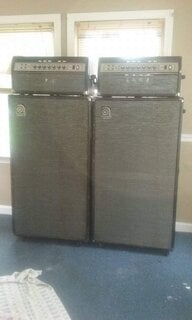
yes, in a conventional speaker you need to magnetize the armature with a current….the NEO magnet is already magnetized (albeit more “weakly”) so it doesn’t need this…… same goes with motors, induction motors (most common electric motor by far) need brushes to keep the rotor magnetized as it rotates…..with NEO, these are no longer needed hence “brushless” motors…..remember, a speaker is nothing more than a motor with a “fixed” rotor….: because these magnets don’t have the same magnetic intensity (flux density) they require more power hence taking the hit in efficiency…..the benefits are worth it however…. lighter speakers and motors that are EMI quieter and don’t require peridiodic brush replacement….
Also, many do not take meds because they do not like how the meds make them feel. Unfortunately, there is not a lot profit in making new psychiatry drugs because the clinical trials are extraordinarily difficult. As well, the metrics of "adequate dose" tend toward objective measures and ignore how the patient feels; there can be a balance between controlling the crazy and feeling OK, but that is not usually how things are done. As well, courts have (rightly) found that involuntary commitment is contrary to personal freedoms. Because of the nature of the institutions, few will voluntarily commit themselves.Yes, resources are stretched very thin, most of the large hospitals which used to house those and chronically ill mental patients got closed during the 80's because of privatization and that's all I'm going to say about thay, well besides the fact that it was a colossal failure and dumped thousands of people into the street and shelters. I would hazard a guess and say that at any given time 90% of mentally ill patients are out on the street and have stopped taking their meds and that is another kettle of fish.
don’t mistake high gain with dynamic range…..bass guitar output levels were not standardized and all over the place when the SVT was designed…..
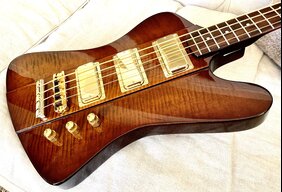
Not only is there a flaw in the paint, but the goofballs at Gibson even installed two extra strings by accident.
Problems like this can also be solved with money. Pay a roadie.It's amazing how many problems wheels solve. A proper hand truck makes getting almost anything anywhere possible. Including up the stairs if you have decent technique using it.
Hey, I resemble that sometimes.
It is very unfortunate that for many/most of the mentally ill, the police are their first contact with 'the system'.
Mental illness is not a policing problem. The solutions lie elsewhere. Unfortunately 'elsewhere' is in sufficiently motivated, staffed, funded, and politically photogenic to do anything.Yes, major police departments usually have people they can talk down from roofs, talk out of killing themselves or others, why don't they have at least on call mental health counselors?

LOL - I own 13 thunderbird basses; some would say I have a mental illness…Mental illness is not a policing problem. The solutions lie elsewhere. Unfortunately 'elsewhere' is in sufficiently motivated, staffed, funded, and politically photogenic to do anything.


Also, many do not take meds because they do not like how the meds make them feel. Unfortunately, there is not a lot profit in making new psychiatry drugs because the clinical trials are extraordinarily difficult. As well, the metrics of "adequate dose" tend toward objective measures and ignore how the patient feels; there can be a balance between controlling the crazy and feeling OK, but that is not usually how things are done. As well, courts have (rightly) found that involuntary commitment is contrary to personal freedoms. Because of the nature of the institutions, few will voluntarily commit themselves.
Mental illness is not a policing problem. The solutions lie elsewhere. Unfortunately 'elsewhere' is in sufficiently motivated, staffed, funded, and politically photogenic to do anything.
Hot off the press -


