• TalkBass has been independent since 1998. Add your voice.
    Create a free account to reply to discussions, view embedded media, and browse with fewer display ads.
    Join freeLog in
    Want zero display ads or expanded classifieds tools? Compare plans.

Thunderbird Club

Looks very interesting, if a bit pricey.....the 784 miles X2 drive to pick it might be prohibitively expensive though.....


My oldest amp, the Acoustic 150b, at 100? watts, seems to be the loudest one I have, in my small apartment living room test :unsure:
The volume controls on a number of old amps, including ACC, is that the volume goes up to 100% very quickly as you turn up the knob. Then it hits max volume somewhere around noon and just makes more dirt instead of more volume. They can be very loud very quickly. Then that is all you get.

I love 'em but harbor no illusions about some magical power they might have. That said, I think they do manage more power than they are rated to have. Run them through the cabinet they were meant for and you get maximum efficiency. The best I ever heard a 370 sound was through some kind of Ampeg stack. So there is a flip side, too. I didn't like the 370 all that much normally.
 
So, in general terms, neo drivers are better with SS/class D higher wattage amps, and standard (ferrite, ceramic?) drivers tend to match better with lower wattage tube amps?

I’ve been finding that my lower wattage tube amps definitely benefit when being used with ported/vented cabinet(s).
yes, to both…the main reason for the NEO direction is to keep back surgeons from becoming too wealthy and keep older bassists in the game I think….:D
 
and that’s the crux right there…..250, tube, ss, Class D or whatever is still the same power into a speaker. traditionally, audio power measurements were/are done into a resistor (2, 4, 8, 16 or whatever amount of Ohm) which is not truly representative of how a speaker really behaves. for example, a 4 Ohm speaker may go up to over 20 Ohm at higher frequencies making the “pure resistor” test/characterization method lack in real world terms. the reason the Audio Engineering Society (AES) chose this way is because it’s quiet and cheap (no need for audio chanbers to test purely electrical performance of the amp), and gives you unbiased amp data.
now, you add speakers and those earlier measurements remain purely a benchmark reference that doesn’t really tell you much about how the particular amp/speaker combo will perform…..add to that the variable of the signal (type of instrument for example) to be used and the complexity just keep growing…..
magnetic materials have come a long way and the recent NEO type magnets, although making everything MUCH lighter and portable are also MUCH more inefficient necessitating substantially more power to attain the same Sound Pressure Levels (SPl) adding to the confusion…..now 800 Watts is commonplace but you have to be very careful when you use an amp like this with traditional non NEO speakers or you’ll quickly fry them……apologies for the verbosity, the issues can become pretty involved…..
Great info, Chuck! I learned from it. Thanks for taking the time to explain it.
 
The volume controls on a number of old amps, including ACC, is that the volume goes up to 100% very quickly as you turn up the knob. Then it hits max volume somewhere around noon and just makes more dirt instead of more volume. They can be very loud very quickly. Then that is all you get.

I love 'em but harbor no illusions about some magical power they might have. That said, I think they do manage more power than they are rated to have. Run them through the cabinet they were meant for and you get maximum efficiency. The best I ever heard a 370 sound was through some kind of Ampeg stack. So there is a flip side, too. I didn't like the 370 all that much normally.


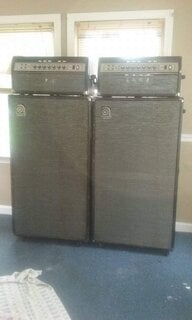
70's Ampegs are like that too, they're very high gain, I rarely turn mine above ten 'clock, actually so were Fenders. I think most non master volume amps were like that.
 
the original Starbucks…..without the shot of grappa of course…..:rolleyes:
B4F95423-A4D7-4D1F-8659-86AF5D9DA009.jpeg
:bookworm:
 
I never realized that neo speakers were less efficient than normal speakers, is the magnetic field weaker or is it something else?
yes, in a conventional speaker you need to magnetize the armature with a current….the NEO magnet is already magnetized (albeit more “weakly”) so it doesn’t need this…… same goes with motors, induction motors (most common electric motor by far) need brushes to keep the rotor magnetized as it rotates…..with NEO, these are no longer needed hence “brushless” motors…..remember, a speaker is nothing more than a motor with a “fixed” rotor….: because these magnets don’t have the same magnetic intensity (flux density) they require more power hence taking the hit in efficiency…..the benefits are worth it however…. lighter speakers and motors that are EMI quieter and don’t require peridiodic brush replacement….
 
70's Ampegs are like that too, they're very high gain, I rarely turn mine above ten 'clock, actually so were Fenders. I think most non master volume amps were like that.
don’t mistake high gain with dynamic range…..bass guitar output levels were not standardized and all over the place when the SVT was designed…..
 
and that’s the crux right there…..250, tube, ss, Class D or whatever is still the same power into a speaker. traditionally, audio power measurements were/are done into a resistor (2, 4, 8, 16 or whatever amount of Ohm) which is not truly representative of how a speaker really behaves. for example, a 4 Ohm speaker may go up to over 20 Ohm at higher frequencies making the “pure resistor” test/characterization method lack in real world terms. the reason the Audio Engineering Society (AES) chose this way is because it’s quiet and cheap (no need for audio chanbers to test purely electrical performance of the amp), and gives you unbiased amp data.
now, you add speakers and those earlier measurements remain purely a benchmark reference that doesn’t really tell you much about how the particular amp/speaker combo will perform…..add to that the variable of the signal (type of instrument for example) to be used and the complexity just keep growing…..
magnetic materials have come a long way and the recent NEO type magnets, although making everything MUCH lighter and portable are also MUCH more inefficient necessitating substantially more power to attain the same Sound Pressure Levels (SPl) adding to the confusion…..now 800 Watts is commonplace but you have to be very careful when you use an amp like this with traditional non NEO speakers or you’ll quickly fry them……apologies for the verbosity, the issues can become pretty involved…..
Good explanation Chuck! I regularily use a D800+ with speakers that can't handle 800 Watts, but one of the nice things about Mesa is the pots. They have a little physical resistance, so you have to intentionally turn them. I take the amp out of its bag and the settings are exactly where I left them. With my GK MB200, I have to check / dial in everything before launching.
 
Good explanation Chuck! I regularily use a D800+ with speakers that can't handle 800 Watts, but one of the nice things about Mesa is the pots. They have a little physical resistance, so you have to intentionally turn them. I take the amp out of its bag and the settings are exactly where I left them. With my GK MB200, I have to check / dial in everything before launching.
One thing you could try on the GK is to pull off the knob, slide an o-ring down the shaft (ahem), then replace the knob. It adds resistance.
 
yes, to both…the main reason for the NEO direction is to keep back surgeons from becoming too wealthy and keep older bassists in the game I think….:D
It's amazing how many problems wheels solve. A proper hand truck makes getting almost anything anywhere possible. Including up the stairs if you have decent technique using it.
 
After a month in, my Sweetwater rep is still working at it. I can’t imagine what would happen with Gibson if I had a major problem. I’m offering to do the repairs for them..Still not a rant

View attachment 4998881
I had a super teency weency paint bubble on the neck of an SG I purchased new. But it was right where I placed my thumb on the back of the neck or I'd never had noticed. it drove me crazy . Brought it to a luthier that's also a Gibson warranty center. Gibson took care of it.
 
yes, in a conventional speaker you need to magnetize the armature with a current….the NEO magnet is already magnetized (albeit more “weakly”) so it doesn’t need this…… same goes with motors, induction motors (most common electric motor by far) need brushes to keep the rotor magnetized as it rotates…..with NEO, these are no longer needed hence “brushless” motors…..remember, a speaker is nothing more than a motor with a “fixed” rotor….: because these magnets don’t have the same magnetic intensity (flux density) they require more power hence taking the hit in efficiency…..the benefits are worth it however…. lighter speakers and motors that are EMI quieter and don’t require peridiodic brush replacement….
Dude, you seriously should consider this stuff for a living! :laugh:
 
and that’s the crux right there…..250, tube, ss, Class D or whatever is still the same power into a speaker. traditionally, audio power measurements were/are done into a resistor (2, 4, 8, 16 or whatever amount of Ohm) which is not truly representative of how a speaker really behaves. for example, a 4 Ohm speaker may go up to over 20 Ohm at higher frequencies making the “pure resistor” test/characterization method lack in real world terms. the reason the Audio Engineering Society (AES) chose this way is because it’s quiet and cheap (no need for audio chanbers to test purely electrical performance of the amp), and gives you unbiased amp data.
now, you add speakers and those earlier measurements remain purely a benchmark reference that doesn’t really tell you much about how the particular amp/speaker combo will perform…..add to that the variable of the signal (type of instrument for example) to be used and the complexity just keep growing…..
magnetic materials have come a long way and the recent NEO type magnets, although making everything MUCH lighter and portable are also MUCH more inefficient necessitating substantially more power to attain the same Sound Pressure Levels (SPl) adding to the confusion…..now 800 Watts is commonplace but you have to be very careful when you use an amp like this with traditional non NEO speakers or you’ll quickly fry them……apologies for the verbosity, the issues can become pretty involved…..
Actually, that was a very well thought out and concise response to a very complex question with lots of variables and interdependencies, and expertly put in layman’s terms so even my thick skull gets it. :thumbsup: