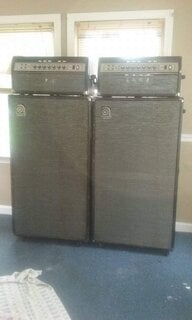
From a stage amp perspective, even an indoor arena and outdoors are the same.
Except for all that awful echo you get in an arena. I've not played many but you prayed it sounded better in the house than it did onstage
 .
.
TalkBass has been independent since 1998. Add your voice.
Create a free account to reply to discussions, view embedded media, and browse with fewer display ads.
Join free Log in
Want zero display ads or expanded classifieds tools? Compare plans.
From a stage amp perspective, even an indoor arena and outdoors are the same.
.
I will also note that I can normally get very close to Jack Casady’s sound on White Rabbit with my rig, using either the CP or the Greco. The bass is prominent enough on that song, and it’s iconic enough, that it matters. I can get the CP (or the basic IV, now E1) to sound pretty close to early Motown bass as well, even though that was almost all Fender (AFAIK).
VH's case wasn't as nutty as it seems. They did that as a test to see if the facility was paying attention to their requests. If they saw they didn't honor that, then they wouldn't have paid attention to their power needs for their show, etc.

I have to read a lot for work, so my brain and eyes have no interest in doing it for fun for now. I get antsy at work when I have to plow through 300 or 400 pages. I think everyone would. I used to enjoy reading history, and probably will again once I retire someday.Given the information stated, I think it's called prostate issues. Or Hemorrhoids, but let's not go there.
Kidding aside, I kind of am at the same place. I have to do a ton of reading for work and still read about a book a week for personal reading. But I find it difficult to sit down an read these days. I'd rather tinker or work on something in the garage. For whatever reason, I can't get into fiction, science or otherwise. I try and my brain keeps telling me "it didn't happen" and I can't focus or stay with it. Not that I'm sophisticated or anything, fiction just doesn't click for me. Likely due to lack of imagination on my part.
I know knuckle-dragger is a thing, butt-dragger is also?Blue Monday................
I'm ass draggin' into work, really beat from rehearsal last night.



What genre is “Uhhh…” if not soft jazz?
Is that the genre that includes the riff "Bow-chick-a-wah-wah"? Because I could see "Uhhh" being the vocal track..."adult urban contemporary"
I have to read a lot for work, so my brain and eyes have no interest in doing it for fun for now. I get antsy at work when I have to plow through 300 or 400 pages. I think everyone would. I used to enjoy reading history, and probably will again once I retire someday.
I have often thought that it was VH just being rock stars and the electrical/mechanical demands being an explanation that was backed into the behaviour later.I kind of see VHs point. I'm just not sure how effective it would have been. It would work on some level of knowing they read the rider and honored that one relatively easy aspect, but it was no surety they would keep more difficult and costly parts. It definitely would affirm that their requests were at least read, beyond that I'm not sure it would prove much. But maybe it worked.
When I was in the army, everything had to be done in triplicate. One for the inbox, one for the outbox, and one to destroy so that the Russians don't get it.This didn't seem uncommon from what my wife experienced when working at Ft. Knox when we were dating. Over simplification here, but she would chat about what she did that day and would be procedures for handling maintenance requests (paperwork). She would tell of the convoluted path that would be taken at times just to get the paperwork to the finial person to sign off. The first time she talked about what she did one day I started asking why it seemed so odd to get things where they needed to be. Just get the end person or one who needed to know the paperwork and skip all people who just look at it and send it on to the next. She said it didn't make sense to anyone there, but that was how it was set up and you don't question it. Likely one of those situations where the process was set up and just added to as time went on without stopping and evaluating the big picture and things just got cumbersome, and since no one was looking to the bottom line like a business has to, there was not much incentive to tear it up and start over.
My friday afternoon routine at the medical equipment depot was to go to a department to learn what they do. Step by step. When I didn't understand why something was done the way it was, I asked why. Everyone quickly figured out was that there was a wrong answer "because that's how we have always done it". I re-engineered a few business processes that way.This happens with large companies, but at times they will pay outsiders to come in and evaluate how they do things and to find blind spots that they have grown accustomed to over the years. A friend's father used to do that for companies. He would follow people around, learn what they did and see if there were better ways of doing it. Some times what seemed odd to an outsider did make sense, often it was simply process "creep," or even at times people creating process to justify their jobs. My wife retired from a Fortune 50 company and at times would see that kind of poorly defined process. Toward the end of her time she would have input and be able to question things and suggest better ways of doing some things. Often because the process was set up at the main office by people who never had to actually work the process and never really understood what task needed to be accomplished. They just looked at the process, and on paper it seemed to work just fine. At times she would have to tell people in the big office that what they devised didn't work because they didn't understand what was involved. Most knew that and agreed.
Nope. 26 pages of instructions. I'm told that the Navy's recipe is similarly long.The fonts are just really big. I hope.

My current van is ex-government. Monterrey County bought it in late 2009. It was probably one of the first Transit Connects in the country. They didn't license it until March 2010. Then, they put 23k miles on it and sold it with a little body damage in 2018. The van I had before was a 2002 Chevy that was owned by the Washington Department of Transportation before I got it. It had obviously had a few skirmishes with construction equipment along the way, and repaired with varying levels of skill. But it was also a van with very few miles on it when I got it. I don't know exactly what the Government does with this stuff, but they don't use it near as much as I do when they are done.

It’s at least an indicator.I kind of see VHs point. I'm just not sure how effective it would have been. It would work on some level of knowing they read the rider and honored that one relatively easy aspect, but it was no surety they would keep more difficult and costly parts. It definitely would affirm that their requests were at least read, beyond that I'm not sure it would prove much. But maybe it worked.
I know. I was being silly. My first f/t software engineering job was for a traffic engineering firm. I learned (very quickly, almost a prodigy) how to read RFPs and how to write proposals, as well as how to fluff up design docs, operational docs, etc. to meet the unofficial standards of government agencies. The real art was getting it just right for the entity involved. A small city happy with who they were had simpler verbiage than the same sized city planning to be the next Atlanta. Never mind state and federal agencies.I'm certain I don't. I also hope wouldn't take 33 pages (to be exact), to help me get there for typical situations. The guy that read it didn't come away with it being that kind of problem being solved, but that is was something that was simply too verbose that would hardly, if ever, be seen in the private sector. Maybe it made sense in some way, but it didn't to him.
This didn't seem uncommon from what my wife experienced when working at Ft. Knox when we were dating. Over simplification here, but she would chat about what she did that day and would be procedures for handling maintenance requests (paperwork). She would tell of the convoluted path that would be taken at times just to get the paperwork to the finial person to sign off. The first time she talked about what she did one day I started asking why it seemed so odd to get things where they needed to be. Just get the end person or one who needed to know the paperwork and skip all people who just look at it and send it on to the next. She said it didn't make sense to anyone there, but that was how it was set up and you don't question it. Likely one of those situations where the process was set up and just added to as time went on without stopping and evaluating the big picture and things just got cumbersome, and since no one was looking to the bottom line like a business has to, there was not much incentive to tear it up and start over.
This happens with large companies, but at times they will pay outsiders to come in and evaluate how they do things and to find blind spots that they have grown accustomed to over the years. A friend's father used to do that for companies. He would follow people around, learn what they did and see if there were better ways of doing it. Some times what seemed odd to an outsider did make sense, often it was simply process "creep," or even at times people creating process to justify their jobs. My wife retired from a Fortune 50 company and at times would see that kind of poorly defined process. Toward the end of her time she would have input and be able to question things and suggest better ways of doing some things. Often because the process was set up at the main office by people who never had to actually work the process and never really understood what task needed to be accomplished. They just looked at the process, and on paper it seemed to work just fine. At times she would have to tell people in the big office that what they devised didn't work because they didn't understand what was involved. Most knew that and agreed.
Thunderbird. Kind of...
View attachment 5041218
You’re our favorite ass dragon!Blue Monday................
I'm ass draggin' into work, really beat from rehearsal last night.
Ok, I’ll bite, ahemYou’re our favorite ass dragon!


Ctrl F….I have to read a lot for work, so my brain and eyes have no interest in doing it for fun for now. I get antsy at work when I have to plow through 300 or 400 pages. I think everyone would. I used to enjoy reading history, and probably will again once I retire someday.

You’re our favorite ass dragon!
Ok, I’ll bite, ahem


