• TalkBass has been independent since 1998. Add your voice.
    Create a free account to reply to discussions, view embedded media, and browse with fewer display ads.
    Join freeLog in
    Want zero display ads or expanded classifieds tools? Compare plans.

Thunderbird Club

only real way to eliminate one of the coils is to bypass it with a wire…..the cap does this for higher frequencies and shunts them to ground so instead of exciting the instrument they get suppressed which is why it sounds darker…..
the voicing change happens because you can “tune” the response of an inductor with a cap….. the tuning formula is Fr = 1/2PI x square root of the product of L (inductance) and (capacitance) where
Fr= resonant freq
PI= 6.28

The holy grail parameter (for me) has always been inductance of a Thunderbird pickup and have never been able to secure that very elusive number, although through work, I could set up a measurement, I haven’t gotten around to it hoping I can find a published number the way Ohmic numbers are but have not been that lucky. It is fairly safe to say that for a linearly wound coil, the inductance is directly proportional to the resistance but because so many different winding methods are used it’s not a safe assumption. That leaves an empirical approach……from a Bill Lawrence paper I read, pickup inductances range from 2 to 10 Henries (some higher) so assuming half way inductance (5 Henries) and the .01 value of that cap (from Irv’s photo) and using the above math gives me a response of 712 Hz….
View attachment 5139445

So, in short :laugh: when you flick that pot you shunt some high frequencies to ground AND add a filter response centered at 712 Hz that will inevitably alter the original voicing….
Really hoping this makes sense…
Sorry for the verbosity….
That makes sense to me. Thanks for the explanation Chuck!
 
What is the “passive distortion circuit?”
It’s the same distortion circuit I put in one of my Goth birds as a test to see how well it worked on bass. I think you very briefly tried that one while you were over at my house. It’s a dirt cheap mod, maybe under $5 IIRC (the company that makes them gave me mine for free, gotta love that business model).

To be honest, the distortion was there but not in your face, more of a mild distortion unless you really really dug in, then it got pretty interesting. I put it in place of my tone cap, so I had distortion all the time, but again mild and barely noticeable unless you dug in. Interestingly, you would get full use of the distortion circuit if the tone knob was all the way off (remember, there’s no tone cap so the output didn’t get darker, just more distorted). With the tone knob all the way up it was pretty much zero distortion.

I removed the distortion mod when I converted the Goth (which I will be bringing to the GTG) to an active preamp, but I’ve considered putting it back in the Goth with an on/on switch to activate it. I suspect with an active preamp signal the distortion circuit will be much more pronounced. It’s debatable how useful it will be in an actual musical setting, essentially it’s a very very basic on board distortion pedal. I’ve just never been much of a pedal guy on basses, guitars yes, basses just not much for some reason.

@JIO tried one out as well on one of his basses. He may be more of a pedal guy than I am, so he might have a different take on it.
 
That’s apples to apples for sure.
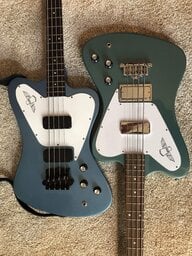
Plus, mine is going to be refinished, probably Rallye Green, the late '60s Chevy color. It will just keep getting more similar with time.

A little more seriously, the neck feels like a Gibson neck, and it balances like a Thunderbird should. It makes for great raw material to do all kinds of things with if you don't like it as-is. There are people who love 'em as-is, too. Mine ate batteries, so I didn't spend the time to dial it in as an active bass. That may not be normal for them.
 
Interesting pickup(not mine):
car-roofing-jpg.5139071
It's probably pretty quiet inside and probably weighs a whole lot. What nailing pattern and nails do you suppose he used to keep the roof from blowing off at freeway speeds?
 
Thunderbird Thursday follies.......
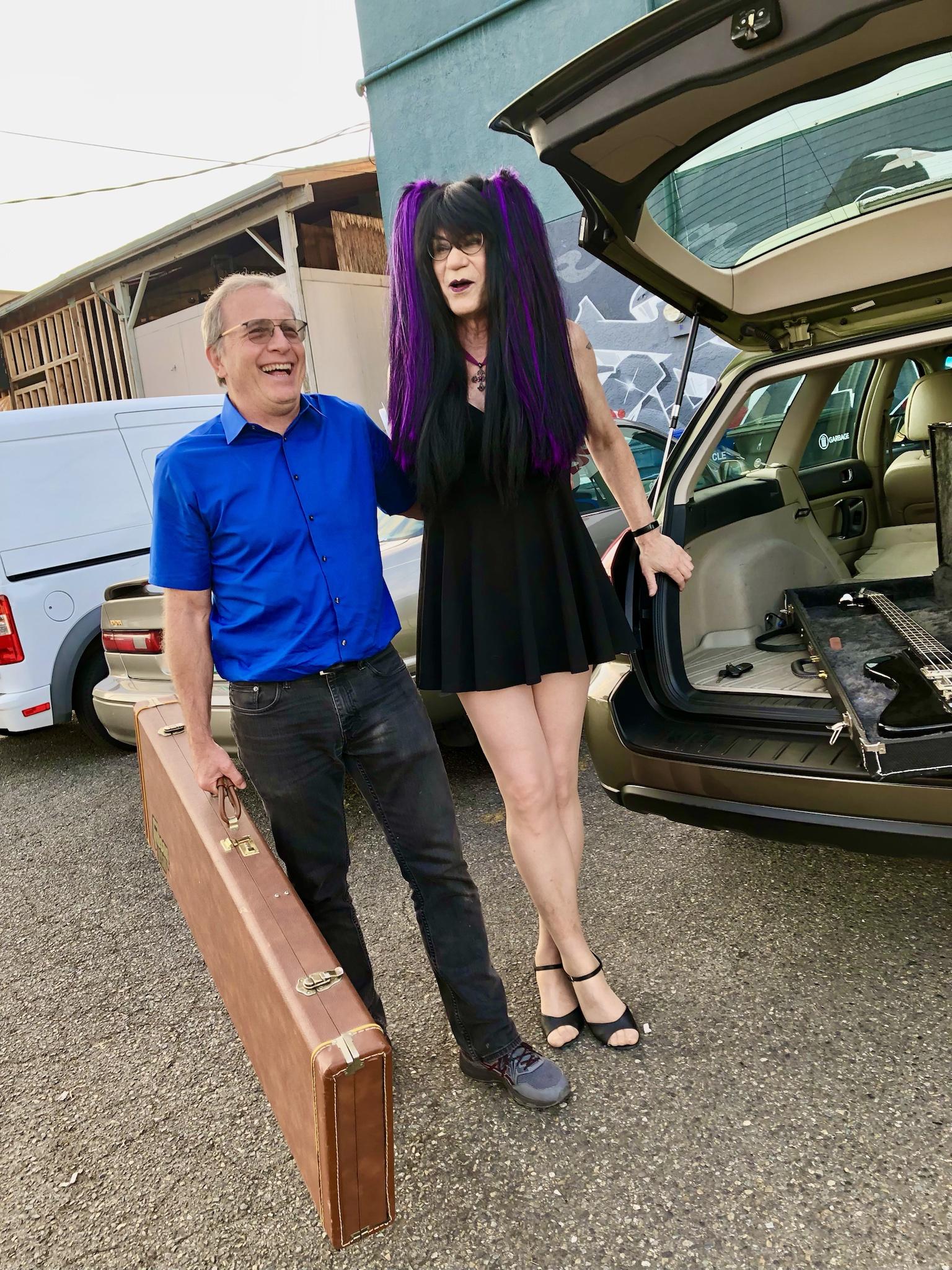
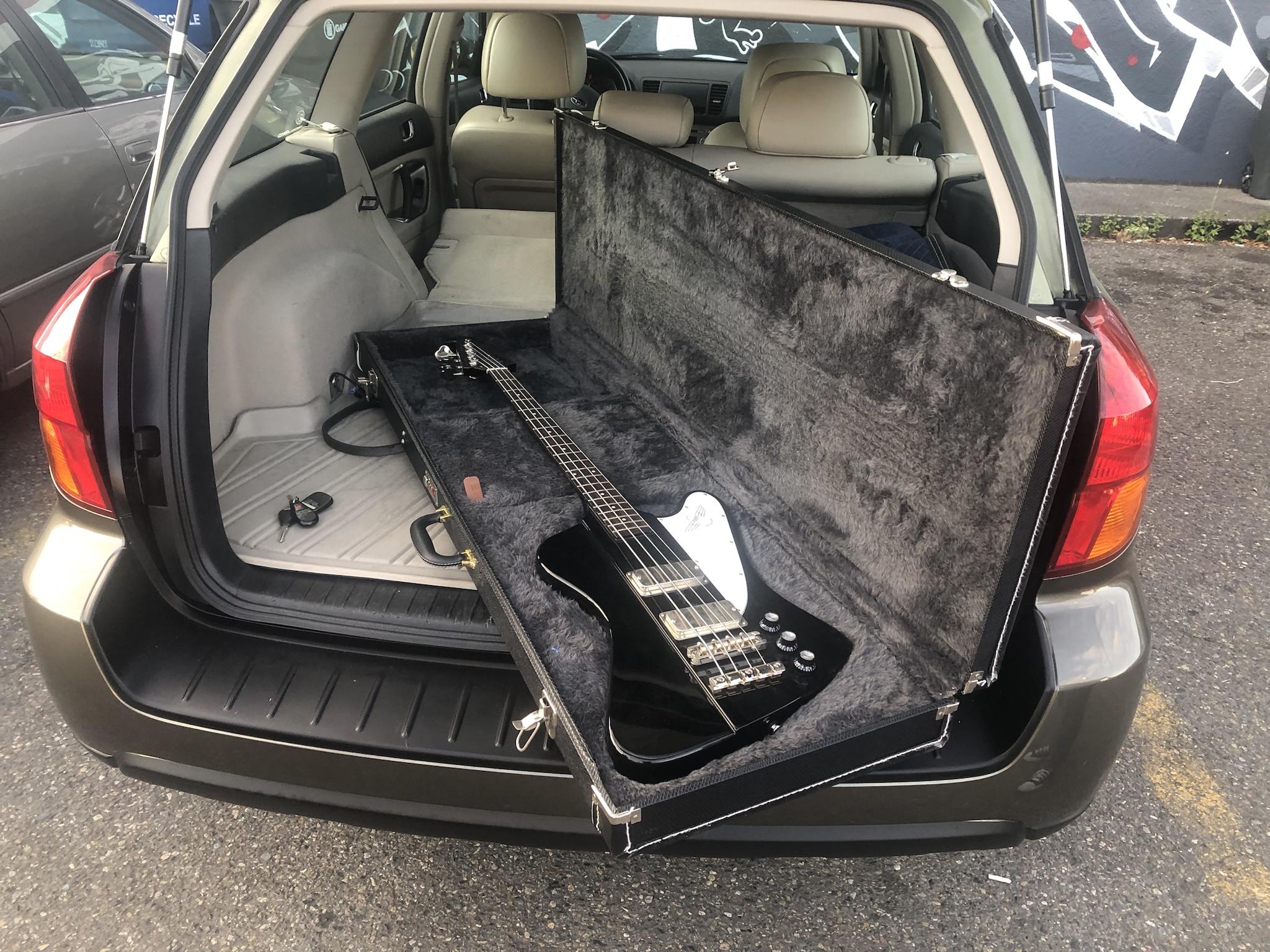
A big "Thank you" to Will @Gaolee for dinner tonight, seems I'll have a hitchhiker on my trip to Hollister!

vBT4YRw.jpg


It'll ride in style, Subies rule!
7Fq0txE.jpg
The Subie Express! Kinda like the pony express, but faster and less dust.

I'm sure happy that VP is off to a good home instead of being neglected by me. And, I sure had a good time last night with you and Frank.
 
Plus, mine is going to be refinished, probably Rallye Green, the late '60s Chevy color. It will just keep getting more similar with time.

A little more seriously, the neck feels like a Gibson neck, and it balances like a Thunderbird should. It makes for great raw material to do all kinds of things with if you don't like it as-is. There are people who love 'em as-is, too. Mine ate batteries, so I didn't spend the time to dial it in as an active bass. That may not be normal for them.

Batteries last a long time as long as the bass is unplugged. I have active basses with batteries that have been in them for years.
 
Batteries last a long time as long as the bass is unplugged. I have active basses with batteries that have been in them for years.
Mine didn't work that way for some reason. There was probably something wrong with the electronics. It would take a couple months to kill its battery, and instead of being passive with no battery, it was silent. That was my one experiment with active bass guitars. It wasn't a success.
 
It’s the same distortion circuit I put in one of my Goth birds as a test to see how well it worked on bass. I think you very briefly tried that one while you were over at my house. It’s a dirt cheap mod, maybe under $5 IIRC (the company that makes them gave me mine for free, gotta love that business model).

To be honest, the distortion was there but not in your face, more of a mild distortion unless you really really dug in, then it got pretty interesting. I put it in place of my tone cap, so I had distortion all the time, but again mild and barely noticeable unless you dug in. Interestingly, you would get full use of the distortion circuit if the tone knob was all the way off (remember, there’s no tone cap so the output didn’t get darker, just more distorted). With the tone knob all the way up it was pretty much zero distortion.

I removed the distortion mod when I converted the Goth (which I will be bringing to the GTG) to an active preamp, but I’ve considered putting it back in the Goth with an on/on switch to activate it. I suspect with an active preamp signal the distortion circuit will be much more pronounced. It’s debatable how useful it will be in an actual musical setting, essentially it’s a very very basic on board distortion pedal. I’ve just never been much of a pedal guy on basses, guitars yes, basses just not much for some reason.

@JIO tried one out as well on one of his basses. He may be more of a pedal guy than I am, so he might have a different take on it.

Do you mean this? I tried it but I think it's more for a guitar than a bass. It didn't really offer much - the name is fitting. Serek sells a passive bass with built-in distortion but I don't know how they do it.

upload_2023-7-28_8-46-45.jpeg
 
Last edited:
Mine didn't work that way for some reason. There was probably something wrong with the electronics. It would take a couple months to kill its battery, and instead of being passive with no battery, it was silent. That was my one experiment with active bass guitars. It wasn't a success.

Active basses have to offer a passive setting to be usable if the battery dies, or to choose passive over active. Most active basses have that, but some don't.
 
It’s somewhat interesting that Young’s worked with tons of people including members of the Band, Linda Ronstadt, Rick James, Duck Dunn, etc, but never members of the Eagles.
I’m not sure if there ever were any Neil recordings with an Eagles member on them. I recall from reading a biography (Shakey, I think) that he and Frey hung out sometimes. And the Eagles played at a Tonight’s the Night concert in England. I’ll have to see if I can find out any more.
 
Active basses have to offer a passive setting to be usable if the battery dies, or to choose passive over active. Most active basses have that, but some don't.


The Ibanez multi-scale 5-string I bought new a few months ago is the only active bass I've owned (other than an ABG :cautious: ) that has a passive option from the factory.
My Squier Contemporary Jazz does now, with the Sadowsky pre-amp I put in.

The rest - including my Thunderbird Pro 5, which has passive pickups and could have, maybe should have, had the option from the factory, but doesn't - battery dies or is removed, no signal.

:)
 
The B-stock Gator Thunderbird case arrived yesterday while we were out all day. Thankfully it was still there when we arrived.[1] I opened it today. There was no description I could find on the Gator page of why it was B-stock. The sticker on the bag the case was in said there was slight wood damage on the corner. It's really more cover material damage. Unless someone has a better idea, I'll put some clear nail polish on it to keep it from tearing more.
As the photos show, the VP fits with a little room to spare at the headstock. The body cutout isn't form-fitted, but that means it can hold nearly any Thunderbird, I hope. I tried shifting the body, and it's held firmly in place by the points of contact. For the price, I'm quite happy with this. The inspection date was two years ago.

why-second.JPG full-vp.JPG body-vp.JPG hs-vp.JPG

[1] I had noted on the Gator page that I wanted it dropped off at the back door. It was at the front but I have no way of knowing whether Gator failed to pass that on or the UPS driver just didn't do it. Thankfully our neighborhood crime rate is very, very low and we've not heard of any stolen packages; I just don't like chancing it. It does seem to be random whether such requests result in the packages being at the back door, by the garage on the side of the house, or on the front porch. This is true regardless of shipper.
 
Last edited:
It’s the same distortion circuit I put in one of my Goth birds as a test to see how well it worked on bass. I think you very briefly tried that one while you were over at my house. It’s a dirt cheap mod, maybe under $5 IIRC (the company that makes them gave me mine for free, gotta love that business model).

To be honest, the distortion was there but not in your face, more of a mild distortion unless you really really dug in, then it got pretty interesting. I put it in place of my tone cap, so I had distortion all the time, but again mild and barely noticeable unless you dug in. Interestingly, you would get full use of the distortion circuit if the tone knob was all the way off (remember, there’s no tone cap so the output didn’t get darker, just more distorted). With the tone knob all the way up it was pretty much zero distortion.

I removed the distortion mod when I converted the Goth (which I will be bringing to the GTG) to an active preamp, but I’ve considered putting it back in the Goth with an on/on switch to activate it. I suspect with an active preamp signal the distortion circuit will be much more pronounced. It’s debatable how useful it will be in an actual musical setting, essentially it’s a very very basic on board distortion pedal. I’ve just never been much of a pedal guy on basses, guitars yes, basses just not much for some reason.

@JIO tried one out as well on one of his basses. He may be more of a pedal guy than I am, so he might have a different take on it.
Thanks George. Maybe we can discuss you helping me mod my Goth for that circuit.