
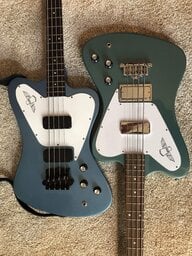
Massachusetts? Milliamps? Master of Arts? Madder of ‘ats? Mother of Allthunderbirds?If we can't talk MA...
View attachment 7101452

TalkBass has been independent since 1998. Add your voice.
Create a free account to reply to discussions, view embedded media, and browse with fewer display ads.
Join free Log in
Want zero display ads or expanded classifieds tools? Compare plans.
Massachusetts? Milliamps? Master of Arts? Madder of ‘ats? Mother of Allthunderbirds?If we can't talk MA...
View attachment 7101452
That’s over-rated.Thanks, Miles. One day I'll grow up instead of just old.

I just think he was hungry.Massachusetts? Milliamps? Master of Arts? Madder of ‘ats? Mother of Allthunderbirds?

I don't see why 1/8 phone jacks wouldn't solve the issue. It isn't like the jacks and cables need to handle huge ampacity loads.The problem, of course, is standards. You'd have to sell old->new adapters until the new standard reached critical mass, then sell new->old adapters. You'd really sell both all along, but the new->old would have very low sales at first (early adopters, newbies, etc.)
The RCA phono plug would take less space and provide better connections. The 1/8" / 3.5mm plugs like some headphones use are just smaller versions of the 1/4" phone jacks.
For those who don't know, they're called phone plugs / jacks because that's what the early switchboard operators used when plugging in to connect one line/extension to another. The first patents around these were filed in the early-mid 1890s. So it is, indeed, ancient tech back when the phone switch was an operator.

One of the weaknesses of most phone plug/jacks, regardless of size, is the minimal contact between plug and jack. If this is improved, and the cables are made sturdily, I'd have no objection to these for a new standard. You'd still want a really sturdy cable and plug between instrument, pedalboard/pedal if any, and amp.I don't see why 1/8 phone jacks wouldn't solve the issue. It isn't like the jacks and cables need to handle huge ampacity loads.

One of the weaknesses of most phone plug/jacks, regardless of size, is the minimal contact between plug and jack. If this is improved, and the cables are made sturdily, I'd have no objection to these for a new standard. You'd still want a really sturdy cable and plug between instrument, pedalboard/pedal if any, and amp.
Micro USB? AHEM"Is it in yet?"


yeah you got this volumetrically mondo connector with under 10 mils(?) of contact area lol....further, way overkill, .773 Vac @600Ohm (minimal current) has been the AES "full" volume std from day one......One of the weaknesses of most phone plug/jacks, regardless of size, is the minimal contact between plug and jack. If this is improved, and the cables are made sturdily, I'd have no objection to these for a new standard. You'd still want a really sturdy cable and plug between instrument, pedalboard/pedal if any, and amp.
ancay ouyay easeplay aysay atthay inyay englishyay ?yeah you got this volumetrically mondo connector with under 10 mils(?) of contact area lol....further, .way overkill, .773 @600Ohm (minimal current) Vac has been the AES "full" volume std from day one......

the connector is huge because it's meant to be constantly handled and cycled, the (max) current they (1/4" jacks) are meant to carry as defined by the internationally ratified electrical (AES = Audio Engineering Society) standards is 0dBm = full scale = volume maxed = 775 mV at 600 Ohms which draws just over 1mA.... nothing basically, today it's even less since 600Ohm systems have been replaced by 10k inputs since 70/100 Volt systems (old distributed PA systems as in schools and hospitals) have not been used in decades.....hope this is a little clearer?....sorry, I just cut to the chase with Miles...ancay ouyay easeplay aysay atthay inyay englishyay ?
uchmay easieryay otay understandyay , anksthaythe connector is huge because it's meant to be constantly handled and cycled, the (max) current they (1/4" jacks) are meant to carry as defined by the internationally ratified electrical (AES = Audio Engineering Society) standards is 0dBm = full scale = volume maxed = 775 mV at 600 Ohms which draws just over 1mA.... nothing basically, today it's even less since 600Ohm systems have been replaced by 10k inputs since 70/100 Volt systems (old distributed PA systems as in schools and hospitals) have not been used in decades.....hope this is a little clearer?....sorry, I just cut to the chase with Miles...
Oh ma ghunka ha.ancay ouyay easeplay aysay atthay inyay englishyay ?
Right? The cycling still makes sense with instruments and amps (other than those in practice spaces or dedicated stages) but not for pedal boards.the connector is huge because it's meant to be constantly handled and cycled, the (max) current they (1/4" jacks) are meant to carry as defined by the internationally ratified electrical (AES = Audio Engineering Society) standards is 0dBm = full scale = volume maxed = 775 mV at 600 Ohms which draws just over 1mA.... nothing basically, today it's even less since 600Ohm systems have been replaced by 10k inputs since 70/100 Volt systems (old distributed PA systems as in schools and hospitals) have not been used in decades.....hope this is a little clearer?....sorry, I just cut to the chase with Miles...
Thanks Mate!@dagrev
Happy Birthday Donnie!
Hip Hip Hooray!
Thank you, Sir.So it’s your birthday! Have a happy one Donnie!
Mad Adder, of course. Nasty things, those are.Massachusetts? Milliamps? Master of Arts? Madder of ‘ats? Mother of Allthunderbirds?
Right? The cycling still makes sense with instruments and amps (other than those in practice spaces or dedicated stages) but not for pedal boards.
The initial use case (switchboards) might see a plug or jack used more in a week to month than a touring rig sees in years.
Dude. Truer words..... The two guitarists I am playing with didn't have a functioning turner between them. I got so annoyed with the never ending tuning nonsense, I bought 2 cheap tuners on Amazon. They were both really happy with how much better we sounded as a band after using them....The beauty of a pedal board is that everything stays plugged in, other than the first input and last output, ideally all powered by a great power supply. Of course you have people like our guitarist who insists on using batteries and crap cables, so he's always wrestling with signal issues. Meanwhile I plug in and am ready to go. Never a problem, at least from my end.


