• TalkBass has been independent since 1998. Add your voice.
    Create a free account to reply to discussions, view embedded media, and browse with fewer display ads.
    Join freeLog in
    Want zero display ads or expanded classifieds tools? Compare plans.

Thunderbird Club

I wouldn't use a tuner up front and as part of the chain....you're then limited to the audio specification of a device that's used randomly....further, if you are using a passive bass with a long cable, the potentially augmented noise to signal ratio may confuse the tuner....FX loops are there for a reason.....
My signal chain is pretty easy. The wireless receiver is also a tuner. That comes first. The Broughton hi/lo filter comes second. Whatever else comes third or third and fourth. DI box comes last. There's no FX loop in my archaic technology. It's all linear and seems to work OK.
 
I wouldn't use a tuner up front and as part of the chain....you're then limited to the audio specification of a device that's used randomly....further, if you are using a passive bass with a long cable, the potentially augmented noise to signal ratio may confuse the tuner....FX loops are there for a reason.....
One of the reasons I went with the Korg Pitchblack was its true bypass switch. I haven't had any problem with 20 foot cables and Thunderbirds. YMMV.
 
So we will get reports on the befiore and after differences?
Yep, plan on some Garage Band samples. (Hey it’s what I have)

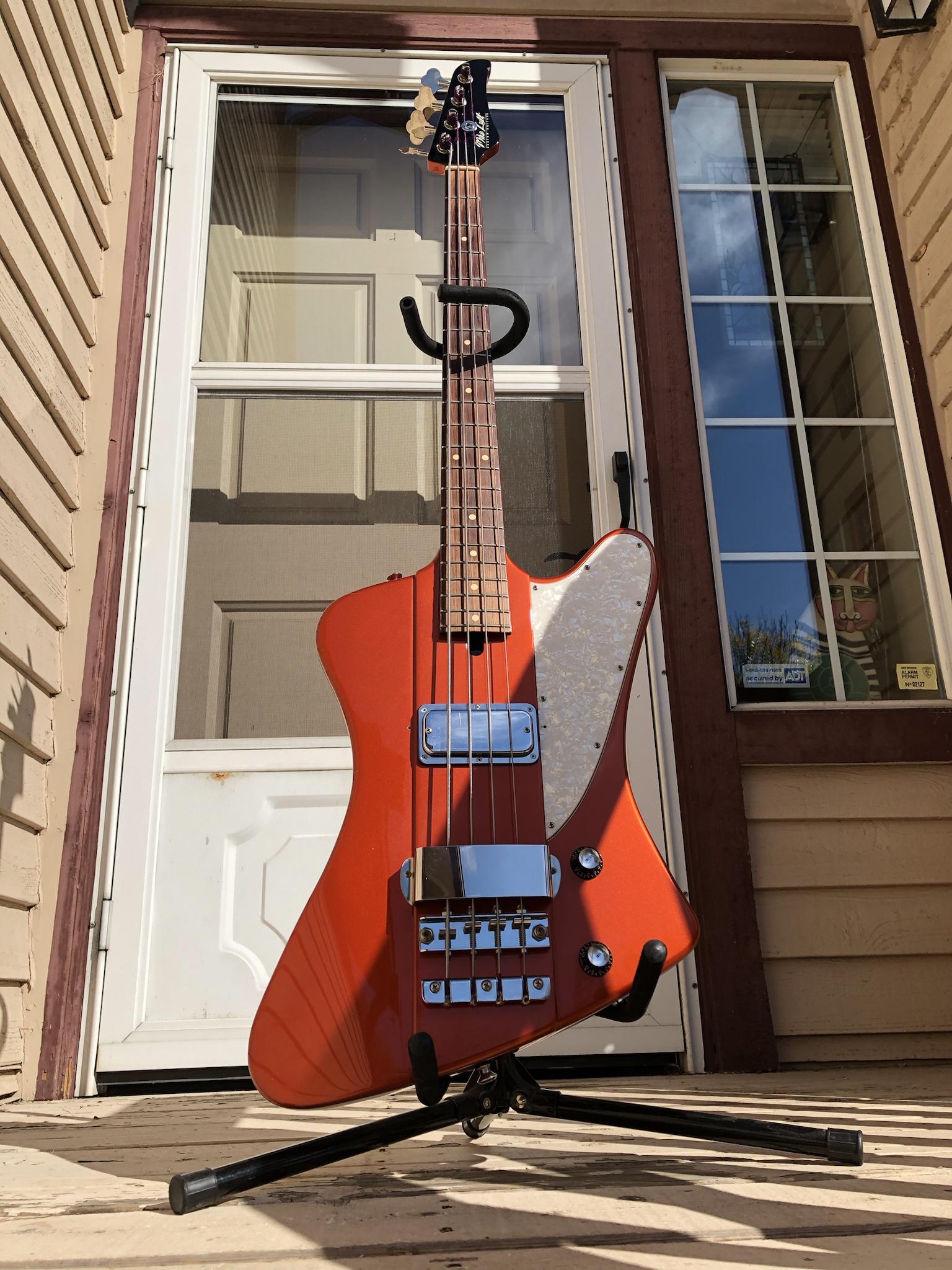
Purple Sparkle vs Ebony
Ebony w/ 760s vs 916 AlNeo’s

Will measure string to pickup top where the 760’s sit now: and try and match closely for the 916’s then sample after I find the sweet spot for them, and measure the final height.
 
I wouldn't use a tuner up front and as part of the chain....you're then limited to the audio specification of a device that's used randomly....further, if you are using a passive bass with a long cable, the potentially augmented noise to signal ratio may confuse the tuner....FX loops are there for a reason.....

You know, had not thought about that, as I use my Strobo Stomp mostly, and wireless (Shure GLXD) almost exclusively in a live setting. A 20 ft 20 year old Mogami cable as a backup and at home.

I retract my suggestion to put tuner first.
 
Loosely related, you might want to consider the Fender Mustang Micro headphone amp for silent playing. It plugs into the bass, you plug headphones into it, and it has bluetooth to stream audio to it so you can play along with it. It's been invaluable for me for practicing later at night in a NYC apartment.

Yeah, seems like a good idea. Especially for the living room, when my GF is off for the summer and I don’t want to wake her. I do have my Ampeg SGT-DI setup on my bench in the garage, ready to go for headphones, but it’s just the grab it and play it for a few minutes scenario that I’m talking about. That’s when I notice the little “less than perfect” playability of all my basses, whether it be strings for various tunings, and or action or other strange vibrations (like a loose bridge saddle), and adjust accordingly.
 
beauty....is that a 34" scale?...

Yes, yes!

nJKH2pz.jpg


7Bjkvoa.jpg
 
Would you say that your pickups have a strong magnetic pull?

I have almost all variety of boutique vintage style T-bird pickups in my ‘birds, including Lollar, Novak, Thunderbucker Ranch, Gemini UK, and Gibson re-issues. I had a set of Dunable D-Bird pickups that I put in my ‘99 Ebony ‘bird, and I spent A LOT of time trying to make that bass playable, including starting with a pro-setup, fret level, PLEK, and a second look from a second shop, but that friggen bass was a buzz monster… a kind of zingy buzz, especially accentuated with new Boomers. It made it no fun to play when not plugged into an amp. I frequently play my basses in the early mornings, just acoustically, so the fret buzz that is not normally noticeable when playing plugged into or especially with the band, is very noticeable. Then when trying a different set of strings, I noticed as a started to loosen the string it “snapped” down on the pickups. I took a small screwdriver and did an informal magnetic pull test on all my thunderbird pickups and found that the Dunable had a significantly stronger pull than the others. I drove the pickups down in the body and it seemed to help a little, but I wasn’t happy with how far away the pickups were from the string.

Since I had a set of Gemini UK “Devastators” sitting in their box waiting for my next (at that time, to be determined) Thunderbird, I decided to drop them in, and, almost immediately that bass was playing way better with no zingy buzz. I left those pickups in it and now it’s one of my best players.

The only other bass I have with this buzzy problem is my 2013 Gibson EB, which has the stock DeCola’s. These are also pickups with a very strong magnetic pull on the strings. Again with this one I drove the pickups deeper in the body, but it’s still “buzzier” than I like. That one stays at my rehearsal space and is only played with the full band at volume. It’s a great sounding bass for sure.

So, is there a way for you to compare the magnetic pull of your pickups to that of say a set of stock TB+ or Gibson Vintage Re-Issue pickups?
Magnetic pull is rated by gauss. I have scene a few different magnets used in T birds to try and get the gauss up in these t bird pickups. Some have had custom Alnico 8 magnets made. The only way for a comparison is if gauss readings can be taken from the other pickups. Most people do not have a gauss meter laying around so no readings available.

Reading in these pictures shows how much more gauss the small Neodymium magnets have than standard A5 T bird magnets and how much stronger the A5 is at the top of the pickup with the Neodymium under it. This was done to simply boost the factory pickup without changing it to much. There is also a custom build available that would stick out of the bottom of the cover like later Thunderbird pickups that have full sized Humbucker magnets. Shown in the 3rd picture. This also gets the gauss up and can be had with Neodymium or not
 

Attachments

  • IMG_20240114_103621236_HDR.jpg
    IMG_20240114_103621236_HDR.jpg
    615.1 KB · Views: 3
  • IMG_20240114_103635677_HDR.jpg
    IMG_20240114_103635677_HDR.jpg
    637.7 KB · Views: 4
  • IMG_20240113_133838155.jpg
    IMG_20240113_133838155.jpg
    841.9 KB · Views: 5
I wouldn't use a tuner up front and as part of the chain....you're then limited to the audio specification of a device that's used randomly....further, if you are using a passive bass with a long cable, the potentially augmented noise to signal ratio may confuse the tuner....FX loops are there for a reason.....
Makes great sense.
 
  • Like
Reactions: Chucky Stiletti
I think my concern is I’d want less gauss, since the problems I experienced with humbuckers with strong pull is what I’m trying to steer clear of. The Gibson vintage re-issue pickups don’t have a particularly strong pull but are plenty hot….
Hot is usually a reference to more winds on the coil. Not a reference to gauss. A overwound pickup is what most assemblers do since most are using pre made parts , do not make custom Parts or make custom magnet orders. We try not to use time doing the same thing others are doing