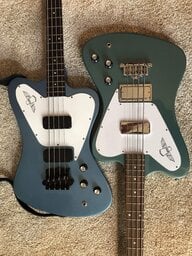
I even do it playing my headless Factorbird fretless which has zero neck-dive.

(no headstock, heavy solid Koa body) Aside from aiding neck-dive (at whatever level) on a standard T-bird, overlapping the jutting lower bout with your strap draws the guitar body to your body and stabilizes it so focused playing isn't being compromised/distracted by fighting the instruments ergonomics. Many T-bird players ride their basses lower which works for them, but playing one in a less R&R position benefits from this simple functional solution. I am well aware that playing a T-bird is all about how badass they look and sound, (and I 100% agree with that) so my addressing that particular design shortfall is only to offer advice to help make playing one more comfortable/enjoyable. Not slagging T-birds, why would I as a "dyed in the wool" T-bird player since 1974 when it was my only instrument? I would have to say I am one of the T-birds' greatest advocate, and as a designer/builder of basses I am keenly aware of how to make an instrument that makes playing it effortless. Most production basses have design compromises - as proof there is no
one design that everyone uses. Add to that the very active "modding" community which reinforces players making their chosen basses uniquely their own.
View attachment 7429101






 Glad to see this club still going strong.