
I am in desperate need of that AI.They have some AI going that makes you look better than the actual pic


TalkBass has been independent since 1998. Add your voice.
Create a free account to reply to discussions, view embedded media, and browse with fewer display ads.
Join free Log in
Want zero display ads or expanded classifieds tools? Compare plans.
I am in desperate need of that AI.They have some AI going that makes you look better than the actual pic

Trying to figure out what happened to my recording setup. No changes but now when the audio interface is plugged into Waveform, the vocals have virtually no volume. Unplug the interface and Waveform sounds perfect. Unfortunately, you need the interface to record the bass.......
So, I gave it shot hoping I could hear well enough to get something useful with the 64. Love CCR because the bass lines are simple and can be dumbed down if need be. The exported MP4 doesn't have the volume issues.

Yes, recording software.What is Waveform? A DAW?
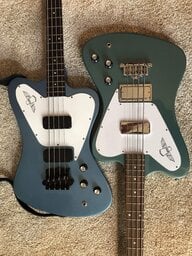
 You may have forgotten that you already posted the white one already. Just sayin'.
What type of interface and OS?Yes, recording software.

Well you’re a great player. I have two discs of yours that you graciously provided. I used them for reference, along with Brian’s and Ken’s, when setting up my new receiver recently. And FWIW, I’m proud to have you as a good friend too Geo. And everyone else here too.
Thanks for the kind words Marshall - it's been a real treat to spend time with you via this club.I read a short paperback book on Radiohead about how they got together up to their breakthrough LP "OK Computer". If you are a Radiohead fan, I highly recommend it. Bass-player Colin Greenwood (brother of Jonny Greenwood on guitar) used some of the money they got from that seminal LP sales to pay for bass lessons. That blew me away because I consider him one of my favorite bass players and that he used his well deserved riches to further his music knowledge just made me appreciate him and his playing more.
His playing on this is a good example of why I hold him in high regard -
Ever consider a cab stand when using one cab to get it up a little, or just not a problem needing to be solved?Let's Go!....
View attachment 7441536
Most likely Bullhide given when you said you bought them. Oddly enough bullhide was not always from a bull and often was used of extra heavy cow leather that was as durable. Generally it's a little more expensive than normal cow hide because there is less of it (either way), and it's more difficult to work with and had more waste. I've got a black like your's and a creme color Noc that might be my best fitting boots.Excellent question.
I'm essentially self taught. Took 'lessons' as a 13yr old for maybe a month first starting out. Learned by listening and reproducing. Tried to learn how to read many times in my life - it never stuck. (a left brain/right brain thing...) But lately I've realized that it's harder to play wrong notes. Not fatigued wrong notes, but understanding my fb instinctually so I don't often hit a wrong note in a progression. Something I now don't have to think about while playing - the first step to fully expressing yourself!Interesting. Gene Simmons did the same think with Carol Kaye. Was never into KISS, but I thought that was pretty impressive. He already made more in a year than she likely did her whole life and thought it important. Don't know how long it lasted.
Along the same lines, Neal Peart did the same thing and talked about what he leaned. Impressive from one the best drummers who likely will ever live. I don't recall who he took lessons from. A known jazz guy was all I recall.
Waveform Free audio editing software - mac, pc, linux - Tracktion SoftwareWhat type of interface and OS?
Same here. My bass lesson was a paper a guy drew for me with notes on the neck and Mary Had A little Lamb notes on the back. I kind of play be feel and what I hear in my head you might say. I never count. Well very, very rarely, even then I'm counting beats on the bass (thumps) for others if there is a longer and unnatural space between parts. But I have watched a handful of videos. Most are either over my head or something I already figured out to do.I'm essentially self taught. Took 'lessons' as a 13yr old for maybe a month first starting out. Learned by listening and reproducing. Tried to learn how to read many times in my life - it never stuck. (a left brain/right brain thing...) But lately I've realized that it's harder to play wrong notes. Not fatigued wrong notes, but understanding my fb instinctually so I don't often hit a wrong note in a progression. Something I now don't have to think about while playing - the first step to fully expressing yourself!
So in my way of seeing it - we never can have enough learning. Not only learning the instrument we play, but learning what our voice is and being able to capitalize on it in a positive, creative way through our playing.
I read a short paperback book on Radiohead about how they got together up to their breakthrough LP "OK Computer". If you are a Radiohead fan, I highly recommend it. Bass-player Colin Greenwood (brother of Jonny Greenwood on guitar) used some of the money they got from that seminal LP sales to pay for bass lessons. That blew me away because I consider him one of my favorite bass players and that he used his well deserved riches to further his music knowledge just made me appreciate him and his playing more.
His playing on this is a good example of why I hold him in high regard -
IMO a musician is someone always growing their knowledge and skill base. Like McCartney, who learned by coping Jamerson early on and later Bruce, Squire, JPJ, and others who fed off him and vice versa. They pushed each other. Bass guitar is still a young instrument in the overall scheme of things. Bass players are a community in and of themselves. They are usually the coolest player in the band. And deservedly so.Interesting. Gene Simmons did the same think with Carol Kaye. Was never into KISS, but I thought that was pretty impressive. He already made more in a year than she likely did her whole life and thought it important. Don't know how long it lasted.
Along the same lines, Neal Peart did the same thing and talked about what he leaned. Impressive from one the best drummers who likely will ever live. I don't recall who he took lessons from. A known jazz guy was all I recall.
Yah, you want to feel good/identify with the artists you respect and Colin is that player for me.That is excellent.
I came from piano. Started with the ubiquitous Hal Leonard book. Chords and keys.I'm essentially self taught. Took 'lessons' as a 13yr old for maybe a month first starting out. Learned by listening and reproducing. Tried to learn how to read many times in my life - it never stuck. (a left brain/right brain thing...) But lately I've realized that it's harder to play wrong notes. Not fatigued wrong notes, but understanding my fb instinctually so I don't often hit a wrong note in a progression. Something I now don't have to think about while playing - the first step to fully expressing yourself!
So in my way of seeing it - we never can have enough learning. Not only learning the instrument we play, but learning what our voice is and being able to capitalize on it in a positive, creative way through our playing.
If you listen to the best bass-players of all genres - why we are drawn to them is because they service the song. They get inside it, they surround themselves in it - then they nail it. Any time I can be part of that is a good (rehearsal/performance) day.
I envy you - I listen to Kirstin & Paul, and Cherie & Paul fluently converse music (chords & keys) and I'm so humbled.I came from piano. Started with the ubiquitous Hal Leonard book. Chords and keys.
Look up Greg’s Bass Shed. Unpretentious, a nice guy, a little nerdy, and very easy to communicate with. His transcriptions are great. His lessons are unhurried and to the point. His British Blues series and walking lessons are excellent. As are his song tutorials.Same here. My bass lesson was a paper a guy drew for me with notes on the neck and Mary Had A little Lamb notes on the back. I kind of play be feel and what I hear in my head you might say. I never count. Well very, very rarely, even then I'm counting beats on the bass (thumps) for others if there is a longer and unnatural space between parts. But I have watched a handful of videos. Most are either over my head or something I already figured out to do.
One thing I always wanted to be good or better at is walking blues bass lines. I can do it, but it doesn't sound as well thought out as it could. But I really don't have a need for it so I don't get to use it unless playing along with a recording.
And I you. If only I had a tenth of your skill. It has been a journey relearning stuff I knew fifty years ago.I envy you - I listen to Kirstin & Paul, and Cherie & Paul fluently converse music (chords & keys) and I'm so humbled.
When I got my hat years ago I intentionally didn't want a Stetson because that's what everyone was buying. And, I liked what I found in the Bailey (light gray). Not at thing wrong with Stetson. Fantastic hats and the history to prove it.
In 1922, George S. Bailey, a mid-western man with a penchant for hats, founded the Bailey Hat Company in Los Angeles, California. Bailey saw the emerging need for a hat company that not only catered to the West Coast market, but one that also catered to the Western wear market. George Bailey saw a vast and as yet, untapped customer base in southern California and dedicated himself to providing those customers with fine quality hats and great styling.
The American west was booming, and Los Angeles was leading the charge. A population explosion was underway and due to the proliferation of cattle ranches, farms, mines, oil fields and, of course, movies, southern California’s economy was growing at a breakneck pace. Los Angeles-based film studios accounted for nearly one-fifth of California’s annual manufacturing business in the early ‘20s and it was there that George Bailey would start his business. He catered directly to the needs of the ‘New West’ outfitting southern California ranchers, businessmen, oil tycoons, and the newest segment of the population, movie stars, with ‘the best hat possible’.
Today, Bailey design explores the juxtaposition of Hollywood elegance and Western toughness and is influenced by both directional culture and fashion that serves as a unique framework for original design. The collection consists of timeless products that customers buy again and again as well as cultural statement pieces that are unique and packed with style.


