Original note posted on different forum from @Tim Skaggs
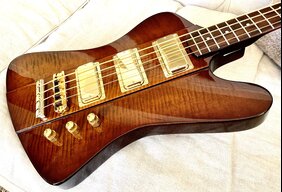
I have a stock / original ‘91 Gibson Thunderbird that has 60 Hz hum like a Jazz Bass with two bridge pickups.
It’s shielded to death with conductive paint AND aluminum shielding tape in the control cavity and the pickup cavities. Everything is grounded and has been checked with a meter to verify good continuity.
The internet says the original ‘91 TBirds have “humbuckers” in both neck & bridge positions. I have my doubts about that. Either one of the pickups turned on, or both on
and it hums to high heaven.
The wires from both pickups are single conductor with a shield, and both the shield and the single conductor make up the electrical connection to the pickups. The wire goes into an epoxy glue filled back about of the pickups so there’s no way to visually confirm anything with the pickups.
I’m tempted to wrap both pickups in aluminum foil to see if it helps, but it would probably keep them from picking up the string vibration and they would probably still hum…
Anyone have any info on ‘91 Tbird pickups? Are they really single coils?
It wouldn’t be the first time. I also have a Gretch Electromatic 220 that the manufacturer claimed for 10 years had humbuckers & then @LowEndLobster discovered otherwise.
GBassNorth response…
I don’t know for a fact, but I suspect they are humbuckers. My 1991 Gibson Tbird 3 is all humbucker.
Keep in mind, many humbucker pickups can also be wired in single coil by the factory or owners. The easiest way to check if your pickups are wired in humbucker mode is to do a tap test on each pickup.
How to do a tap test:
Connect bass output jack to your amp and power on.
Turn your on board tone knob to full bright.
Turn your on board volume up about halfway.
Note:
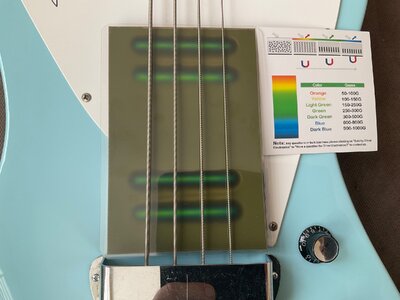
Most Thunderbird humbuckers will have two magnetic bars or banks of poles that run the width of the pickup. One magnetic bank on the neck pickup will be nearer the neck (north bank) and the other magnetic bank will be nearer the bridge (south bank). This applies to the bridge pickup as well. You can see the magnetic fields caused by the bars in these pics below…
View attachment 7460399View attachment 7460400
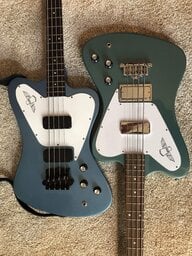
The Thunderbird exception would be the bicentennial model (made from 1976 to 1979), it’s a totally different beast called a sidewinder.
Using a screwdriver lightly tap the tip of the driver against the neck pickup cover near where the string crosses over the pickup, maybe as much as a half inch back from the leading edge of the pickup. Do this at each string area for the north bank of the neck pickup. You should hear an audible pop or clack as you tap the pickup cover with the screwdriver at each string area along the length of the north bank of the neck pickup. If so, you have confirmed that magnetic bank is active, and you have at the very least a single coil pickup. If you hear no sound you have confirmed that magnetic bank is dead or not there or not wired into the volume pot.
Now do the exact same tap test across the south bank of the neck pickup at each string (maybe as much as half an inch before the bridge side of the neck pickup) to confirm it’s active as well. If you hear an audible pop or clack when you tap the screwdriver in this area under each string you have confirmed the South bank is in fact there and working.
If both the north and south magnetic banks respond to the screwdriver tap test with an audible pop you have confirmed your neck pickup is built and wired as a humbucker. If for some reason you only get an audible pop across one of the two banks but not the other you have confirmed that your pickup is either a single coil pickup or a humbucker wired as a single coil.
Repeat the same test with the bridge pickup (be sure to turn its volume on first).
You should find you have two functioning humbuckers wired and operating in humbucker mode. If so, you can rule out the hum source as being caused by single coil pickups. If you in fact have single coil pickups or pickups acting like single coils in the tap test then post a picture of the inside of your control cavity so we can see how it’s wired.
If you have confirmed working humbuckers are in place but still have noticeable hum it is quite possibly a grounding or external interference problem.
Common Grounding problems…
Thunderbirds equipped with the three point bridge are grounded on the rear treble side bridge body insert. If that insert has ever pulled loose in the past (not common on Gibson basses but it does occasionally happen) it may have been reinserted and glue added that is insulating the ground wire from the anchor. This can easily cause a hum.
Nylon or coated strings will on rare occasions cause a grounding issue as well.
A grounding wire not properly attached to each pot and the shielding inside the control cavity can cause a grounding issue.
Common External interference problems…
This can come from fluorescent or neon lighting, noisy circuits, bad house wiring, proximity to high power lines and transformers, proximity to exceptionally strong radio signals, and proximity to cell phones and mobile devices.
Hope this helps, we want happy bird owners in this club!