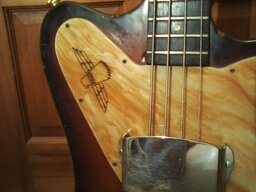
OK, it's "fuzzy". Wuddya want from a flip phone. Happy Thunderbird(s)Thursday!

TalkBass has been independent since 1998. Add your voice.
Create a free account to reply to discussions, view embedded media, and browse with fewer display ads.
Join free Log in
Want zero display ads or expanded classifieds tools? Compare plans.
I don't know if I agree but I don't think the average player could hear the difference either so I'm not disagreeing either. I'm one of those people who strongly believe in the wood you make a guitar out of does affect the sound (to a very small degree). The strings don't vibrate in isolation they interact with the neck as a whole which in turn vibrates and affects how the strings themselves vibrate as part of the whole system. Possibly the fact that a fingerboard had been glued on has more affect than the type of timber it's made from?I'll be interested in your experience with these. My personal inclination is that fingerboard timber has no real effect on tone, as the string is vibrating between the nut/fret and bridge saddle. The only differences are in the 'feel' under the fingers, ie the grain and whether or not it is lacquered.
I'll be interested in your experience with these.
The price for the Rosewood is slightly more expensive than real Rosewood but it doesn't come under the CITES regulations and no tropical rain forest was harmed in their making.Interesting! How does the price compare to that of the real thing?

Are you staining the one in the last pic?I hate dual truss rods, they really weaken a headstock joint, I think they create more problems than they solve. My necks are usually 5 laminates of straight grained quarter sawn which should be stable as a single piece.
Again out of interest I received two fret boards this morning, tell me what you think of the quality and more importantly what they are
View attachment 3011522
View attachment 3011523
View attachment 3011524
What kind of power are you looking at?More thinking about the tower of jank. I already have a ToneHammer, which is a preamp. I don't see any reason I can't hijack a 100 watt or so Class D power amp from a stereo or even a car stereo to power the tower. If it costs more than about $50, I may as well just spend the money and get a used real bass head, though.
Probably can't bridge that. Is that new? Be nice to have Dynaco around again..Seriously, one of these might be really cool. But i know it won't be in the right price range.
View attachment 3011785
View attachment 3011786
No, it's just water to give an idea of how it would look when oiled. It behaves in the same way as real Rosewood, very very impressive stuffAre you staining the one in the last pic?
I've mentioned you into a post above this, I'd be very interested to hear your thoughtsI had a 2008 American Jazz bass with graphite rods nice enogh but rather sterile. I put a Road Worn Jazz Bass neck on it and it came alive. I much preferred it.

Getting the PG to fit the 76 buckers on my 2013 done. Turns out it looks really cool without a PG. I think it would look rad without the PG, all the black hardware and black nylons or rounds...

I don't know if I agree but I don't think the average player could hear the difference either so I'm not disagreeing either. I'm one of those people who strongly believe in the wood you make a guitar out of does affect the sound (to a very small degree). The strings don't vibrate in isolation they interact with the neck as a whole which in turn vibrates and affects how the strings themselves vibrate as part of the whole system. Possibly the fact that a fingerboard had been glued on has more affect than the type of timber it's made from?
It doesn't harm the wood huh?No, it's just water to give an idea of how it would look when oiled. It behaves in the same way as real Rosewood, very very impressive stuff
It's not wood, well it has wood in it. It's longs fibres of wood aligned and soaked in resin before being cast I suppose. After the wetting had dried there was no fingerprint of the water at all, no marks, no raised grain, no colour bleed nothingIt doesn't harm the wood huh?

I would actually suspect the anesthesia. The explanation is way too sciencey for here. (And I am rarely reluctant to provide a sciencey answer)
I work in an anesthesia department

4 1/8" walnut veneers, just a decorative stripe
My Epiphone in this case which uses standard veneer but same thing
View attachment 3009982 the 5 main laminates are Mahogany
I work in an anesthesia department, and seriously doubt that...
Most modern anestetic drugs used today are metabolised very fast and don't give such a late allergic response. Since most anestetic drugs are either administered iv or inhaled (except nerve blocks, which are local), you will see an allergic reaction almost immediately. If a drug was accidentially administered subcutaneous you might see a local reaction - But then you wouldn't be administering an iv line on the arm having surgery.
Some local anestetic drugs used for nerve blocks may give an allergic reaction - But I've never seen this occur that late after surgery, as it usually occurs shortly after the block.