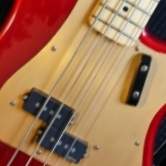
hello again T-Bird fellows. Can anyone point me to a place that I can get a routing template for T-Bird pickups? I am considering installing a set of Deep Sixx pickups in a Squier Jazz for fun.

TalkBass has been independent since 1998. Add your voice.
Create a free account to reply to discussions, view embedded media, and browse with fewer display ads.
Join free Log in
Want zero display ads or expanded classifieds tools? Compare plans.
hello again T-Bird fellows. Can anyone point me to a place that I can get a routing template for T-Bird pickups? I am considering installing a set of Deep Sixx pickups in a Squier Jazz for fun.



You're not supposed to use a dead blow hammer and a flat head screwdriver?

Me at school battle of the bands with my Epiphone Thunderbird Pro V.

"So I got to compare a set of my 66s against CBs. They measure out a
little different
Pup R L Q
66N 8.635 3.713 2.095
CBN 8.420 3.031 1.801
66B 9.231 4.371 2.267
CBB 9.382 4.026 2.054
I get a little more L for R than they do, that could be a difference
in the mag perm of their magnets. I'd expect my N to be a bit louder
than theirs due to the large diff in L.
That does show up in the VU meters once recorded.
66 NB pair -5.9
CB NB pair -5.4
66N -3.2
CBN -6.9
Their N seems a little quieter and brighter than mine. I could easily
unwind mine a little to get the same."


They're also closer to vintage specs than China Buckers. I sent a pair to Steve (ThunderBucker) to scope:
"So I got to compare a set of my 66s against CBs. They measure out a
little different
Pup R L Q
66N 8.635 3.713 2.095
CBN 8.420 3.031 1.801
66B 9.231 4.371 2.267
CBB 9.382 4.026 2.054
I get a little more L for R than they do, that could be a difference
in the mag perm of their magnets. I'd expect my N to be a bit louder
than theirs due to the large diff in L.
That does show up in the VU meters once recorded.
66 NB pair -5.9
CB NB pair -5.4
66N -3.2
CBN -6.9
Their N seems a little quieter and brighter than mine. I could easily
unwind mine a little to get the same."
As they say in auto racing, the last 10% of performance cost 90% more.
ThunderBuckers sound more 'musical' to me. There's more harmonic content compared To CBs, probably due to how they're wound. ThunderBuckers are hand scatter wound, CBs probably by machine. (BTW Chinabuckers are shipped from Heilongjiang which is about as far north of Hong Kong as you can get.) No electronics get made in HK these days, land is too expensive for factories.
Luckily, I don't have to compromise, the basses I build get ThunderBuckers.


I get that R = Resistance, but what does L and Q stand for?

I'm also curious. There's a lot of technical information I don't know about, and being a geek, I'm curious.Thank you...I was afraid to ask,lol
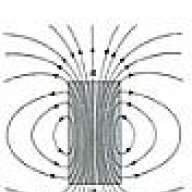
L is inductance, the resistance to a change in current flow. It is affected by number of turns squared, and any permeable (iron-like) materials in the magnetic circuit. In this case, mostly the recoil permeability of the alnico magnets (how much they act like iron to a magnetic field)(ferrite magnets don't act like iron at all, they act like air). Q is the ratio of the inductive reactance to the pure DC resistance of the coil. A perfect inductor would have no resistance at all and an infinite Q. Q is also affected by losses in the magnetic circuit, which is mainly eddy current losses in the alnico magnets.I'm also curious. There's a lot of technical information I don't know about, and being a geek, I'm curious.

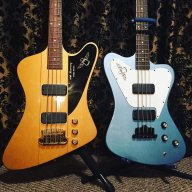
A couple of the birds got some playtime this weekend...
This photo was taken during soundcheck
View attachment 886578
Cool pics) Mike Lull?
Plus an explanation of how it works. That's priceless, in my opinion.L is inductance, the resistance to a change in current flow. It is affected by number of turns squared, and any permeable (iron-like) materials in the magnetic circuit. In this case, mostly the recoil permeability of the alnico magnets (how much they act like iron to a magnetic field)(ferrite magnets don't act like iron at all, they act like air). Q is the ratio of the inductive reactance to the pure DC resistance of the coil. A perfect inductor would have no resistance at all and an infinite Q. Q is also affected by losses in the magnetic circuit, which is mainly eddy current losses in the alnico magnets.
In this case, the CBs seem to be getting less L for equivalent resistance, which is turns basically. Maybe the coils aren't wound as tightly (that would raise R per turn) or their magnets have higher eddy current losses. Either way the differences aren't large. Mainly what I offer is different winds and some customization.
Plus an explanation of how it works. That's priceless, in my opinion.
Plus a sound clip comparison. Same bass, same strings, same setup. ThunderBuckers are 1 & 3


I've seen 'angry piano' a lot through this thread.
Has anyone got a clip that they can point me to?