
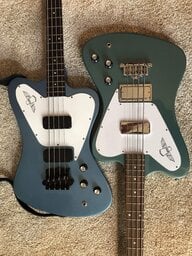
Fender first made the Jaguar bass in 2005 (and mine has a 2005 serial number). It must have been something else, with a shape similar to a Jaguar guitar or Jazzmaster guitar.Almost bought one of these new in '96 - cool basses but especially with your pu upgrade.

Enjoy the benefits of a premium membership!
Upgrade Account
-
TalkBass has been independent since 1998. Add your voice.
Create a free account to reply to discussions, view embedded media, and browse with fewer display ads.
Join free Log in
Want zero display ads or expanded classifieds tools? Compare plans.
You are using an out of date browser. It may not display this or other websites correctly.
You should upgrade or use an alternative browser.
You should upgrade or use an alternative browser.
Thunderbird Club
- Thread starter TBird1958
- Start date
-
- Tags
- club thunderbird
More options
Who Replied?

I’m with you on this. Gibson has been making guitars with 2 piece bridges since the 1950s. It’s not difficult or risky to locate them in the correct spot on a bass. Either they are using some existing bodies/bridges, or they just don’t care enough to make the change.I don't buy it, with computer modeling, CNC manufacturing and a very good two piece bridge available I call it unresponsive at best. The dislike for the three point isn't exactly news to anybody...........even Gibson.

Told you guys not to bitch about the three point.....
I’m not. I’ll still get one.Told you guys not to bitch about the three point.....

- Jun 30, 2010
- 49,587
- 221,942
- Disclosures
- musician/artist/owner - Gildaxe
that is true, however, that was in the final spasms of Henry-ownership. I know they stopped production of the SG-bass and Thunderbird around 2015 because the warehouse was filled to the roof with them, and had enough stock to last at least 2 years of demand. It’s not too far fetched (I.e. believable) the same happened with the non-rev T-bird.
For sure - it was the same for transitional Fender to CBS in '65. A '66 and probably '67 and some '68 Fender basses were the same as a "pre-CBS" at twice the ("collectors") price.
Last edited:
- Jun 30, 2010
- 49,587
- 221,942
- Disclosures
- musician/artist/owner - Gildaxe
Told you guys not to bitch about the three point.....
3-point bridge is the new neck-dive


Agree.
I suspect the threepoint decision on the new NR was driven largely by a combination of supplier cost for the bridge, installation cost of the bridge and ease of meeting quality control standards with the more forgiving threepoint. Don't forget, there were a slew of Epiphone Embassy basses with the new two piece bridge that wouldn't intonate properly - many of which were probably returned to the store for a refund. IIRC to a lesser degree it even happened with some of the Thunderbird VPs. And it's not a cheap fix to correct it.
If I worked in the product supply chain at Gibson I'd ask which bridge can I get cheaper (probably the three point, maybe not by much though), what are we already tooled for (pretty much the three point but not a huge deal to change this tooling), what's our QC failure rate with the three point (probably approaching zero out the door) vs the two piece (significantly higher, including returns, reimbursements, bad press and potentially lost customers - very big deal, especially to a company trying to improve its image). Kind of a no brainer.
Which is still stupid. It’s not hard to get the bridge right. If I can do it, they sure can.

- Mar 13, 2008
- 18,894
- 142,206
- Disclosures
- Endorsing Artist Mike Lull T Bass pickups, The Bass Shop, Seattle WA.
Told you guys not to bitch about the three point.....
Never been a problem just be as smart as the thing you're trying to adjust.
3-point bridge is the new neck-dive
Meet the new neck dive, same as the old neck dive!
Absolutely unresponsive at best, and possibly risk averse as well. Not uncommon in a work environment where people are focused on keeping their job vs doing what's right. Not sure if that environment still exists at Gibson but it sure did under the old leadership.I don't buy it, with computer modeling, CNC manufacturing and a very good two piece bridge available I call it unresponsive at best. The dislike for the three point isn't exactly news to anybody...........even Gibson.
...and yet they (Epiphone) totally screwed up the installation and sent countless Embassy basses out the door in the last couple of years with an incorrectly located bridge making it impossible to intonate. Returns were significant, profits were lost, consumers weren't happy and their image was further tarnished. They managed to do this in spite of computer modeling, CNC manufacturing and a perfectly good two piece bridge. And yes there have been some TBird VPs with similar issues, fortunately not many.I’m with you on this. Gibson has been making guitars with 2 piece bridges since the 1950s. It’s not difficult or risky to locate them in the correct spot on a bass. Either they are using some existing bodies/bridges, or they just don’t care enough to make the change.
I personally love the two piece bridge and really wish they had put it on the new Gibby. But coming from a corporate product design background I can easily imagine a design meeting where someone suggests using the VP bridge and a senior manager whose more concerned with losing his job and wants to avoid risk responds with - "Are you aware how many Epiphone Embassy basses we had to eat last year because of that stupid bridge, we aren't going down that path!"
Of course we'll never know the logic they used for sure. They had a good option and chose not to use it, likewise one would think they are perfectly capable of properly installing the two piece but they in fact failed that task on a significant number of basses as well. Looks to me like the three point was the safe option and easy path. I can live with it, it's a perfectly functional bridge, just wish they had gone the extra yard and used the two piece.
- Jun 30, 2010
- 49,587
- 221,942
- Disclosures
- musician/artist/owner - Gildaxe
Never been a problem just be as smart as the thing you're trying to adjust.
Meet the new neck dive, same as the old neck dive!
For sure - owning a non-Fender bass has its own idiosyncratic things that we put up with. That's part of why Fender gets scorn from players, because it's meat & potatoes - it simply works. I'm not pro or anti either - all varieties have their own qualities and unique sonic footprint. But it cracks me up that when design comes to a zenith - it is viewed (by some) as passe! Hail the triumph of opinion!


Agree.
I suspect the threepoint decision on the new NR was driven largely by a combination of supplier cost for the bridge, installation cost of the bridge and ease of meeting quality control standards with the more forgiving threepoint. Don't forget, there were a slew of Epiphone Embassy basses with the new two piece bridge that wouldn't intonate properly - many of which were probably returned to the store for a refund. IIRC to a lesser degree it even happened with some of the Thunderbird VPs. And it's not a cheap fix to correct it.
If I worked in the product supply chain at Gibson I'd ask which bridge can I get cheaper (probably the three point, maybe not by much though), what are we already tooled for (pretty much the three point but not a huge deal to change this tooling), what's our QC failure rate with the three point (probably approaching zero out the door) vs the two piece (significantly higher, including returns, reimbursements, bad press and potentially lost customers - very big deal, especially to a company trying to improve its image). Kind of a no brainer.
I don't buy it, with computer modeling, CNC manufacturing and a very good two piece bridge available I call it unresponsive at best. The dislike for the three point isn't exactly news to anybody...........even Gibson.
I’m with you on this. Gibson has been making guitars with 2 piece bridges since the 1950s. It’s not difficult or risky to locate them in the correct spot on a bass. Either they are using some existing bodies/bridges, or they just don’t care enough to make the change.
Absolutely unresponsive at best, and possibly risk averse as well. Not uncommon in a work environment where people are focused on keeping their job vs doing what's right. Not sure if that environment still exists at Gibson but it sure did under the old leadership.
...and yet they (Epiphone) totally screwed up the installation and sent countless Embassy basses out the door in the last couple of years with an incorrectly located bridge making it impossible to intonate. Returns were significant, profits were lost, consumers weren't happy and their image was further tarnished. They managed to do this in spite of computer modeling, CNC manufacturing and a perfectly good two piece bridge. And yes there have been some TBird VPs with similar issues, fortunately not many.
I personally love the two piece bridge and really wish they had put it on the new Gibby. But coming from a corporate product design background I can easily imagine a design meeting where someone suggests using the VP bridge and a senior manager whose more concerned with losing his job and wants to avoid risk responds with - "Are you aware how many Epiphone Embassy basses we had to eat last year because of that stupid bridge, we aren't going down that path!"
Of course we'll never know the logic they used for sure. They had a good option and chose not to use it, likewise one would think they are perfectly capable of properly installing the two piece but they in fact failed that task on a significant number of basses as well. Looks to me like the three point was the safe option and easy path. I can live with it, it's a perfectly functional bridge, just wish they had gone the extra yard and used the two piece.
I don't disagree with any of the above. But I think the unit of analysis is wrong.
Go back a couple of years - Gibson filed for bankruptcy and was restructured with equity swapped for debt. Debt holders took control of the company. Debt investors are quite different from equity investors. Debt investors NEVER want to lose money on a bond. They don't care if they are making almost nothing as long as the principle is secure. Equity holders on the other hand are happy to take some risk; losses on one stock are made up for with the out-sized returns on another; a luxury available to debt holders.
You now have a Gibson with a board of directors controlled by debt holders who were forced to accept equity. They are already feeling wounded and will be very risk averse. So I am betting that every Gibson design is being signed off by the Board of Directors and they are being very cautious (never another debacle like robo-tuners on everything, or Firebird X). So a board that saw returns on the Embassy for a two piece bridge is not going to approve that again.
Contrast to how I suspect things are currently going at 7ender. Board sees a new design and asks about incremental sales and incremental operating profit, caring little about the specifics of design (although probably not going to sign off on another Dimension any time soon).
In time, when the Gibson debt holders have made back their money and are cycling out of the investment and off the board, there will be the opportunity to get a bit more experimental. But that time is not now.

Gaolee
Official leathers tester and crash dummy
I want a chrome Squier badge on all of them. It just doesn't fit.That means a lot, coming from a self-professed shallow person.

I think that wall is plumb now. Go ahead and nail it!Yes indeed!
View attachment 4139862


- Jun 30, 2010
- 49,587
- 221,942
- Disclosures
- musician/artist/owner - Gildaxe
Fender first made the Jaguar bass in 2005 (and mine has a 2005 serial number). It must have been something else, with a shape similar to a Jaguar guitar or Jazzmaster guitar.
Sorry, (my bad) not '96 - but '06... introduced in June of '05 (as Fender does 1/2 year launches) I went to buy one in December '06 and ended up getting the '51 P RI of the same product launch. I ended up hating the mustard colour and buzzy single-coil so did a total redefinition of the bass.
Wow!!!View attachment 4140085
'65 TBII, 66 Embassy, '67TBIV, '68TBII, '72LP, '72EB4 (modded by a previous owner)
View attachment 4140086
'76 or '77, '77, '76, '77, '79, '86
View attachment 4140090
'80, '01, '03, 05
View attachment 4140095
'71 SB400, early Ibanez Ripper project (original pickups looked like mud buckers but the previous owner let it sit in a leaky car trunk for two years and the electronics were ruined), '72 EBL currently waiting restoration with modern SG bass pickups (that mud bucker lives in an RD Artist in Scotland now).
View attachment 4140097
'75 Ibanez (bolt on neck, one of the best recording birds I've ever owned), '77 Greco TBII, '88 Greco TBIV, Epi Japan TB IV (not sure what year)
Some of these dates are approximate or based on foggy memory.
It was suggested I share these again (some of you will remember these photos). Once upon a time I went through a bit of a collecting phase and in 2005 this was my Gibson (and Gibson adjacent) contingent. I still have 8 of these, but the rest were sent off into the world. I regret selling a few of them, but am mostly grateful I got the chance to own and play them for a few years.
Some Embassy ('64) love back at you!
- Jun 30, 2010
- 49,587
- 221,942
- Disclosures
- musician/artist/owner - Gildaxe
I think that wall is plumb now. Go ahead and nail it!
It's plum nailed!
- Mar 13, 2008
- 18,894
- 142,206
- Disclosures
- Endorsing Artist Mike Lull T Bass pickups, The Bass Shop, Seattle WA.
For sure - owning a non-Fender bass has its own idiosyncratic things that we put up with. That's part of why Fender gets scorn from players, because it's meat & potatoes - it simply works. I'm not pro or anti either - all varieties have their own qualities and unique sonic footprint. But it cracks me up that when design comes to a zenith - it is viewed (by some) as passe! Hail the triumph of opinion!
Recently on the Seattle Area Bass Players FB a member (he's quite the bass virtuoso ) came up with the phrase "Dad Tone" and put together a 10 second video about it, hilarious!
- Jun 30, 2010
- 49,587
- 221,942
- Disclosures
- musician/artist/owner - Gildaxe
Recently on the Seattle Area Bass Players FB a member (he's quite the bass virtuoso ) came up with the phrase "Dad Tone" and put together a 10 second video about it, hilarious!
Fill us in, what's "dad tone?"
- Mar 13, 2008
- 18,894
- 142,206
- Disclosures
- Endorsing Artist Mike Lull T Bass pickups, The Bass Shop, Seattle WA.
Fill us in, what's "dad tone?"
I'm quoting, "innovate not, question nothing, Dad Tone!" "Jaco only needed four, slapping is for ***holes" Dad Tone!
Told you guys not to bitch about the three point.....


