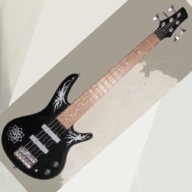
I'm going to try a serious answer, even though this is a subject that causes much eye rolling, usually justified.
As has been pointed out, the woods in a solid-body instrument don't affect tone nearly as much as other factors. However, the most-pointed attack and greatest sustain result from materials which do NOT resonate with the strings. You would want materials which do not absorb vibrations. Furthermore, "tone" can be affected by which frequencies the neck and body absorb.
Because necks are subject to much more flexing than bodies, a stiff neck is your first consideration. After that, any stiff-wooded body should be fine.
Thank you for posting this.
Also, sound is not going to bounce around the guitar and constructively interfere with the strings and make some tones louder - it's purely subtractive for all reasonable considerations. 'Resonant' bodies are ones that vibrate enough for you to hear them but in general resonance is another way of saying you have nothing left to lose, I mean another way to say you are heating the guitar up slightly.
In theory you can apply a notch filter to get the characteristics of a resonant body IF you have a full signal to send, and indeed it's what some effects units do. For most solid body guitars, as evidenced by innumerable tests, it's pretty much undetectable, though, and I'd worry much more about pickups.
Just the effect of a humbucker with single coil options shows the power of pickup changes, along with amp settings and other factors. A friend with an Aria Les Paul guitar would complain that as soon as I picked it up I'd select just the bridge pickup, select just one coil, slap some spring reverb on the amp and make it sound almost like my Telecaster. It suited me, though.

 ).
).