
Enjoy the benefits of a premium membership!
Upgrade Account
-
TalkBass has been independent since 1998. Add your voice.
Create a free account to reply to discussions, view embedded media, and browse with fewer display ads.
Join free Log in
Want zero display ads or expanded classifieds tools? Compare plans.
You are using an out of date browser. It may not display this or other websites correctly.
You should upgrade or use an alternative browser.
You should upgrade or use an alternative browser.
Tone wood
- Thread starter doomprophet8
- Start date
More options
Who Replied?

If you look here (someone did the science for us), you'l find that shellac and polyurethane both let moisture through - in a month they both approach equilibrium when put in a humid environment:
https://pdfs.semanticscholar.org/bab4/0086457939ac609cbfc48cc11fe5e8763c81.pdf
I'll heartily recommend you consider a torrified (aka roasted) neck if humidity swings are causing you issues. I have a few roasted necks, and they are more stable than standard ones. I do apply poly finishes them, but that's mostly to keep the dirt from crawling into the grain.
Thanks! That's good and useful information.
I intend to build my next bass myself, will most likely use "thermo-treated" wood (it's a process invented here in Finland that apparently makes the wood very similar to naturally aged wood). Something like torrification, but a little more complex with more steps to it using a pressure, heat and moisture controlled "oven". Juha Ruokangas (Ruokangas Guitars) makes extensive use of the process.
I like shellac for many reasons, it has some interesting properties and when applied properly can result in a very thin (and beautiful) layer.

Let's seeHow about tone metal !! I wonder if the Lowes model sounds better than the home depot model? View attachment 3565612



As long as it isn't on fire or infested with termites, I'm pretty sure any wood'll do.

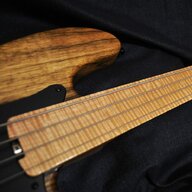
If you are still contemplating a solid wenge body, be careful! A typical size bass body made out of that will weigh nearly 10 lbs on its own, with the finished bass probably somewhere in the 13-14 lb range. I am working on designing a neck-through build and wenge wings alone are probably going to be over 5 lb.

Having went the custom route years ago, here are my suggestions.
Playability should be more important than the woods you use. No point paying a ton of money for tone wood voodoo if the neck, scale length, weight, string spacing and balance are off. Figure those things out by playing a lot of different basses.
Beyond acoustic instruments, I don't buy the tone wood thing, BUT here are thibgs to consider that have noticeable impacts on tone:
- pickups, their type, their spacing, their height, their preamp if active
- your pedals
- your amp
- your cab and speaker type/configuration
If you want a bright, snappy yet punch metal bass tone, you should probably just consider splitting your signal into two parallel signals, eq the lows to taste, add an OD to the mids/highs and eq to taste. I have found that gets me the tone I want MORE than the bass I play does.
As far as wood goes, no point paying for exotic or expensive tone woods if you are painting them a solid colour. Those are usually for their asthetic appeal of the wood grain. Any worthwhile luthier will know which woods offer strength and stability for each mechanical part.
Playability should be more important than the woods you use. No point paying a ton of money for tone wood voodoo if the neck, scale length, weight, string spacing and balance are off. Figure those things out by playing a lot of different basses.
Beyond acoustic instruments, I don't buy the tone wood thing, BUT here are thibgs to consider that have noticeable impacts on tone:
- pickups, their type, their spacing, their height, their preamp if active
- your pedals
- your amp
- your cab and speaker type/configuration
If you want a bright, snappy yet punch metal bass tone, you should probably just consider splitting your signal into two parallel signals, eq the lows to taste, add an OD to the mids/highs and eq to taste. I have found that gets me the tone I want MORE than the bass I play does.
As far as wood goes, no point paying for exotic or expensive tone woods if you are painting them a solid colour. Those are usually for their asthetic appeal of the wood grain. Any worthwhile luthier will know which woods offer strength and stability for each mechanical part.
In fact, even if it's not wood it works too.As long as it isn't on fire or infested with termites, I'm pretty sure any wood'll do.

Do NOT sweat this stuff. Buy what you like the look and feel of, and what you can afford. I buy based on look and feel of the instrument as much as anything. Get good pickups and quality electronics (I'm sure your builder can help guide you). The tone is almost all in the electronics (I have a bunch of basses of different woods) and strings. Others will argue.U mean the solid wood is better for the neck? But multiple woods have some advantages such as more strength in the neck.
And last question : the top wood is effective in the tone ? Or it is only for the appearance and beauty?
My punchiest bass is a Warwick Rockbass Corvette $$. If I get into another metal or punk band, I'll probably play that one most. Maple neck, red stained body (ash?) and aggressive passive pickups.
If you like the look of a 5 pc maple/wenge neck, get it. If you think a quilted maple top will look great, do that. Then enjoy!
Which species of flea?Well he uses metal ones, but it's really the jack he uses that defines his tone... Either that or the faces he pulls, but I haven't yet finished my rigorous scientific testing. I've had one anomalous result and everyone knows that you have to get exactly the same result every time before recommending one over the other, because otherwise it's not true science... or something.
Mmmmm pancakes! May I have blueberries too? What does blueberry wood sound like?In addition, roasted maple is delicious with pancakes.
As an engineer studying thermodynamics, that would be a cool video!Everything that is transferred that is not audible as sound from the body (which is next to nothing on a solid body instrument) ends up as heat. I'll see if I can find any youtube videos showing this or think of a way to demonstrate it myself.
Mmm, maybe like this?Mmmmm pancakes! May I have blueberries too? What does blueberry wood sound like?


A very good question. I'm not a metal player but I'd suggest a Dingwall NG4/5 would suit you. With limited knowledge your custom bass may be an expensive disappointment.Which players do you like the sound of?
A very good question. I'm not a metal player but I'd suggest a Dingwall NG4/5 would suit you. With limited knowledge your custom bass may be an expensive disappointment.
Yes, it's the risk. Of course, there are different types of Progressive Metal, but there are a lot of basses on the market that would suit perfectly, as others have already pointed out. Another example:
...
I'll heartily recommend you consider a torrified (aka roasted) neck if humidity swings are causing you issues. I have a few roasted necks, and they are more stable than standard ones. I do apply poly finishes them, but that's mostly to keep the dirt from crawling into the grain.
Also, laminating the neck with the grain in different directions can provide more stability, too.


