• TalkBass has been independent since 1998. Add your voice.
    Create a free account to reply to discussions, view embedded media, and browse with fewer display ads.
    Join freeLog in
    Want zero display ads or expanded classifieds tools? Compare plans.

Tonewoods are real for violins, acoustic guitars, grand pianos, harps, and similar instruments. Solid bodies like the Travis Bean and the Dan Armstrong Ampeg have non-wood bodies and Modulus Graphite basses have carbon fiber necks.

I disagree because I played violin and cello for years, and if you have an electric violin or electric cello, it's just magnifying the sound that the wood and strings produce. I believe it's the same thing with solid body instruments. Some basses are semi hollow and you'd notice the difference even more with those basses.
 
Last edited:
  • Like
Reactions: GlennRH and Afc70
M
Pretty sure nay-sayers would ruin it for you even if your ideal it to keep it friendly.
Probably so! Maybe if there is a Tonewood club, the Mods could keep it kinda like the effects forum- where somebody who doesn’t like or use effects will get warned for going in and saying negative things against effects. Maybe it should just be a place for the tonewood believers to converse. The deniers could form their own club :laugh: I suppose, to discuss something they don’t believe in, with other tonewood disbelievers… (I’m definitely in the camp that believe and from years of experience playing, can definitely hear woods do indeed influence the tone of an instrument.)
 
C668335B-EB3B-4FF0-A307-0EDF4E07D4BA.gif
 
  • Like
Reactions: lug and Stingray5
The mass of the body/neck will of course affect how the strings vibrate and which frequencies are attenuated the most, even with solid bodies. You can't get around the laws of physics. With two identical basses (like two P-basses from the same series), what will determine the mass of the instrument? The density of the wood. Of course the distribution of the mass will also matter as density can vary in different areas of a piece of wood. All of this will not only affect the tone but also things like dead spots, having an even response along the neck and sustain.

I'm just happy that lots of people don't believe in this and don't notice the difference so that dead sounding instruments with severe dead spots, uneven response along the neck, nasty overtones, and/or a generally "dead" tone will leave the stores and save me some time sifting through all of the rubbish to find a good one.

Ever wondered why a Squier doesn't sound like a Fender Custom Shop even if you install Custom Shop pickups in it? I'll give you a hint: It's got something to do with trees.
 
Last edited:
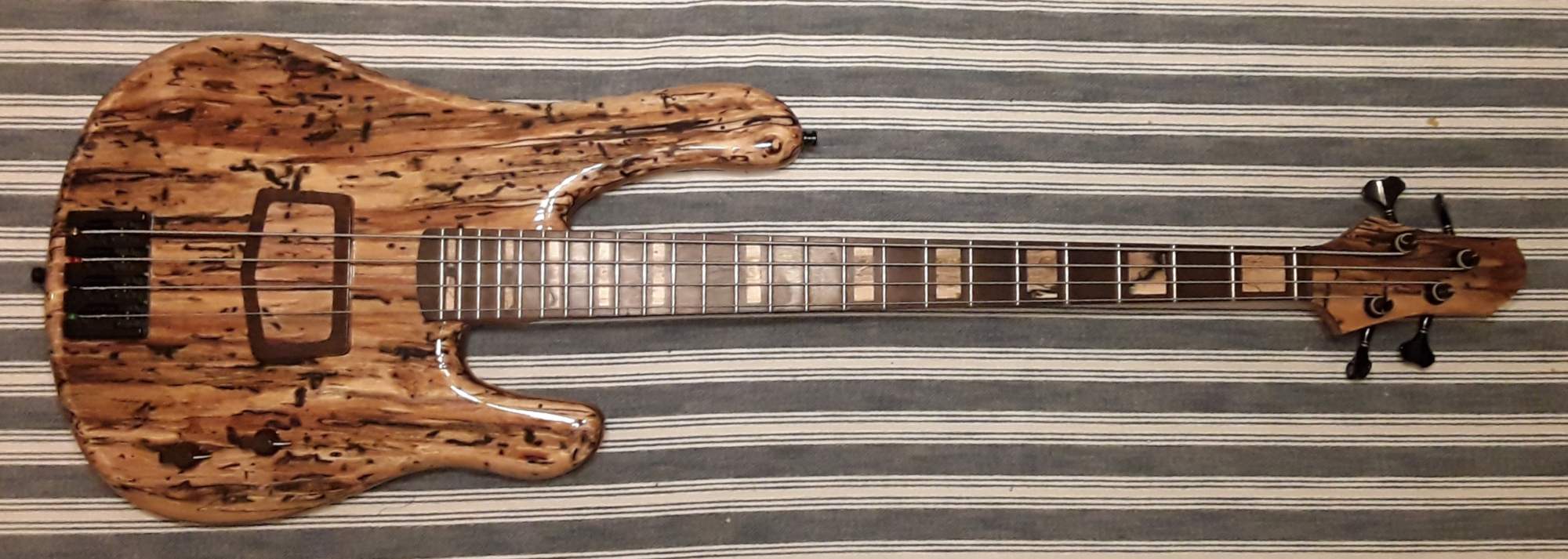
Count me in! I want to be in the tonewood club. Like most, I tend to listen to what my eyes tell me. But I also happen to build instruments and have found it's not hard to use weird woods in weird ways and still have it sound good.

This one is basically tonemushroom plus toneresins. Driftwood top, cherry body, maple/cherry neck and roasted walnut fretboard with carbon fiber stiffening rods. It's a 32" scale with an EMG Geezer Butler P in the P location, but moved bridgewards by 1/4" to compensate for the slight reduction in brightness that happens going from 34" to 32". It has a hipshot bridge on a walnut block mounted into the body and Gotoh tuners. It sounds just like a P. Everyone who's played it has commented the same thing. :)
 
View attachment 4716150Not just tone but weight, density, dryness, how it reacts to temperature and humidity as well as the trade offs with the different wood combinations.
Now THAT would be a discussion more worth having, imo. And more useful to know what to expect when caring for your instrument and if it is even well built to start with based on the quality of the wood.
 
  • Like
Reactions: GlennRH and GTHintz
If the wood makes no difference in the tone, then how come two identical instruments can sound completely different? Hardware and electronics are pretty deterministic, IMO. If the only variable is the specific hunks of wood used, even within the same variety, then it seems to me that the wood had some impact.
 
While most people seem to have more- or less-defensible opinions about tonewood, for me, the very concept of tonewood is actually not a matter of opinion, but of acceptance: It's a matter of materials science in the context of musical instrument construction.

Even then, people who either accept or reject tonewood as a valid, applicable concept in musical instrument-making seem to vary in the degree of attachment they bring to discussing it.

Therefore, while I fully accept that every part of a musical instrument inevitably plays a role in its tone/timbre/sound (materials, design & engineering, and fit & finish), and while I would welcome constructive discussion based on this acceptance, just the term tonewood seems highly attractive to argumentative detractors.

Including when argumentative detractors claim "just kidding," I'd see a TB Tonewood Club club placing great demands on moderators.

Before, in good faith, I ask to join the TB Tonewood Club, would TB moderators please pledge vigilant moderation aimed at ensuring constructive discussion?
 
  • Like
Reactions: Afc70 and Gregory H
After all the heat I got for posting about tonewood I'd like to ask if we can start an official tonewood Club
(assuming it doesn't exist already)

So we can talk about our theories freely and openly without people getting mad that we have a different opinion than them.
Aside from the fact that discussions around tonewood are always contentious here, the main issue with the other thread was that there were glaring problems with the experiment that @LowEndLobster performed - the fact that he wired the pickups incorrectly guaranteed significant tone differences, and the difference in scale length between the two basses was also an additional variable. It's this sort of dismissal of additional variables that muddies the discussion around tonewood. It goes all the way back to "mahogany = dark" (because Les Pauls have humbuckers) and "alder = bright" (because Strats & Teles have single coil pickups).
 
I feel bad for those who have nothing better to do but make fun of people's opinions on wood. Some of you need to get a life.
you know... there's such a thing as empiric research. There have been plenty of people who tested this and you (yes, even YOU) can just go on the interwebs and look for such evidence. It will be pretty overwhelming and you will realize pretty quickly, that it just doesn't matter what kind of wood your electric bass is made out of, if you plan on playing it... you know.... with an amp. BUT, you don't have to take my word for it. Go buy a piece of plywood and screw a string and a pickup to it. Try to roughly tune it to pitch and get a bass with the same strings and pickup. Play it, record it, convince yourself that it truly does matter. Take the audio clips and compare them. Ask someone to play them at random to you and make a quiz out of it. See what you'll find... I just feel like it's a bit of a waste of time, since many people have already done exactly that....
But if you want to believe in something, then that's good for you. Placebo is a real thing and can help you in your eternal search for meaning and happiness in life (no sarcasm). But don't expect everybody to applaud you when you come forth with such an opinion and act like the others are being mean to you... I'm sorry, but that's kinda how it goes when people hold onto weird / controversial beliefs.
 
I feel like the whole tonewood argument comes down to, when we pluck the string, does the wood that makes up the neck, fingerboard, and body of the bass resonate, and is that resonance part of the signal sent thru the pickups, to the amp, and out of the speakers? If so, there is no argument, different woods will provide different tones. If not, then wood makes no difference in amplified sound. But it still comes down to the feel of the instrument in the hands of the player. And that feel dictates how, and how well, one performs. The audience doesn't care what your instrument is made of, but it's certainly legitimate that the player does.
 
  • Like
Reactions: Roger W and GlennRH
Maybe if there is a Tonewood club, the Mods could keep it kinda like the effects forum- where somebody who doesn’t like or use effects will get warned for going in and saying negative things against effects. Maybe it should just be a place for the tonewood believers to converse.
Like a self referential echo chamber such as found in flat earth and cryptozoological groups?

The deniers could form their own club
The use of the term 'denier' is a pejorative derived from those who don't ascribe to the historical reality of the Holocaust around WW2.

I've planted my flag on the hill of 'I don't believe it makes anywhere near the difference the tonewood beliers say it does, nor is it consistent amongst specific species or even necessarily amongst pieces from the same tree' viewpoint. However, in light of verifiable and repeatable evidence, I will change my mind, and have on many issues over the years. I've yet to actually see any such evidence presented. And anecdote does not constitute evidence.