• TalkBass has been independent since 1998. Add your voice.
    Create a free account to reply to discussions, view embedded media, and browse with fewer display ads.
    Join freeLog in
    Want zero display ads or expanded classifieds tools? Compare plans.

Too hard to please?

I'm 67, playing bass for over half- a Century now. I'm wondering if there any other bassists like me out there.. I've owned SO much bass gear over this time period, it would literally fill a couple of pages.
All the way from my several B-15N's, and Supro Thunderbolt, to my Sunn Coliseum, Pearce B2P, GK's, SVT'S, Shuttle 9.0, and high power Carvin heads... and cabs from Sunn, Ampeg, SWR, Acme, Peavey, Cerwin-Vega, to EA, Avatar, Mesa, Epifani, Schroeder, and Carvin BRX's. A lot of combo amps in the mix, too. Here's my dilemma... I've never been totally happy with any of it. All of it disappoints me..usually in the area of distortion, or excess speaker cone travel/ farting. Even with high power amps, with cabinets rated for high power, this phenomena occurs. I have yet to find a single 'stand alone' cabinet that I can use. Some have come close, but not yet. The only time I have been truly happy with my bass sound/ power/ volume and fidelity, is in concert situations, where large side fills powered by a lot of serious wattage send my signal back to me. The onstage backline bass amps, at that point sound like garbage in comparison. Figuring I needed to go power amp-preamp, I tried lugging around a Mackie M1400 and an SWR Grand Prix, a folded horn 15, and an SWR Triad on top- it was pretty good, but too big, heavy, and still not what I'm looking for. I bought a BFM 'Jack' cab, and it also disappointed me- although I'm impressed with it as a mid/ high box, it's excellent in that regard. This past weekend, I used my Carvin BX 1500, an Epifani UL-112, and a Schroeder 115L. All high quality equipment. Heavy Speakon cables, all Mogami and Monster patching cables input and output to my single effects unit- a Zoom B-3. Yeah, some of you will bash the Carvin, but it is a lot better than the amps they used to make. I was still not satisfied with this rig. I was not running it at an excessive volume, either.
Have any of you felt this way about your gear?

I'm 66, been playing for more than 50 years, when I bought my first SVT in 1975 my search ended. I do own other amps and like them and occasionally use different cabs with SVT heads. I like the Ampeg tone in particular. I like an articulate tone with plenty of mids and bottom, and I get it from the SVT, if I want more bottom I use my PR-410HLF with the SVT head, gets loud and goes low. Most of my tone is the way I play the bass anyway.
 
Last edited:
I have, indeed played electric bass through some FRFR setups.. low volume... it seems to me that these are definitely for near field, facing the performer cabs. I loved a steel box Mackie 15- not a 'Thump' - that a keyboardist used to bring to a gig where I'd sit in. The bass sounded great through it. I think it was one of the first of the new series of redesigned SM series... no more molded plastic enclosure. I know a local bassist that uses an SM450, plastic second gen- with his active Tobias six. It has an o.k. amount of volume...In the audience, it always sounds 'impotent' for lack of a better term. Like as we used to say in Queens. like ya pissin' against the tide.' I've played through it at a few jams, and did not like it at all. No balls. Playing my Lowendall upright, with a Fishman Full Circle through a QSC K-10, on a stand up near my ear, was pretty convincing, that that, is a FAR more preferable amplification method for that instrument, than my old GK MB 150S, which is rendered instantly obsolete once compared.
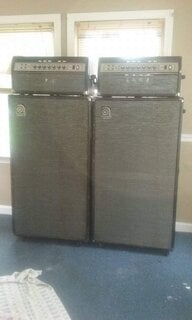
I toyed with the idea of just buying a small PA, but the LF boxes would still be big. I built a small 'J' box, using my B-36 MF cabinet- which I still have..as a guide, and reduced the dimensions for a single 15. I still have that cab, too. It has an old Carvin Eminence Neo 15 in it, and it sounds excellent for just low end. THIS rig pictured, I still have. The Mesa cab now has a B&C 12, and the bottom cab, is my homebuilt Folded Horn sub. That Pearce B2P is a great amp, I've had it almost 20 years. I may bring it out of retirement soon. P.S. that Foster horn in the lower cab is not connected.
 

Attachments

  • Toll Bros w Tina 6-19-15 3.jpg
    Toll Bros w Tina 6-19-15 3.jpg
    2.7 MB · Views: 41
  • Like
Reactions: Zbysek
As far as working on my volume, and EQ, and 'technique' goes... really? I'm a performing, working bassist..for 50 years.. I've worked with many rock and blues legends. I hardly think I need any tutorial in these areas. But thanks anyway.

Well, with all due respect, if that was completely true, you wouldn't be on here with vague questions and vague goals asking strangers on the internet how to achieve something that you can't even seem to articulate yourself.

When you're depending on the pro sound folks to be at your level of preparedness and expertise, and they are not, I can't imagine what would be possible from an on-stage rig to overcome that obstacle.

Well, the reverse is certainly also true. And honestly probably more common than the other way around. A decent sound guy can keep a great sounding band sounding pretty good, but even the best sound guy can only do so much with a band that doesn't have a clue how to achieve a nicely balanced stage sound (or just refuses to). And MANY MANY MANY bands simply don't have the skill to achieve a great stage sound or just don't care and want to do the ego trip "everything louder than everything else" thing.

When the guitar just by itself (or anything else, like drums, bass, etc...) sits on top of the entire FOH mix, the best you can do is try to get a reasonable balance for everything else and try to keep the vocals mostly audible. Honestly I think I might start offering "band coaching" services on how to sound good on stage, choose material, tighten arrangements, etc... it would be more for my own sanity when running sound than for the money.

***

Anyway, back to the OPs issue.

I really think you don't know what it is you want, because in 6 pages you haven't really specified to the degree that anyone could offer really good advice.

BUT, I will take a stab at some possible solutions, based on your posts, others posts, and reading between the lines.

First, to describe your issue as I understand it, you seem to want a big, immediate, deep, clear, clean bass sound. Unfortunately, that does mean size, weight, and cost are going to be issues. No way around that.

The first option I would suggest, would be a custom build 18" sub, using the most sub focused driver you can get your hands on. I'm talking something with a response down into the 30s or even 20s. Don't skimp on cab size. Tune it as low as is feasible to get rid of any low mid bump in the response (that's what kills your tone and makes it sound loud, but tubby and cheap and annoying). I would pair this with a stout 3 way 2x10. You want to build this with a similar concept, but maybe with less emphasis on lows for the 10s, unless you want to be able to use it as a standalone. 2 10s, a 5 or 6, and a tweeter/horn. You probably want to get some skilled help with both cabs as it's clear this stuff is not in your area of expertise.

Then you run whatever preamp you care to (maybe your Pearce), into an active crossover (or use one on your preamp if there is one), and into 2 sides of an old school SS power amp, in the 400-600w per side range. Then you have to figure out where to set the crossover, but 100 Hz is a good starting point. The target would be to get a sort of "smack" from the sound, which is I think what you're missing and trying to achieve. Using a legit 18" sub should get a response curve that will get you along those lines.

The next option, is you might just be looking for a more traditional bass cab but with a lot of square inches. Something as simple as an SWR 4x10 might be a good place to look (or maybe 2 of them). Either the Goliath III or IV, or the Golight (but not the sealed Marcus Miller version). Using a pair of those, even at low volumes, should give you some of that immediacy you seem to be looking for. A Henry the 8x8 may also be a good choice. You could substitute the SWR for any number of other choices, but they have a really nice tonal profile and easily available for pretty cheap. A high end modern alternative might be the Genzler bass array 4x10.

Which leads me to my last suggestion, which would be something more along the lines of the Phil Jones stuff, or maybe one of the MAS cabs. Using multiple smaller drivers is going to get you a different sort of vibe than for instance a single 12 with a tweeter. The downside is the Phil Jones stuff at least tends to be heavy and expensive.

I would say if you try all 3 of those approaches and can't get close to what you're looking for, it's probably not possible.

But yeah, really you should try to be more descriptive about what it is you're looking for, because your posts have been vague as hell, and I only grasped as much as I did because I have a similar (I think) thing that I'm looking for, that I call "bottomless" bass, where the notes just have a snap to them, even down to B or A, and there's no "restricted" or stuff feeling in the low mids. It seems like that might be similar to what you're looking for. But you should also describe what gear you are using in depth, and also what kinds of music you're playing, and what sort of tone or tones you're after. Because even if you look at 3 "slapping" players, as on the SMV album (Stanley, Marcus, and Victor), they all have pretty different tones, even within that sort of same world.

So the more and better information you provide, the closer people will be able to get with their suggestions. But at the very least you should probably stop mixing cabs and stop raising them off the ground. Figure out which of your main cabs you like the best, buy a match for it, stack them on the ground, and then go from there. And maybe try a different head too, like maybe an SWR or an old Trace or something more boutique like a Euphonic, etc...
 
The best bass sounds I’ve ever heard were at the hands of fully trained & experienced studio recording engineers that were doing live sound.

The guitarist in one of my bands does TV audio production as a job and is a real stickler for good tone & proper EQing.

Two mates each have their own recording studios. When either of them does audio at church it sounds phenomenal.

@LHbassist - Maybe these are the best people to be asking for direction. They’re the first people I’d ask.
 
  • Like
Reactions: Al Kraft
Well, the reverse is certainly also true. And honestly probably more common than the other way around. A decent sound guy can keep a great sounding band sounding pretty good, but even the best sound guy can only do so much with a band that doesn't have a clue how to achieve a nicely balanced stage sound (or just refuses to). And MANY MANY MANY bands simply don't have the skill to achieve a great stage sound or just don't care and want to do the ego trip "everything louder than everything else" thing.

When the guitar just by itself (or anything else, like drums, bass, etc...) sits on top of the entire FOH mix, the best you can do is try to get a reasonable balance for everything else and try to keep the vocals mostly audible. Honestly I think I might start offering "band coaching" services on how to sound good on stage, choose material, tighten arrangements, etc... it would be more for my own sanity when running sound than for the money.
As you know Chris I've had the opportunity to benefit from your live mixing expertise firsthand, and I agree that it's a collaboratve process and one where both the band and sound tech need to bring their "A game" for the best results. When I think about great pro-sound techs I've worked with, our band's experiences with you are at the top of my list for how it's done right. If you do decide to offer those "band coaching" classes, I can't think of anyone I've worked with who would have more to offer...I only hope our band wouldn't be one of your expamples of how frustating life can! :)
 
  • Like
Reactions: agedhorse
Thanks for the endorsement. And no, you guys were fine, and that's a difficult room anyway, so if I got something reasonably balanced in the room I was happy. On the other hand, I worked with some bands there that just refused to adapt to the room, and so the drums or electric guitar would just obliterate the entire mix. At some point I just stop asking people to turn down when it's clear it's not going to happen. Everything is supposed to sit together and be blended nicely, that's why they call it a MIX. No one element is supposed to stick out over and above the rest, and most venues until you get to places that are really huge and will just swallow sound, you have to moderate your individual volumes to leave some "meat on the bone" for the sound guy. But if something is already too loud for the room before I even put it in the PA, what do you expect me to do with that?
 
As an audience member, how would you feel if you were being pummeled by something because the player's attitude was "my way or the highway"?
If the band and sound crew are not 100% focused on giving the audience the live music experience of a lifetime, people need to be replaced. Now that does not mean that the band doesn't have on-stage monitoring needs in order to give a good performance, but this again is where collaboration carries the day IME.

Bands need to remember that the sound techs are mixing for two audiences, the house and the band. A little cooperation (and dare I say appreciation) goes a long way in getting the perfect mix for both audiences. Good bands and good sound techs understand this bigger picture and know they have to work together.
 
If the band and sound crew are not 100% focused on giving the audience the live music experience of a lifetime, people need to be replaced. Now that does not mean that the band doesn't have on-stage monitoring needs in order to give a good performance, but this again is where collaboration carries the day IME.

Bands need to remember that the sound techs are mixing for two audiences, the house and the band. A little cooperation (and dare I say appreciation) goes a long way in getting the perfect mix for both audiences. Good bands and good sound techs understand this bigger picture and know they have to work together.

Agreed, but when you have to pick one, the audience wins. What may sound like $&(! on stage may fit the house mix beautifully.
 
I own and exclusively gig with and use an Epifani UL 501 head with a mesa boogie traditional powerhouse 2x10 cab.

i was always dissatisfied with the cab no matter how i dialed in my amp and my basses and whichever my technique was I never liked the end result. I played the amp head with other cabs and cab-less (IEM) and its phenomenal so after doing lots of research i went out and bought a Barefaced Big Baby II and the combination sounds exactly what i was after, volume wise articulation, dynamics, harmonic content and timbre. Ive heard great thinks about bergantino cabs as well though. I GAS for another Big Baby II
 
  • Like
Reactions: bbh
I've come to terms with the idea that I sound like me and there's no way around it. That provides a certain amount of calm and allows me to focus on technique, which is where I'll make the biggest changes.

My biggest issue is every time I play bass for an extended period of time, I end up switching back to guitar and losing a lot of the ground I gained. Since this is my current band situation, I'm focusing on fingerpicking and hybrid picking so I can at be prepared next time I switch (because it'll surely happen again).

From a gear standpoint, which is what this thread is really about. I made the biggest gains this year just being able to learn my amp at rehearsal and gig volumes, which actually isn't something I've been able to do before. NYC was a cruel mistress in that regard. I was always playing out of some rehearsal room rig or backline. In that setting, the biggest gains were made when I cycled through compressors and landed on the BOSS BC-1x.
 
Agreed, but when you have to pick one, the audience wins. What may sound like $&(! on stage may fit the house mix beautifully.
I've been there a few times, but find that the more experienced sound techs and band members know how to make the best of what's possible even in these sub-optimal situations. But to your point, I agree that the audience always comes first when there are trade-offs.
 
  • Like
Reactions: bbh and agedhorse
Agreed, but when you have to pick one, the audience wins. What may sound like $&(! on stage may fit the house mix beautifully.

TBH, my perspective on this will depend on how much I (or the band) is getting paid. A bigger compromise on my stage sound generally leads to less comfort (ex. not being able to hear myself) and less enjoyment overall. The more more I get paid, the more I'm willing to tolerate those negatives.

I'm playing a gig for enjoyment purposes - which, TBH, is not that often nowadays - I likely will be playing more technical music and need my stage sound to be more on point. But at these types of performances I'm often playing with skilled players who are conscientious about their instrument's stage presence, so I'm not put into the situation of escalating volume wars.

I tend to like a pretty loud bass sound on stage, the volume of which is pretty much dependent on how loud the kick and guitars are at my stage position. If there is a loud drumfill on stage or lots of rumble from the subs that can cause issues in bass audibility. Despite that, I don't think I've been asked to turn down or adjust amp EQ by a soundguy more than a handful of times over 20+ years of playing professionally.

Most of that probably stems from the fact that I tend to reproduce the sound of my bass on stage, which is basically the same sound that FOH gets through a DI. I rarely use amp EQ unless it's a very boomy room that requires a low cut on the bass amp. Any added effects are gain matched and EQ'd to not create any frequency spikes in the signal. I don't use a compressor to retain all playing dynamics and to allow the bass to be freely compressed in the FOH as needed for that mix. I think that approach aids in not causing issues between the stage sound and FOH.
 
TBH, my perspective on this will depend on how much I (or the band) is getting paid. A bigger compromise on my stage sound generally leads to less comfort (ex. not being able to hear myself) and less enjoyment overall. The more more I get paid, the more I'm willing to tolerate those negatives.

I'm playing a gig for enjoyment purposes - which, TBH, is not that often nowadays - I likely will be playing more technical music and need my stage sound to be more on point. But at these types of performances I'm often playing with skilled players who are conscientious about their instrument's stage presence, so I'm not put into the situation of escalating volume wars.

I tend to like a pretty loud bass sound on stage, the volume of which is pretty much dependent on how loud the kick and guitars are at my stage position. If there is a loud drumfill on stage or lots of rumble from the subs that can cause issues in bass audibility. Despite that, I don't think I've been asked to turn down or adjust amp EQ by a soundguy more than a handful of times over 20+ years of playing professionally.

Most of that probably stems from the fact that I tend to reproduce the sound of my bass on stage, which is basically the same sound that FOH gets through a DI. I rarely use amp EQ unless it's a very boomy room that requires a low cut on the bass amp. Any added effects are gain matched and EQ'd to not create any frequency spikes in the signal. I don't use a compressor to retain all playing dynamics and to allow the bass to be freely compressed in the FOH as needed for that mix. I think that approach aids in not causing issues between the stage sound and FOH.

To me, if you are performing, you are performing - you have accepted an offer to play in a public forum. That means you are entertaining others. If you want to play for yourself, play at home. That's how my jazz band operates. We rehearse weekly, and play the tunes we want to play, the way we want to play them. But at a gig, regardless of the compensation, we design our set list for the audience.
 
Since my living came from providing audio for live events, for audiences, I had to balance the needs of everybody... the audience, the band, the promoter and sometimes the venue and those surrounding the venue if outdoors.

I am generally hired by the promoter/venue, and when they get complaints from the audience that it's too loud (for example), I have to address this however I can. Generally the bands are quite cooperative (they want to be booked back) but when they are not, I just have to do the best I can and sometimes the mix will suffer when I am told by the one who pays me that the volume needs to come down.

Only once did the promoter at this particular venue where there were noise restrictions to the surrounding areas have a band that turned into real pricks. Not my problem, a discussion with the tour manager about the SPL limits, and the penalties that come with that get deducted as an already agreed upon show expense that gets deducted at settlement pretty much got their attention. Sometimes penalties can be pretty steep, especially when it's willful and repeated.

I don't know how familiar many of you guys are with casino gigs, real casinos, generally you get a warning or two but after that you can end up dealing with "security" that at some properties can be awfully intimidating. You probably won't get paid, your agent will get an ass reaming, and you may find yourself held until THEY feel it's time for you to go home. Your gear will be pre-packaged for your departure. They are great gigs when you follow their rules, but what they say goes, or else.
 
The best bass sounds I’ve ever heard were at the hands of fully trained & experienced studio recording engineers that were doing live sound.

The guitarist in one of my bands does TV audio production as a job and is a real stickler for good tone & proper EQing.

Two mates each have their own recording studios. When either of them does audio at church it sounds phenomenal.

@LHbassist - Maybe these are the best people to be asking for direction. They’re the first people I’d ask.


I have done plenty of gigs where the FOH bass sound was excellent. One memorable one, was in Church.. the sound was amazing, and the huge surprise- was the number of incredible, non- professional female vocalists. One in particular, was so amazing- I actually asked her if she wanted to do some gigs. She didn't think she was good enough. Wow.
Digressing to the bass sound- The bass in my Avatar, is one I built back in 1993. All Alembic electronics including the Stanley Clarke signature tone controls. It has three WMXY-5 pickups, two pan pots, for any combination of pickups. When properly mixed, that bass sounds just incredibly good. Those pros that do engineer sessions always do the best work. No drowning out half the band with subs. To me, there's nothing better than hearing the 'return' of a well mixed band coming back to your ears in a good sounding room.
 
  • Like
Reactions: Groove Doctor
"I don't know how familiar many of you guys are with casino gigs, real casinos, generally you get a warning or two but after that you can end up dealing with "security" that at some properties can be awfully intimidating. You probably won't get paid, your agent will get an ass reaming, and you may find yourself held until THEY feel it's time for you to go home. Your gear will be pre-packaged for your departure. They are great gigs when you follow their rules, but what they say goes, or else."

Andy, is right.

I play a lot of casinos, both in the showrooms, and the lounges. There is a local casino that has a printed warning in the dressing room. It basically says that musicians playing there are essentially parsley on the plate of the guests, window dressing- this is not a concert venue kinda vibe.
Fine. The mixing is done by various techs with an Ipad, and onstage in-ears only and recently upgraded Avioms. The pay- is LOWER for a musician in a Quartet, than it was in 2004. I'm not kidding. So, either we take it, or leave it. I've also worked in that same casino, in the various upstairs convention rooms. Believe me, All I want to do, is walk in, set up, plug my DI in, set the amp where it can be heard, get a good sound, play the gig, and go home afterwards. I always cooperate fully with the techs. Minimum aggravation, is always the best way to work any gig.
One of my favorite places to work, is either the Bow and Arrow Lounge at Feather Falls in Oroville, CA. or in the Showroom. My Avatar was taken onstage there in the FF Showroom. I've done hundreds of gigs there. A lot of traveling- it's 2.5 hrs. to or from Reno, where I live. Brad in the lounge, and Joe Hammons in the showroom, are really excellent.
Many years ago, Brad could really get harsh in his warnings about Db levels. He was right, there is no need to impress anyone, a good relationship begins with understanding where the Hell you are, your reason for being there, what is required and not required, and the responsibilities of others in doing THEIR job. I've never not been paid, and thankfully, never had any issues with security. Some agents, are not really very nice- and play junior high school level games with other agents and screw over and even blacklist some musicians they don't like....others are pretty cool.