
The thing simplified it for me was to just know the names of the open strings. Everything goes up from the open. G goes G# to A, D to D# to E A to A# to B. etc. B and E don't have sharps. All other notes do. That made it simple for me. Flats are just another name for sharps C sharp is D flat. That took a little more thinking about it but not alot.

Enjoy the benefits of a premium membership!
Upgrade Account
-
TalkBass has been independent since 1998. Add your voice.
Create a free account to reply to discussions, view embedded media, and browse with fewer display ads.
Join free Log in
Want zero display ads or expanded classifieds tools? Compare plans.
You are using an out of date browser. It may not display this or other websites correctly.
You should upgrade or use an alternative browser.
You should upgrade or use an alternative browser.
- Status
- Not open for further replies.
More options
Who Replied?
As everyone is saying...there are no secret tricks. Call out the note names as you play slooooowly.
Play up and down each string from the nut to the end of the fingerboard. Play scales in all keys. Play arpeggios in all keys. Pick any of the 12 notes and play it in every possible location on the neck.
It sinks in, don't expect it to be overnight. I can still stumble calling out the names in keys I seldom play in and I've been playing for many decades.
Play up and down each string from the nut to the end of the fingerboard. Play scales in all keys. Play arpeggios in all keys. Pick any of the 12 notes and play it in every possible location on the neck.
It sinks in, don't expect it to be overnight. I can still stumble calling out the names in keys I seldom play in and I've been playing for many decades.


...
...
B and E don't have sharps.
...
Except that they do. Which is why I recommended learning notes in the context of keys. What are the notes of F# major scale?
If the answer makes your head explode, try the enharmonic Gb instead!
Last edited:
I learned a few "words" on the fret board like:
GAB on 3/5/7th fret of the E string
GAB also on G string as Open/2nd/4th fret
BEAD on 7th fret (downward towards the floor) for all strings from E to G
then similarly BEA on the 2nd fret of the A string
once you have those you can find the others easier, sort of like the home row on a keyboard and a "word" sticks in you mind better
GAB on 3/5/7th fret of the E string
GAB also on G string as Open/2nd/4th fret
BEAD on 7th fret (downward towards the floor) for all strings from E to G
then similarly BEA on the 2nd fret of the A string
once you have those you can find the others easier, sort of like the home row on a keyboard and a "word" sticks in you mind better

Every time you pick up the bass the first thing you should do is play chromatically up and down each string (stopping at the 12th fret, double dot). Refer to the notes as “sharp” going up and “flat” when going down. Say the notes out loud as you go.
For example, your E string would be as follows.
E F F# G G# A A# B C C# D D# E
E Eb D Db C B Bb A Ab G Gb F E
*You do not need a bass in hand to work on this either. Say them out loud while you’re driving or in the shower.
Once you’re rock solid on that try the same thing but rather than going chromatic try skipping every other note (play whole steps rather than half steps).
Get good at that? Try it in thirds.
When you’re practicing, spend a moment saying the notes out loud for any given riff/groove. Once you’re solid on the notes try to play the same notes but somewhere else on the neck (go up or down an octave, etc). Again, just one quick riff and it’ll take 3-5mns of your time.
Find a beginners reading book with NO tabs and spend 5-15mns a day reading. Same idea, once you’re comfy with the exercise, try it somewhere else on the neck (if you start on C on the A string, try starting on C on the E string, etc).
After you’ve done all that you could start learning all your major scales and arpeggios.
Doing all these things just 5mns a day is better than for an hour once a week. You’re trying to build muscle memory more than anything and that happens through repetition, not duration.
Ps. If you have the time and a little extra cash take a few lessons. I teach locally and virtually, as do most teachers these days.
For example, your E string would be as follows.
E F F# G G# A A# B C C# D D# E
E Eb D Db C B Bb A Ab G Gb F E
*You do not need a bass in hand to work on this either. Say them out loud while you’re driving or in the shower.
Once you’re rock solid on that try the same thing but rather than going chromatic try skipping every other note (play whole steps rather than half steps).
Get good at that? Try it in thirds.
When you’re practicing, spend a moment saying the notes out loud for any given riff/groove. Once you’re solid on the notes try to play the same notes but somewhere else on the neck (go up or down an octave, etc). Again, just one quick riff and it’ll take 3-5mns of your time.
Find a beginners reading book with NO tabs and spend 5-15mns a day reading. Same idea, once you’re comfy with the exercise, try it somewhere else on the neck (if you start on C on the A string, try starting on C on the E string, etc).
After you’ve done all that you could start learning all your major scales and arpeggios.
Doing all these things just 5mns a day is better than for an hour once a week. You’re trying to build muscle memory more than anything and that happens through repetition, not duration.
Ps. If you have the time and a little extra cash take a few lessons. I teach locally and virtually, as do most teachers these days.

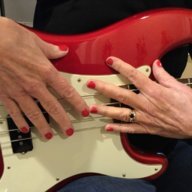
Here's an excellent exercise to learn your fretboard. Run the pentatonic scale, on two strings, SAYING THE NOTES OUT LOUD as you pluck them. Four notes at a time, advancing one note each step.
So E (open), G - both on E string; A (open), B. Then G, A on E string, B, D on A string. Then A, B on E; D, E on A. Go to the end of the fretboard, then work back to the head. Saying it aloud!
Then do the A/D strings, then the D/G strings.
Then do it in all the other keys. Always start as close the head if you can. So for the key of F, you'll start at F; for the key of F# you'll start at E (b7), for G you'll start at F, for A you'll start E (5th), G (b7) - and so on.
This will bring you out in a cold sweat at first... go slowly. But if you do that each day for 15 minutes or so, you'll soon know where every note on your fretboard is, and how they relate to each other.
NOTE - the really important thing is to say the notes out loud. You can learn a pattern and reproduce it pretty easily - what you're trying to do is link the note names and positions by using that.
Have fun!
So E (open), G - both on E string; A (open), B. Then G, A on E string, B, D on A string. Then A, B on E; D, E on A. Go to the end of the fretboard, then work back to the head. Saying it aloud!
Then do the A/D strings, then the D/G strings.
Then do it in all the other keys. Always start as close the head if you can. So for the key of F, you'll start at F; for the key of F# you'll start at E (b7), for G you'll start at F, for A you'll start E (5th), G (b7) - and so on.
This will bring you out in a cold sweat at first... go slowly. But if you do that each day for 15 minutes or so, you'll soon know where every note on your fretboard is, and how they relate to each other.
NOTE - the really important thing is to say the notes out loud. You can learn a pattern and reproduce it pretty easily - what you're trying to do is link the note names and positions by using that.
Have fun!

Coming from a musical background (including extensive theory) before I played bass, note ID on the fretboard developed more in terms of intervals and patterns, more than note names for me. Once you know where a few fundamental notes are, you can easily extrapolate the rest of the board with time. I tend to learn the specific notes as I need them. Thinking in patterns/intervals:
I know that an octave is 2 stings down and two frets right. So if I know that E string, 5th fret is A, I know that D string 7th fret is the octave.
I know that 1 string down and 2 frets right is a fifth above. I know that that 1 string up, same fret is a fifth below.
To be clear, this is not a sight reading method - it's a take you time and flush thing out method.
Using this method, all you need to do is identify the notes on your lowest string and then extrapolate the other note values by interval. With time, you'll be easily able to identify notes all over the neck without all the thinking. Learn you intervals - especially bass critical intervals (3,4,5,6,7, octave) - and the rest will just come.
I know that an octave is 2 stings down and two frets right. So if I know that E string, 5th fret is A, I know that D string 7th fret is the octave.
I know that 1 string down and 2 frets right is a fifth above. I know that that 1 string up, same fret is a fifth below.
To be clear, this is not a sight reading method - it's a take you time and flush thing out method.
Using this method, all you need to do is identify the notes on your lowest string and then extrapolate the other note values by interval. With time, you'll be easily able to identify notes all over the neck without all the thinking. Learn you intervals - especially bass critical intervals (3,4,5,6,7, octave) - and the rest will just come.

Interesting… I find it fascinating that some people associate learning the notes on the bass with a lack of “joy.”
Is it work learning about something you love?
… over a period of time of course!
If a person doesn’t want to commit to that depth, cool… but, it’s not like having a root canal!
Is it work learning about something you love?
… over a period of time of course!
If a person doesn’t want to commit to that depth, cool… but, it’s not like having a root canal!
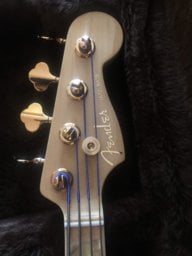
My Teacher had me focus on the E & A string first, noting that the progression was repeated on the D & G if you started at the 2nd fret.
You will find your own way, and it will be worth the effort...
You will find your own way, and it will be worth the effort...

I am having hard time to memorize notes on fretboard.
Right now I find next reference: what string I am on and what's the distance either to root, octave or note on 0th, 7th and 12th fret, then I need to look how many halfsteps from reference point I am and then add or deduct the distance. I feel like 5yr old connecting letters to words.
When I play note passages over a single chord or known and excersised chord changes, it flows wells, but new chord overloads my CPU and RAM and disturbes playing.
When I play and say notes loud, even the good 'ol C major scale kills.
How can help myself?
Scott's Bass Lessons has some excellent exercises for this very thing, such as diatonic (mode) scales, arpeggios, etc. Many of them are free on youtube. Essentially, they force you around the fingerboard while it's recommended that you say the name of the note (and sing it for ear training if you can). Very slow BPM at first but it works and speeds up if you make it part of your everyday practice routine for 5-10 minutes a day. Not affiliated in any way.
Yeah, I think saying the note names out loud really helps. I would start with a single string (ex. 4th string) and just do E, F, G, A, B, C, etc., skipping the sharps/flats. Then do the next string. Then I would play every A on the fretboard, followed by every B, etc. For that, you can look at a diagram until you don't need it anymore. Some would say just do this from open strings to the 12th fret because it just repeats after that, but I think it's much better to do it all the way up.
You could also make flash cards to randomize it a bit. One card might say "4th string: A" and then you play the 5th fret and the 17th fret on the 4th string. Then the next one says "1st string: G" and you play the open string and the 12th fret, etc.
You could also make flash cards to randomize it a bit. One card might say "4th string: A" and then you play the 5th fret and the 17th fret on the 4th string. Then the next one says "1st string: G" and you play the open string and the 12th fret, etc.
Last edited:
That's pretty much the way I did it, too. Wasn't a lot of memorization involved.Coming from a musical background (including extensive theory) before I played bass, note ID on the fretboard developed more in terms of intervals and patterns, more than note names for me. Once you know where a few fundamental notes are, you can easily extrapolate the rest of the board with time. I tend to learn the specific notes as I need them. Thinking in patterns/intervals:
I know that an octave is 2 stings down and two frets right. So if I know that E string, 5th fret is A, I know that D string 7th fret is the octave.
I know that 1 string down and 2 frets right is a fifth above. I know that that 1 string up, same fret is a fifth below.
To be clear, this is not a sight reading method - it's a take you time and flush thing out method.
Using this method, all you need to do is identify the notes on your lowest string and then extrapolate the other note values by interval. With time, you'll be easily able to identify notes all over the neck without all the thinking. Learn you intervals - especially bass critical intervals (3,4,5,6,7, octave) - and the rest will just come.
For trying to learn notes all over the fretboard, just focus on naturals and get them down first. If you know where the naturals are, then you also know where the sharps and flats are and you’ll find yourself becoming familiar with them just by doing that and it won’t overburden you at first.
For arpeggios, it’s great to know the actual notes, but by patterns alone you can find a minor or major third, flat five, etc… As you start putting the pieces together and know that the 3rd of an A7 is a major third and it has a minor seventh, that should also come together that the 3rd is a C# and the m7 is a G, so you’ll know what notes you’re playing if you think about it, but playing the right intervals regardless while learning still gets you through the gig.
For arpeggios, it’s great to know the actual notes, but by patterns alone you can find a minor or major third, flat five, etc… As you start putting the pieces together and know that the 3rd of an A7 is a major third and it has a minor seventh, that should also come together that the 3rd is a C# and the m7 is a G, so you’ll know what notes you’re playing if you think about it, but playing the right intervals regardless while learning still gets you through the gig.
You take the same route as you take to Carnegie Hall. That’s really it. There aren’t any meaningful shortcuts, you just punch the clock and put the time in.
I'd just add to that. Nothing is more of a buzzkill than playing a stinky clam because you don't know where the note you meant to play is.Interesting… I find it fascinating that some people associate learning the notes on the bass with a lack of “joy.”
Is it work learning about something you love?
… over a period of time of course!
If a person doesn’t want to commit to that depth, cool… but, it’s not like having a root canal!

Do you know your learning style; that is your primary or most comfortable way of learning? Do you remember patterns more readily than sequences, either numeric or audibly? Visual learner.
If you're a visual learner (seeing), when you gain knowledge by seeing/watching rather than hearing or logic/math or physical activity, the key would be patterns, as many have already mentioned.
Audible (aural) learner? Focus on ear training.
Logical/Math (thinker)? Scales and relationships, numbering.
Kinesthetic (physical doer)? Practice everything physically and note how it 'feels'. (If you're one of those, that will make perfect sense!)
For combinations, well, combine!
If you're a visual learner (seeing), when you gain knowledge by seeing/watching rather than hearing or logic/math or physical activity, the key would be patterns, as many have already mentioned.
Audible (aural) learner? Focus on ear training.
Logical/Math (thinker)? Scales and relationships, numbering.
Kinesthetic (physical doer)? Practice everything physically and note how it 'feels'. (If you're one of those, that will make perfect sense!)
For combinations, well, combine!

When walking, resting, or doing mindless chores (no bass), I find it helps to visualize where the notes are, using any of the exercises mentioned above.
I play electric and upright.
Some people are very visual and can see the scale notes as a pattern. In my head I picture scales and chords all over the board. Some folks are very sound oriented and hear it well. You want to always be improving in both.
Right off the bat you do not need to worry about half the fingerboard because from 12th fret harmonic up it is just a repeat of the lower board.
The brain is very flexible and can keep learning even if you are old (like me). I normally am a busy gigging musician. During this covid pause in gigs I took up violin. At first the note locations were tricky but it actually has come very fast.
Also, after almost 50 years of playing an upright bass tuned in 4ths, about 3 years ago I went to 5ths tuning for classical. The notes are all in different places but it has worked out great. I did this to get the lowest notes without a C extension normally used in symphonies.
I’m actually playing a very challenging piece, Beethoven’s 5th with my symphony tonight, bass tuned in 5ths. With the notes all in different place than where they were for 5 decades lol.
When I grab a bass tuned in 4ths, or 5ths, or a violin or guitar my brain sees the scales and notes that correspond to that instrument. It came easy enough (after putting the hours in) for me, and will for you.
As others have said, just keep at it.
Some people are very visual and can see the scale notes as a pattern. In my head I picture scales and chords all over the board. Some folks are very sound oriented and hear it well. You want to always be improving in both.
Right off the bat you do not need to worry about half the fingerboard because from 12th fret harmonic up it is just a repeat of the lower board.
The brain is very flexible and can keep learning even if you are old (like me). I normally am a busy gigging musician. During this covid pause in gigs I took up violin. At first the note locations were tricky but it actually has come very fast.
Also, after almost 50 years of playing an upright bass tuned in 4ths, about 3 years ago I went to 5ths tuning for classical. The notes are all in different places but it has worked out great. I did this to get the lowest notes without a C extension normally used in symphonies.
I’m actually playing a very challenging piece, Beethoven’s 5th with my symphony tonight, bass tuned in 5ths. With the notes all in different place than where they were for 5 decades lol.
When I grab a bass tuned in 4ths, or 5ths, or a violin or guitar my brain sees the scales and notes that correspond to that instrument. It came easy enough (after putting the hours in) for me, and will for you.
As others have said, just keep at it.
Last edited:
- Status
- Not open for further replies.


