• TalkBass has been independent since 1998. Add your voice.
    Create a free account to reply to discussions, view embedded media, and browse with fewer display ads.
    Join freeLog in
    Want zero display ads or expanded classifieds tools? Compare plans.

Typical wattage used at small bar gigs

...I'd remind you that throughout his touring days w/ The Beatles (including Ed Sullivan) he was probably using similar wattage. Now I'll grant you he was underpowered for Shea Stadium and many of the other gigs, but he was perfectly audible and present on Ed Sullivan which is a fairly sizeable theater.

But The Beatles asides there were many, many other famous acts from the 60-70's that did very well with much less watts. Lets take a look...

...Anyhoo, you maybe right but I believe the question has not really been answered. Why is it that some of can get away do just fine with 60-70-100-200 watts and some guys can't make a coffee house gig w/ less than 500 watts (not an exaggeration as I saw some say this last week)?...

Thanks for those clips and the correction on the rooftop speaker size. The mid-60's blackface bassman I used back then was a 2x12, and it was what you'd expect from a couple of Jensens in a skinny sealed box. :rollno:

Don't forget the clips are all broadcasts or video shoots, and the sound we are hearing is not what the live audience (if there was one) heard. In the live performance situations, like Conley, the BBoys, and Weather Report, the PA systems of those halls, while not ideal, were contributing. But your point is taken, those bassists used smaller rigs.

Were they happy with what they used? Did they really have other choices? Did they ALL sound great? Could they be heard in the back? Didn't they mostly just settle for what they had? My experience with bass amps in the mid and late 60's during the early stages of the volume arms race was that those older rigs were very limited. The Beatles Anthology DVD contains interviews, especially those with Neil Aspinall, that indicate the live sound issues were one of the reasons the band hated touring, and given Beatlemania, it is not hard to understand. When I heard the Fab Four in St. Louis, the sound was "not great," and was essentially dependent on the house system of a huge baseball stadium!

Yet, I am willing to bet that those bassists in the clips would have all jumped at the chance to have their pick of the rigs we can choose from.

Don't forget 500 watts is not twice the loudness of 250. In fact, it is basically the same. 2500 watts is twice the potential loudness. In any case, I think the OP's question of "how many watts for a small club" is not very answerable unless a few things are defined about the situation: musicianship, band loudness, PA, skill/existence of sound person, acoustic character of the space, crowd size, background noise, etc.

We all have volume knobs, as they did in the old days, but now ours give us a bigger range of choices. Ears have not changed, nor have the laws of physics. Taste has probably not improved. ;)

They weren't smarter or better 40 years ago, they were just stuck with fewer choices, and gear cost more. In 1968 (winter '69?), my Marshall Major cost me $1,200, which is $7,450 in 2008 dollars according to Tom's Inflation Calculator. All IMHO. :D
 
Thanks for those clips and the correction on the rooftop speaker size. The mid-60's blackface bassman I used back then was a 2x12, and it was what you'd expect from a couple of Jensens in a skinny sealed box. :rollno:

Don't forget the clips are all broadcasts or video shoots, and the sound we are hearing is not what the live audience (if there was one) heard. In the live performance situations, like Conley, the BBoys, and Weather Report, the PA systems of those halls, while not ideal, were contributing. But your point is taken, those bassists used smaller rigs.

Were they happy with what they used? Did they really have other choices? Did they ALL sound great? Could they be heard in the back? Didn't they mostly just settle for what they had? My experience with bass amps in the mid and late 60's during the early stages of the volume arms race was that those older rigs were very limited. The Beatles Anthology DVD contains interviews, especially those with Neil Aspinall, that indicate the live sound issues were one of the reasons the band hated touring, and given Beatlemania, it is not hard to understand. When I heard the Fab Four in St. Louis, the sound was "not great," and was essentially dependent on the house system of a huge baseball stadium!

Yet, I am willing to bet that those bassists in the clips would have all jumped at the chance to have their pick of the rigs we can choose from.

Don't forget 500 watts is not twice the loudness of 250. In fact, it is basically the same. 2500 watts is twice the potential loudness. In any case, I think the OP's question of "how many watts for a small club" is not very answerable unless a few things are defined about the situation: musicianship, band loudness, PA, skill/existence of sound person, acoustic character of the space, crowd size, background noise, etc.

We all have volume knobs, as they did in the old days, but now ours give us a bigger range of choices. Ears have not changed, nor have the laws of physics. Taste has probably not improved. ;)

They weren't smarter or better 40 years ago, they were just stuck with fewer choices, and gear cost more. In 1968 (winter '69?), my Marshall Major cost me $1,200, which is $7,450 in 2008 dollars according to Tom's Inflation Calculator. All IMHO. :D
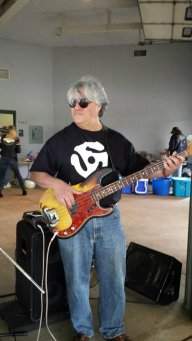
Jim I would certainly agree with you that we geezer would've jumped at the chance for better gear back then. We made due with what we had.

As far as the Beatles go, I think that their desire to quit touring had more to do with the noise of the screaming girls, and their lack of interest in 'the music' than it did with dissatisfaction with their gear. As far as I know, all four Beatles were notoriously non-gear heads.

Look I'm not saying that more watts isn't better but I am saying that if we were able to cover a club in 1968 w/ a 200 Acoustic or a 300 watt SVT, then I don't see why we shouldn't able to do so now. I believe it has more to do with expectations of where we feel we should be in the mix as well as the smiley eq so popular w/ the slappers.

My .02.
 
IMO/IME 400 +/- 100 watts is about the norm for the vast majority of bar bass gigs. 150 to 1200 watts and anything in between wouldnt be out of the ordinary though.

so many variables such as desired tone where you sit in the mix, PA supprt, etc matter more than the exact wattge posted on a message board.
 
My 300w 800RB is doing just fine, and I play exclusively in bars :smug:

I play in a loud "drunk rock" band (see sig) and I've got some stiff competition with a JCM 900 2x12 half-stack and an Ampeg 4x12 half-stack. It's going through an 8 ohm 115 at the moment, but come September, I'll be rockin' a 4 ohm 410 and I don't expect any problems whatsoever. I plan on upgrading to a new Mesa M6 in the future, but that's in the distant future.
 
In a small bar, I bring my 1980's Bassman 120 Combo with a single 15 and use it. Both our guitarists use amps with single or double 12" speakers, so it balances out nicely.

I think the pattern here is the overall sound of the band. This is where communication is important. If the guitar players insist on bringing 200+W huge stacks to gigs, multiply by two (if two guitar players) and a loud drummer, the bass player has to compensate. However, there's another approach, there's no need to play so loud in bars, people run out from such places if its too loud. They could neither really hear what's going on concerning music.

So the communication part is to sit down and talk with the band members, what do they want to achieve? A loud wall of sound, or something that people want to hear? Based on that each member should adjust their amp specifications so it works better.

In most cases a good PA is really the best solution, let the PA handle the overall sound and any amps are mostly for on stage monitoring.

There's even the option to go totally with DI (such as what Todd Rundgren did with the Liars Tour) and let the PA handle the user experience and the monitoring is for band members.

I tested out last night the approach of just bringing a Line 6 PodXT to a bar gig (playing guitar), the biggest problem was indeed monitoring, there was none, so I had to be close to one of the main PA cabs in order to figure out what I was playing. But the guitar sound was crispy and produced, that was for sure.
 
...In most cases a good PA is really the best solution, let the PA handle the overall sound and any amps are mostly for on stage monitoring...

I agree, and see Pedro does, too. My problem has been the communication part. Convincing a couple of guitarists with vintage tube amps that they need to use pedals instead is like trying to convince me that all I need is a DI.

I sympathize with their love of tone, but know that you are correct that loud bands lose their audience in most bars--though there are exceptions. I suspect bassists are rarely to blame.

The main thing is that if people want to dance, drink, talk, and enjoy each other's company, a loud band is not going to work out for long, not matter what the wattage the bassist is packing. :eyebrow:

I have heard genuine exceptions to this recently, but it is just not my thing to stand around in a black room with an all male audience of very large hairy tattooed young guys, and listen to a metal band at 118 db (musicians -25 db earplugs in place) for more than half a set.

I know this for sure because I recently caught a decent metal act at Dan's Silverleaf in Denton, TX. It is a small club, and the bassist had 1600 SS watts burning brightly. He was not really audible, but was actually just a very low freq presence, sort of a loud low rumble or hum. Pitches and even attacks were not distinguishable. It did convey a cavernous and frightening feel, which I think just may have been the point. :eek:

BTW, the guys in the audience were all super polite and I am not putting down metal styles/looks--it is just all very distant from my experience. I told my wife afterward (she was with me), that the guys probably looked at us and thought, "Aw, now ain't that sweet, the Grandparents of one of the guys in the band have the guts to come and hear them!" LOL :D :D :D :D
 
I know this for sure because I recently caught a decent metal act at Dan's Silverleaf in Denton, TX. It is a small club, and the bassist had 1600 SS watts burning brightly. He was not really audible, but was actually just a very low freq presence, sort of a loud low rumble or hum. Pitches and even attacks were not distinguishable. It did convey a cavernous and frightening feel, which I think just may have been the point. :eek:

If the volume levels are at this point, it's even debatable if there's a difference between a band and a tape recorder playing back rhythmic sounds from a factory. Sounds like I'm an old man yelling at clouds, now...
 
There are SO many variables I think it's very hard to have one rig that will cover everything without lugging more weight than you really need.

As previously posted, the volume of the rest of the band has the biggest impact IME. My current band's lineup is guitar, bass, drums, and keys, and we occasionally have a sax player sit in. We play blues rock. The keyboard player specializes in old school organ tone, so he brings a Hammond B3 and a Leslie cabinet to many gigs.

Just the addition of that monster requires way more volume from me to blend in. He likes to play pretty loud.

What I've settled on is this selection of amps:

Carvin BRX112Neo combo - 300 watts into a single 12" neo. That works great for very small rooms or stages, but won't keep up if the Hammond is in the mix. Then I put a 210 neo cab under it, gives me about 700 watts through the 3 speakers. That will handle most situations.

Carvin B1500 head into a Carvin BRX410Neo cab - For big rooms or outdoor gigs this is my go-to rig. That's 1200 watts and I have yet to really challenge the limits of this setup, even when it's crazy loud.

The B1500 into the single 210 is also pretty impressive. The amp is still putting out 1200 watts but the box is rated for 600, so I have to be careful not to overdo it, but it handles most club venues really well.

Most of the time I leave the combo at home to practice, the 210 in our rehearsal space, and the 410 in the garage until it's gig time...then all I have to haul around for rehearsals is my B1500 in an SKB RotoRack...not bad at all.

I like being able to match the rig to the gig and this gear lets me do it.
 
I agree, and see Pedro does, too. My problem has been the communication part. Convincing a couple of guitarists with vintage tube amps that they need to use pedals instead is like trying to convince me that all I need is a DI.

I sympathize with their love of tone, but know that you are correct that loud bands lose their audience in most bars--though there are exceptions. I suspect bassists are rarely to blame.

The main thing is that if people want to dance, drink, talk, and enjoy each other's company, a loud band is not going to work out for long, not matter what the wattage the bassist is packing. :eyebrow:

I have heard genuine exceptions to this recently, but it is just not my thing to stand around in a black room with an all male audience of very large hairy tattooed young guys, and listen to a metal band at 118 db (musicians -25 db earplugs in place) for more than half a set.

I know this for sure because I recently caught a decent metal act at Dan's Silverleaf in Denton, TX. It is a small club, and the bassist had 1600 SS watts burning brightly. He was not really audible, but was actually just a very low freq presence, sort of a loud low rumble or hum. Pitches and even attacks were not distinguishable. It did convey a cavernous and frightening feel, which I think just may have been the point. :eek:

BTW, the guys in the audience were all super polite and I am not putting down metal styles/looks--it is just all very distant from my experience. I told my wife afterward (she was with me), that the guys probably looked at us and thought, "Aw, now ain't that sweet, the Grandparents of one of the guys in the band have the guts to come and hear them!" LOL :D :D :D :D


Ya know Jim everytime I read about the volume nightmare other guys experience w/ their guitar players/drummers I feel so grateful for the guys I play with. It's never been a problem w/ either set of guitarist or drummer I play with. Our new keys player is trained composer and very sensitive to volume so the drive to reduce stage volume is even stronger.

As for the volume of the band in a bar setting etc. given that the two bands I play in do oldies (one does soul and the other more pop oriented) I'm kind of hoping that our low volume is actually a selling point.
 
BAHAHAHAHAHAHAHH!!!!

Well here's some historic repretoire being performed by yours truly in a large, semi outdoor venue with a 100 watt amp and p bass just like the old days. The ham-fisted bass player asides, I think the old under-powered amp keeps up pretty good.


Nice, Pedro! It's good to hear the V-4 in action. Next time, though, try to make a longer clip, please.:D
 
Nice Pedro! Well balanced retro reunion.

I'm pretty sure neither my Orange OR120 with the reflector cab or the Mesa M6 Carbine Combo would have been happy in that setting, besides I have yet to get the master vol on the M6 over 9:00 at any of my gigs yet in August even without FOH support.

I'm starting to believe that R&R was meant to be played in the original context of vocals only in the PA and no reinforcement for any of the other instrumentation, it just sounds more authentic to this Old Fart that way, especially in the on topic context of small bar gigs.

Cheers,

Mr. BEAR
 
Nice Pedro! Well balanced retro reunion.

I'm pretty sure neither my Orange OR120 with the reflector cab or the Mesa M6 Carbine Combo would have been happy in that setting, besides I have yet to get the master vol on the M6 over 9:00 at any of my gigs yet in August even without FOH support.

I'm starting to believe that R&R was meant to be played in the original context of vocals only in the PA and no reinforcement for any of the other instrumentation, it just sounds more authentic to this Old Fart that way, especially in the on topic context of small bar gigs.

Cheers,

Mr. BEAR

Thanks Bear. Obviously, I grew up with PA for voice only and was happy to continue that way but I've changed my mind. Its a great advantage to be able to tweak the mix out front without having to blow your fellow bandmates ears out. I don't have any personal experience doing this but it seems logical that doing so would help keep the volume on stage low and make for a more musical and pleasant experience. In other words, I'm anxious to try.