I should have said I use a 5/16 socket on a 1/4" drive. I have Craftsman sockets and they seem to fit okay.

TalkBass has been independent since 1998. Add your voice.
Create a free account to reply to discussions, view embedded media, and browse with fewer display ads.
Join free Log in
Want zero display ads or expanded classifieds tools? Compare plans.

Buying the correct tool is a good idea, sockets tend to be too thick walled.
Just to clarify, 1/4" is not the size of the nut, the nut is a 5/16"
Searching Gibson type truss rod wrench or 5/16" truss rod wrench or 5/16" truss rod tool will pull up some good choices.
I think the Allparts tool works well in most Peavey necks.
I think the Taylor 5/16" is also a good fit.
With the correct tool, there is no need to take off tuners or string tree.
I knew that's what you were saying, just wanted to clarify for anybody who might get it confused.
Some Peaveys have room for a regular socket but most of them I've had did not have room for a regular 1/4 drive six point socket.
And some of the Gibson type tools are too short to reach, the socket part needs to be longer than the short ones.

The B-Ninety is a different design than the peavey bass usually discussed here. There’s no string tree, it’s much lighter, 12” radius on smaller nickel alloy frets, light weight tuners, good access to upper frets even when sitting. The thinness of the neck makes the fretboard feel flatter. The finish on the neck is courser, but the paint finish is better than the late 90s models.Thanks Cliff. I was wondering what are the differences between the 90 and Foundation S Active. Below is a Foundation S Active and B90
View attachment 3673386View attachment 3673388
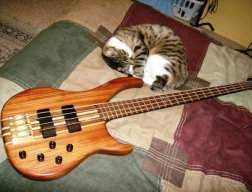
WOW !!! SO COOL !!! It's like a Foundation, but different position for the pups. It looks so natural. I bet it sounds MEAN !!! I can see why we all want to "borrow" your idea.It is a Ric killer, which was my intention with this one. I call it "RicRiot."
SFs sound pretty similar to High Gains, and the locations are pretty much the same as a 4003. Put a switch on it and moved the jack to the side.
View attachment 3673224

IMO the B-Ninety is a niche bass. If your looking for a bass to parade around as a ‘Fender Killer’ or to demonstrate ‘peavey goodness’, then this isn’t the bass you want. The unique neck profile, if appreciated by the player, can make the bass a personal joyful playing experience. It’s fun to play. A guitar player coming to bass will love it because it’s fast and easy to play, but a chunky neck fender slab bass player who spends all their time below the fifth fret might not like it.
I did the EXACT same, but since have ordered the correct tool, so now no tuner removal necessary.So far my Craftsman socket has fit the Peavey basses that I have used it with. I use it on an extension but usually have to remove a tuner to gain access.

Buying the correct tool is a good idea, sockets tend to be too thick walled.
Just to clarify, 1/4" is not the size of the nut, the nut is a 5/16"
Searching Gibson type truss rod wrench or 5/16" truss rod wrench or 5/16" truss rod tool will pull up some good choices.
I think the Allparts tool works well in most Peavey necks.
I think the Taylor 5/16" is also a good fit.
With the correct tool, there is no need to take off tuners or string tree.
8” radius? I haven’t measured but it feels way too flat to be 8”. Well that’s pretty cool!The B-Ninety:
Poplar Body.
Solid brass milled bridge with saddle tracks
All black hardware
Reduced mass mini tuners
P+J internally active split coil hum-cancelling pickups
Neck:
8" radius fretboard
1.6" width at nut
Wide radius back profile
I’m sure that’s correct, but I’m surprised to learn that. Another Peavey innovation, creating a kinesthetic illusion of flatness to avoid retooling costs, then passing the savings along to the consumer. Nice!Peavey operating guide says that.

Rolled edges and a low number radius are my favorites. I can go a bit flatter with 5 and 6 string basses.I prefer the old 7.25" Fender, 8" Peavey, 9.5" Fender, 10" Yamaha fretboard radius necks to the more modern numbers.
Had a Warwick with a 20" radius and just could not feel the love on that one.
I also tend to like a fretboard with the the edges "rolled" a bit, seems I don't notice until they are not that way.
I prefer the old 7.25" Fender, 8" Peavey, 9.5" Fender, 10" Yamaha fretboard radius necks to the more modern numbers.
Had a Warwick with a 20" radius and just could not feel the love on that one.
I also tend to like a fretboard with the the edges "rolled" a bit, seems I don't notice until they are not that way.

I believe someone here was wanting a Generation 1 TL 5 and there is one on GC's website for $599. It looks good in the only photo provided.
[Invalid or Expired Link Removed]

There was a blue TL-5 near me for $399...was keeping it a secret from you guys. Waiting for some gig pay to come in but it got removed....too late