• TalkBass has been independent since 1998. Add your voice.
    Create a free account to reply to discussions, view embedded media, and browse with fewer display ads.
    Join freeLog in
    Want zero display ads or expanded classifieds tools? Compare plans.

Unusual Rock Trivia?

In the name of Allan Holdsworth -
RIP 4/15/2017. I never knew it came down to this.

FANS of acclaimed Bradford-born guitarist Allan Holdsworth, who died earlier this month, have helped raise more than $114,000 to pay for his funeral.

Mr Holdsworth died aged 70 on April 16 in California. He was revered by top musicians including Eddie Van Halen and Tom Morello for his guitar-playing ability and groundbreaking style and technique.

Following his death, a GoFundMe campaign was set up on behalf of his family to raise $20,000 to help cover funeral costs.

More than 2,500 people donated a total of $114,270 – more than five times the initial target – before the campaign was brought to an end by Mr Holdsworth’s family.

The fund was set up as despite his talent, Mr Holdsworth “died broke”, according to his daughter Louise.

She said: “People think dad was rich because he was ‘famous’.

“He refused to sell out, he only played what he wanted, and died broke because of it.”
 
Last edited:
Tony Iommi played a Strat in Jethro Tull at a gig organised by The Rolling Stones.

This is a pic of another band at the gig.
Thedirtymac.jpg

The_Dirty_Mac
 
Last edited:
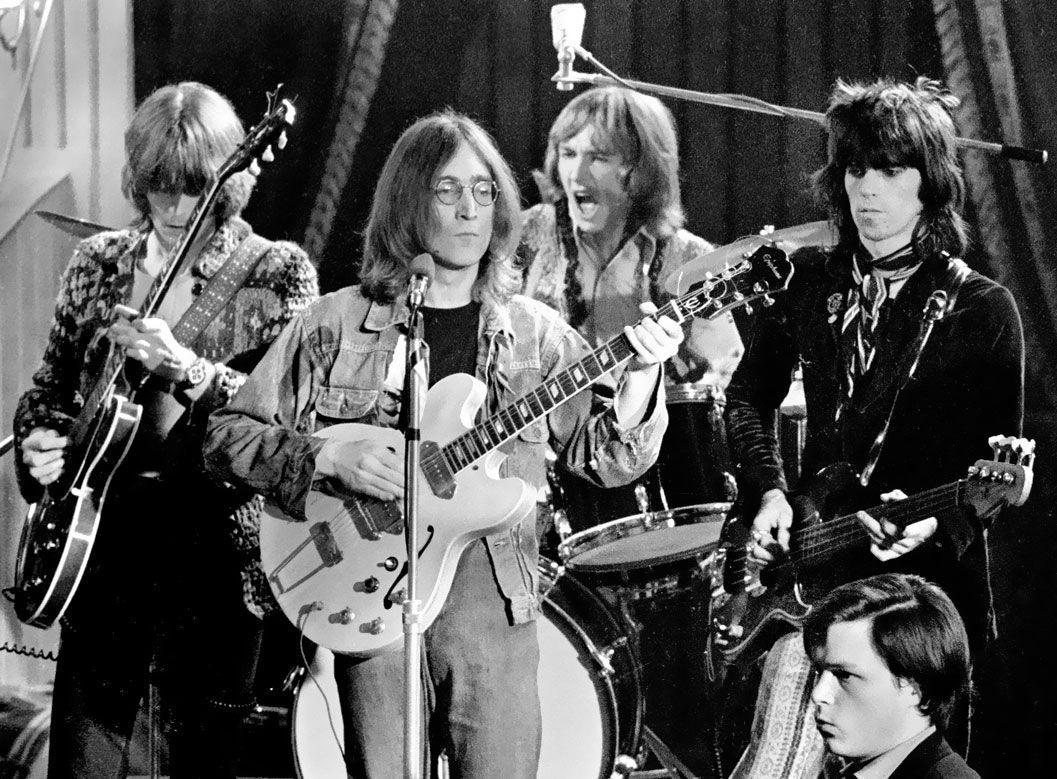
This is a pic of another band at the gig.

"The Dirty Mac" - Lennon's pick up 'super-group' with Clapton, Keith Richards, and Mitch Mitchell on The Rolling Stones Rock and Roll Circus television program.

I believe that's Michael Lindsay-Hogg in the lower right hand corner of that photo. He was the director of the filming that became Let It Be (and later, Peter Jackson's Get Back).
 
"The Dirty Mac" - Lennon's pick up 'super-group' with Clapton, Keith Richards, and Mitch Mitchell on The Rolling Stones Rock and Roll Circus television program.

I believe that's Michael Lindsay-Hogg in the lower right hand corner of that photo. He was the director of the filming that became Let It Be (and later, Peter Jackson's Get Back).
I think Yoko may have graced the performance with some vocals too,,,
 
Tony Iommi played a Strat in Jethro Tull at a gig organised by The Rolling Stones.

This is a pic of another band at the gig.
Thedirtymac.jpg

The_Dirty_Mac

Just to add...
The Rolling Stones and their guests performed in a replica of a seedy big top on a British sound stage—the Intertel (V.T.R. Services) Studio, Wycombe Road, Wembley—in front of an invited audience. The performances began at around 2 pm on 11 December 1968, but setting up between acts and reloading cameras took longer than planned, which meant that the final performances took place at almost 5 o'clock in the morning on the 12th.

By that time the audience and most of the Rolling Stones were exhausted. It was only due to Jagger's sheer enthusiasm and stamina that they kept going until the end. Regardless, Jagger was reportedly so disappointed with his and the band's performance that he cancelled the airing of the film, and kept it from public view. Pete Townshend recalled:

When they really get moving, there is a kind of white magic that starts to replace the black magic, and everything starts to really fly. That didn't happen on this occasion; there's no question about that. They weren't just usurped by The Who, they were also usurped by Taj Mahal – who was just, as always, extraordinary. They were usurped to some extent by the event itself: the crowd by the time the Stones went on were radically festive.
9abeb3ed-15d7-470c-bbec-813bc1eda6b9.jpg
 
Keyboardist and violinist Eddie Jobson was briefly a member of Yes in 1983 after the departure of keyboardist Tony Kaye. Jobson neither recorded nor performed live with Yes. His only official appearances with the band were in promotional photographs, and in the video for "Owner Of A Lonely Heart," but the video was released after Kaye had rejoined and Jobson had departed. This resulted in Jobson appearing (though edited out as much as possible) in the original version of the song's video. Jobson has stated on his website that he was asked to replace Kaye, and was hesitant to do so until after hearing the band's new release, and then rehearsing with the band in London. He returned to his home in the US as a full member of Yes, and set forth learning the band's repertoire. However, several weeks later he received a call from the band's management advising that Kaye was back in the group and the two would be sharing keyboard duties. Jobson declined, and left the band.

[Invalid or Expired Link Removed]

3ebda-trevor9012545.jpg


Last edited:
Ronnie James Dio sang the part of a frog.

Ian Gillan deputised for him on a live performance.

David Coverdale and Glenn Hughes also performed on the album and live.
Dio subsequently performed one of the songs with Deep Purple.

Linking to the above Yes story, you can catch a glimpse of Eddie Jobson in the Gillan video.
 
Ronnie James Dio sang the part of a frog.

Ian Gillan deputised for him on a live performance.

David Coverdale and Glenn Hughes also performed on the album and live.
Dio subsequently performed one of the songs with Deep Purple.

Linking to the above Yes story, you can catch a glimpse of Eddie Jobson in the Gillan video.


i might be wrong, but I suspect The Butterfly Ball which the first clip comes from was the first (western) album focused on what we now call Conservation. Loved that album when I first heard it all those years ag, still do today. :)
 
  • Like
Reactions: SubHuman
Pino Palladino on how he came to play with The Who.

“When the call came to play with the Who I was working with Erykah Badu and D’Angelo, and I had to change my whole style,” he said. “The manager said, ‘John [Entwistle] is dead. Can you do a gig at the Hollywood Bowl in three days’ time?’ You don’t turn down something like that. It was only afterwards that I thought about the consequences. Pete Townshend’s direction was, ‘Play whatever you want, just as long as you play loud!'”
 
Mr Holdsworth “died broke”, according to his daughter Louise.
She said: “People think dad was rich because he was ‘famous’.
“He refused to sell out, he only played what he wanted, and died broke because of it.”

One of the most memorable (albeit sad/tragic) quotes from Allan Holdsworth in a late-1980s magazine interview I read was when he was talking about his SynthAxe and casually mentioned "I had to sell a house to afford this instrument."
 
On New Year's Day, 1962, Decca, looking for a beat group, auditioned two promising young bands: Brian Poole and the Tremeloes and another combo (also heavily influenced by Buddy Holly) from Liverpool called the Beatles. Decca chose Brian Poole and the Tremeloes over the Beatles, reportedly based on location – the Tremeloes were from the London area, making them more accessible than the Liverpool-based Beatles.

Here's a video of the Decca Exec that signed the Tremeloes over The Beatles.
giphy.gif
 
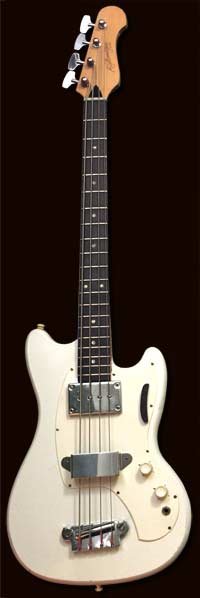
The first Kalamazoo KB basses have a remarkable similarity to the Fender Mustang bass.
Fender's Mustang guitar launched in 1964, and the bass model only followed in mid 1966.

Although the Kalamazoo bass is modelled on the guitars, it may have even preceded the Fender bass! There is no evidence of communication between Fender and Gibson on this matter, but if Fender objected to the Gibson Thunderbird as being too much like a Fender, they would certainly felt the same about the KB bass below. At least they were both contemporaneous, both hitting stores in 1966. The audacity was compounded by offering the line in the same three bold finishes as the Mustang: red, white and blue.
So Gibson hardware and $80 cheaper than a Fender...

1966_Kalamazoo_KB-1_1.jpg


For reasons unknown (although it would not be surprising if it was a threat from Fender), the KB bass and KG guitars were redesigned in 1966 with a new SG body style.

[Invalid or Expired Link Removed]

As the KG guitars were available a year before the basses, the Mustang-style instruments were made in far greater numbers than the SG style ones. For the basses, the reverse is true: the body style changed happened very quickly after the KB bass' launch, so Mustang-style examples are far less common than the SG style.

The original bass had the same styling as the guitars; that is, they were really a copy of the Fender Mustang. Though to be fair, they were fitted entirely with Gibson hardware.