• TalkBass has been independent since 1998. Add your voice.
    Create a free account to reply to discussions, view embedded media, and browse with fewer display ads.
    Join freeLog in
    Want zero display ads or expanded classifieds tools? Compare plans.

Unusual Rock Trivia?

Not exactly rock, but still.
Buddy Rich began playing drums in vaudeville when he was 18 months old, billed as "Traps the Drum Wonder." At the peak of Rich's childhood career, he was reportedly the second-highest paid child entertainer in the world.
"Photo of Buddy Rich as a child performer, from 1923, when Buddy would have been about 6 years old, contributed by Rex Strother, from Salt Lake, Utah."
Invalid Link Removed
I always enjoyed Buddy Rich on Johhny Carson. He was an amazing drummer! Check out this duel between two master drummers on Carson's show.
 
big_dtu8FQ.jpg

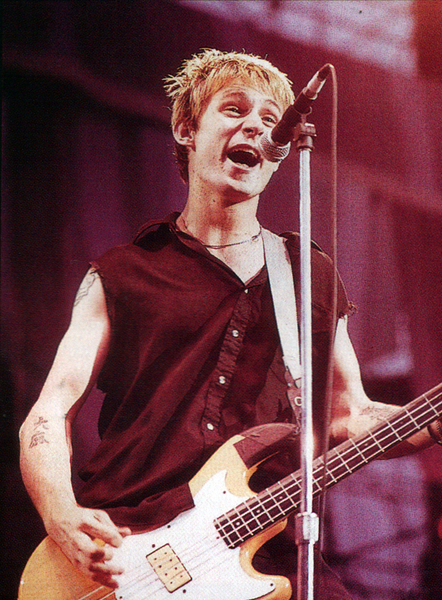
Green Day bassist Mike Dirnt's birth name was Michael Pritchard. He got his name from playing air bass with a pick and saying "dirnt, dirnt, dirnt", trying to pretend playing bass.
 
big_dtu8FQ.jpg

Green Day bassist Mike Dirnt's birth name was Michael Pritchard. He got his name from playing air bass with a pick and saying "dirnt, dirnt, dirnt", trying to pretend playing bass.
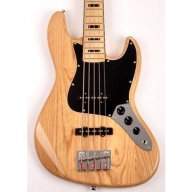
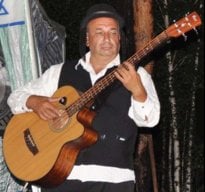
I like the looks of the pickup in that bass, probably sounds great.
At one time he could be seen (early video) playing a Peavey Patriot bass, and it sounded great.
 
  • Like
Reactions: IMMusicRulz
I'm thinking that pic is not from 1974.
FWIW, Casandra posed nude in the Men's Magazine High Society in 1974. :drool:

Looking this up now for historical purposes...Thx!
I also looked up those pics, strictly for historical purposes obviously.
Definitely a ginger (carpet matches the drapes)...back in the days when carpet was still popular. :D
 
The Syn-Ket is fascinating, because, though it was introduced a year before the Moog modular synthesizer, it’s a powerful all-in one multi-timbral instrument. It features a three-tiered keyboard that support microtonal tuning, velocity sensitivity and expressive pitch control via left-to-right motion.

“In 1963, when synthesizers were wall-sized, Paolo Ketoff designed a portable yet sonically rich electronic instrument, the Syn-Ket. Created for film scoring and experimental musicians, the Syn-Ket became a classic of Italian film scoring, with Ennio Morricone being one of the early adopters. Only 8 or 9 where made.

2F69BC16-4E15-4D3E-AF54-5246DF7A9FCD.jpeg
 
In the January 2003 issue of Guitar World, there’s a story called “Do You Want to Know a Secret: Confessions of the Quiet Beatle,” a previously unpublished Harrison interview from 1992. At one point, writer Vic Garbarini asks Harrison to choose his best slide solo.

“The best slide solo I ever played was on… what’s her name? That girl singer who used to be with that all-girl band? Belinda Carlisle of the Go-Go’s! That’s who it was,” Harrison said. “I played on one of her albums. One of the slide solos had its own little tune which related to the tune Belinda was singing, but it’s also a little composition in its own right, which I was really pleased with.” Harrison played on two Runaway Horses tracks—“Leave a Light On” and “Deep Deep Ocean”—but we’re assuming he was talking about “Leave a Light On.” His solo starts at 3:01.
 
“True Love,” Harrison’s shiny, happy 1976 cover of a 1956 Cole Porter tune, is a perfect snapshot of his mid-to late-Seventies slide playing and glassy Strat tone. Just check out his perfect intonation during his mini solos, which start at 1:18 and 1:33. For his slide guitar, he again makes great use of what sounds like an open tuning (probably open E or D) to play two-and three-note combinations of triadic chord tones at the same fret, with excellent pitch centering and a soulful, polished vibrato.

Similar to what he famously did in “My Sweet Lord,” the guitarist throws in his signature diminished-seven arpeggios (over the progression’s diminished-seven chords), with an overdubbed second slide guitar adding a harmony line below the melody. Around this time, Harrison made several humorous (pre-MTV) promotional clips for his singles, including “True Love.”
 
The Library of Congress has a substantial number of items in its Leonard Bernstein collection - scrapbooks, press clippings, programs, diaries, books - and fan mail. In that last category is a letter from eight-year-old Jordan Rudess, future keyboardist of the legendary progressive metal band, Dream Theater.
The letter starts politely enough: "Dear Mr. Bernstein, How long do you practice?" But further down, the young writer changes his tone. "I think I play better than you," asserts Rudess. "Do you want any advice?"
The letter was uncovered by the Library's Music Reference Specialist Heather Darnell. Rudess agreed to an interview with her, and the results are delightful!
Read here Dream Theater’s Jordan Rudess on His Letter to Bernstein | In The Muse: Performing Arts Blog
Invalid Link Removed