• TalkBass has been independent since 1998. Add your voice.
    Create a free account to reply to discussions, view embedded media, and browse with fewer display ads.
    Join freeLog in
    Want zero display ads or expanded classifieds tools? Compare plans.

Unusual Rock Trivia?

Gary Lee Usher (December 14, 1938 – May 25, 1990) was an American rock musician, songwriter, and record producer, who worked with numerous California acts in the 1960s, including the Byrds, the Beach Boys, and Dick Dale. Usher also produced fictitious surf groups or hot rod groups, mixing studio session musicians with his own troops (Chuck Girard, Dick Burns and others). These bands included the Super-Stocks, with the hot-rod song "Midnight Run", and the Kickstands.

Happy%20In%20Hollywood%20-%20The%20Productions%20Of%20Gary%20Usher%20_header_%201000.jpg


Usher's masterpiece was Present Tense, the first Sagittarius album, released in 1968 by Columbia Records. It was known as the most expensive album ever produced at the time. Though the record was basically a Gary Usher solo project, he enlisted many top LA session musicians, and heavily utilized Curt Boettcher as a songwriter, musician, vocalist, and producer. One song stood out in particular..."My World Fell Down".
Many thought "My World Fell Down" was a Beach Boys song and Beach Boy Bruce Johnston sang on the recording too. The song included Glen Campbell on lead vocals and a lot of The Wrecking Crew.


Also worth pointing out is that Usher had written several songs with Brian Wilson (”409” and “In My Room” among them) and also included in the backing group were powerhouse session players Hal Blaine and Carol Kaye, who had both recorded with the Beach Boys. If someone played this for you and told you it was an unreleased—and especially odd—Beach Boys demo, you’d believe them, no problem.

"My World Fell Down" is actually a pretty faithful cover of the song by The Ivy League from 1965.

 
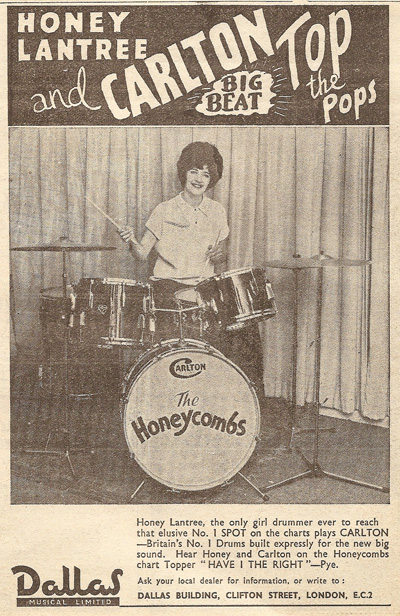
Honey Lantree was that rare thing in a 1960s beat group – a woman. As the drummer of the Honeycombs, who had a No 1 UK hit with Have I the Right in 1964, she disliked being dismissed as “a gimmick”, nor did she buy into the idea of being a pioneer. She just happened to be good on the drums, and that’s the way it was.

honeycarltondrums.jpg


The height of Honey’s fame with The Honeycombs came in the mid-60s when, immediately after the success of Have I the Right, she became the focal point of interest in the band and a magnet for magazines, which chose mainly to write about her clothes, her hair and her looks. I also read that the legendary Joe Meek (Look him Up!) who produced the album, placed a condenser microphone under a set of wooden stairs, and they all lined up and stomped their shoes to the beat of the chorus. Check out the crazy Guitars and Bass. Honey rocks on the drums too.


In the wake of their hit single, the Honeycombs undertook a tour of one-nighters with Gene Vincent with Lulu and the Applejacks (who had a female bass player).
Here's another one of their songs from 1964...

 
Last edited:
Lol…just to expound on Leland and his Billy Thorpe days, here he is laying in front of his specialized Billy rig. Ironically, he had it for sale on reverb.com a few years ago. Geez! What an incredible system. Here’s a pic and links both links to the article and ad.

View attachment 4848710

Leland Sklar Is Selling His Billy Thorpe Rig

Klipsch MCM MSM 1900 Loudspeaker PA System Altec 291-16B Leland Sklar #37951 | Reverb
Dang…massive rig! A lot of those old rockers blew their hearing out. Not sure about Sklar’s. No one wore any ear protection. That’s crazy but I went to quite a few concerts with massive wall to wall amps on stage.
 
  • Like
Reactions: MCF and roccobass
Lol…just to expound on Leland and his Billy Thorpe days, here he is laying in front of his specialized Billy rig. Ironically, he had it for sale on reverb.com a few years ago. Geez! What an incredible system. Here’s a pic and links to both article and ad.

View attachment 4848710

Leland Sklar Is Selling His Billy Thorpe Rig

Klipsch MCM MSM 1900 Loudspeaker PA System Altec 291-16B Leland Sklar #37951 | Reverb
Is he exhausted because he had to move all that stuff by himself?:laugh:
 
The Kinks were able to plagiarize themselves with the song "Destroyer" with a riff that sounds just like "All Day and All of the Night".

"Destroyer" was released as a track on the group's Give The People What They Want album in August 1981, and was the album's lead single in the US. It was not released as a single in the UK.

The song features references to the band's earlier hits, including the riff from 1964's All Day and All of the Night" and lyrics inspired by 1970's "Lola".

"Destroyer" was initially planned to appear on the band's previous album, Low Budget, appearing in early track listings of the in-progress album. However, the song was dropped from Low Budget because the band could not create a satisfactory mix. "Destroyer" was ultimately recorded at the Power Station studio in New York. Drummer Mick Avory attributed the song's dense sound to the studio's audio dynamics.


The Kinks were able to plagiarize themselves with the song "Destroyer" with a riff that sounds just like "All Day and All of the Night".

"Destroyer" was released as a track on the group's Give The People What They Want album in August 1981, and was the album's lead single in the US. It was not released as a single in the UK.

The song features references to the band's earlier hits, including the riff from 1964's All Day and All of the Night" and lyrics inspired by 1970's "Lola".

"Destroyer" was initially planned to appear on the band's previous album, Low Budget, appearing in early track listings of the in-progress album. However, the song was dropped from Low Budget because the band could not create a satisfactory mix. "Destroyer" was ultimately recorded at the Power Station studio in New York. Drummer Mick Avory attributed the song's dense sound to the studio's audio dynamics.


John Fogerty got sued by his old record label for sounding like himself.
 
Regarding the whistle at the end of Otis Redding’s Dock of the Bay. He and co-composer Steve Cropper were supposed to finishing it up when Otis was to return from the I’ll-fated Wisconsin trip. Otis was not the whistler on the song.

Otis Redding did originally come up with a whistle for the end of the song.
According to Steve Cropper, Redding was still pondering adding a 4th verse to “(Sittin’ On) The Dock of the Bay” or lyrics to an outro. Otis just finished up the song with a whistle as a placeholder because he had nothing else left to add. Presumably, when he was to get back from his trip to Wisconsin, him and Cropper were going to finish it up.

So the story goes, a grief-filled Cropper returned to the studio to edit the song, heard the whistle outro again, and thought it fit perfect with the fade-out but needed and overdub. Thus, the call to Sam “Bluzman” Taylor.

Sam Taylor was a career singer-songwriter, guitarist, and session musician. During his truly colorful career, Taylor worked with, rubbed elbows, got breaks for, and influenced a number of popular acts in the 1960s, ’70s.
 
  • Like
Reactions: SubHuman and TyBo
Jimi Hendrix Had the Biggest Concert of His Life Saved By a Pink Floyd Member Who Wasn’t Performing
Roughly a year after his psychedelic version of “The Star Spangled Banner” rocked the Woodstock festival in the United States, Jimi Hendrix was one of the main draws at the 1970 Isle of Wight Festival. In addition to Hendrix and his group, the bill included some of the biggest acts of the day. The Who, Joni Mitchell, the Moody Blues, Miles Davis, Jethro Tull, Sly and the Family Stones, and The Doors also played. Still, Hendrix had a prime slot playing late on the festival’s final day. (It ended up being the early morning hours of the following day). The Guardian estimates at least 600,000 people attended the 1970 Isle of Wight Festival. That would make it Hendrix’s biggest concert in terms of attendance, and it took a member of Pink Floyd to save the day once Jimi took the stage.

Pink Floyd were on their way to success in 1970, but they weren’t yet quite a household name. Floyd didn’t play the Isle of Wight in 1970, but guitarist David Gilmour attended as a fan and sat in the crowd when Hendrix took the stage for the biggest concert of his life. Hendrix followed Jethro Tull on the stage. The bands possessed drastically different sounds, and the sound engineers encountered some issues setting up for Hendrix’s set. Gilmour had some experience working mixing boards after producing former Floyd guitarist Syd Barrett’s solo albums. So he stepped in and salvaged Hendrix’s biggest concert, per Prog magazine (via Guitar World):
“I went down to go to [the Isle of Wight], and I was camping in a tent, just being a punter. I went backstage where our main roadie guy, Peter Watts, was trying to deal with all the mayhem with Charlie Watkins of [Watkins Electric Music]. They were very nervous; they were going to have to mix Hendrix’s sound. I did some mixing stuff in those days and they said, ‘Help! Help!’ So I did.”
 
On July 31, 2008, The Black Crowes filed a lawsuit against Gretchen Wilson for copyright violation, alleging that her song "Work Hard, Play Harder" copied the Crowes song "Jealous Again". Also included in the suit were her label Sony BMG, her publishing company, and the cable network TNT, which had been using the song in commercials. The lawsuit was eventually settled out of court for an undisclosed sum and Black Crowes members Chris and Rich Robinson were given songwriting credits.