• TalkBass has been independent since 1998. Add your voice.
    Create a free account to reply to discussions, view embedded media, and browse with fewer display ads.
    Join freeLog in
    Want zero display ads or expanded classifieds tools? Compare plans.

Upgrading OpAmps in Iffy OEM Preamps Advisable?

Nov 9, 2001
8,047
148
California
Disclosures
No Bogus Endorsements
Has anyone found any improvement in noise/tone by replacing the OpAmps in cheap OEM preamps with higher-grade compatible ones?

The pre in the bass I just picked up runs an 082 and seems excessively noisy to me and I seem to recall that there's a direct replacement Burr-Brown for it.

Just asking. Might be simpler than building a new preamp. :hmm:
 
Has anyone found any improvement in noise/tone by replacing the OpAmps in cheap OEM preamps with higher-grade compatible ones?

The pre in the bass I just picked up runs an 082 and seems excessively noisy to me and I seem to recall that there's a direct replacement Burr-Brown for it.

Just asking. Might be simpler than building a new preamp. :hmm:

Depends. Do you own or at least have access to an oscilloscope? IME it is mandatory to look for ultrasonic oscillations and other potential "gotchas" any time you move to a higher gain/bandwidth opamp. TL082 is a pretty generic part though, and your chances of liking something else better are probably pretty decent. I have done hundreds of op amp replacements in rack gear and floor effects boxes, but have no direct experience related to onboard preamps beyond my own DIY ones. I just used the Bart preamp with my Bart pickups when I had them.

In another thread I think I saw you mention that the preamp uses surface mount devices? That'd be outside of my current skill set. Hat's off to you if you have the tools and skills to deal with it.
 
+1 to the above.

One precaution is that a JFET op amp probably has to be replaced with another JFET type, because the circuit may not contain the extra components needed to balance the bias currents on a bipolar type op amp. Also, there is a direct relationship between speed, noise performance, and current consumption in JFET op amps. This is one reason why active basses often pay a noise penalty.

If the circuit is designed around an 082, there's a chance that resistor values were not chosen for low Johnson noise, in which case a low noise op amp might not make much of a difference.

What's the preamp doing in your bass? If you're up for a DIY job and the circuit is just doing basic gain / buffering, then there are simple discrete JFET circuits that will yield excellent noise performance while remaining relatively frugal of battery juice. Tone control circuits can be done this way, but the complexity might discourage onboard use.
 
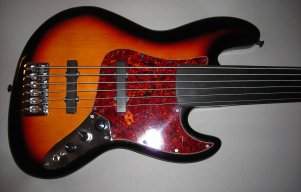
The problem is that the bass has $250 worth of OEM Bartolini BB4 pickups and a fifty-cent preamp the size of a (small) postage stamp mounted on one of the pots. :rolleyes:

There's not much on it and nothing but the 082 that I can readily identify, and assume the noise I'm getting (with the treble up) is traceable to the OpAmp. I'm requesting a schematic, though I don't have great hopes of getting it. Problem could be that it's not a good choice for the rest of the circuit.

I was thinking of building a DIY design if a good one presented itself, but then there'd be the probability of sourcing different value pots, etc., etc. and it's just not worth it to me, nor is buying some obscenely-overpriced aftermarket preamp.

If a quick component change would do it, great, otherwise I'll just blow the whole thing off.

Re working on SMDs, it's not that bad if you know how it's done. 90% is having a fine enough tip, then the solder and flux do all the work for you (there are some fantastic tutorials on pro-grade SMD soldering on YouTube).
 
Re working on SMDs, it's not that bad if you know how it's done. 90% is having a fine enough tip, then the solder and flux do all the work for you (there are some fantastic tutorials on pro-grade SMD soldering on YouTube).

I finally just addressed my declining near field vision, so perhaps I'll take a stab at doing a little rework with some fine tips on my Hakko 936, thanks. I've looked into getting a dedicated SMD rework setup, and just taking a quickie class in the city, but my humble shop needs things like better ventilation a lot more really.

Best of luck with the preamp. I don't blame you for wanting to keep it real as far as your total investment goes.
 
Has anyone found any improvement in noise/tone by replacing the OpAmps in cheap OEM preamps with higher-grade compatible ones?

The pre in the bass I just picked up runs an 082 and seems excessively noisy to me and I seem to recall that there's a direct replacement Burr-Brown for it.

Just asking. Might be simpler than building a new preamp. :hmm:

Replacing the op amp generally will lower the noise (if you choose wisely) but won't affect the tone. It may affect the headroom, however, not necessarily always for the better.

Best is to find a low noise plug-compatible version. Just solder it in and go. Best if you can find someone who has discovered the best replacement or if you have access to all the data sheets and can understand what they mean. Somewhat harder is to get an "equivalent" op amp and provide the changes in the circuit to allow the new one to work right. Such differences often involve pinouts, bias, and compensation. Often you can do much better and quicker to just start over with a new design.

Burr Brown is known for having a bunch of higher quality parts that are direct subs for common not so quality parts. However, high end op amps are a bit like high end instruments in that as you begin to push the limits, each tiny increase in performance is accompanied by a large increase in price. There are other outfits making "boutique" quality direct replacement op amps too.
 
There's not much on it and nothing but the 082 that I can readily identify, and assume the noise I'm getting (with the treble up) is traceable to the OpAmp. I'm requesting a schematic, though I don't have great hopes of getting it. Problem could be that it's not a good choice for the rest of the circuit.

As a quick experiment you could try bypassing both input and output to ground with 100pF or so. Might just be external crap that's not being filtered out very well.
 
Burr Brown is known for having a bunch of higher quality parts that are direct subs for common not so quality parts. However, high end op amps are a bit like high end instruments in that as you begin to push the limits, each tiny increase in performance is accompanied by a large increase in price.

Free engineering samples are your friend. B-B is part of Texas Instruments these days, and T-I and National are both pretty liberal about giving away samples in small quantities IME.
 
Actually, as a better sanity check than the bypass cap, what about disconnecting the pickup and temporarily replacing it with an equivalent resistor across the preamp input? Do you still get the same level of noise?
 
good posts above, my 2cents:
the 082 isn't THAT noisy by itself... the 062 is noisier, but I could still use in my designs with good results, probably the bias divider resistors are too high value, or are not filtered.. one of the noise sources can be the non-inverting input(s) of the chip.
(pin 3 and pin5 in that case)
are you sure, it's a 082? it needs quite high supply currents compared to the usual low-consumption opamps used in many onboard preamps..
 
For years I've been tracking the available op amp chips for use in onboard pres. There are very few out there that can beat the On Semi MC33178 for low noise AND long battery life, AND maintain a reasonable gain bandwidth (GBW). Other chips can beat the 33178 on one or maybe two of these scores, but I don't know of any that can beat all three.

The OPA1642 suggested by other posters has better noise and GBW, but will drain the battery 3x as fast as the 33178.

The TL062 is ridiculously noisy and fairly slow, but its power consumption is very low.

If you find anything better... I want to know!
 
After getting better light and magnification, I got some crud off of it and sure enough, it IS a 062! :eek:

The question is "why?"

This board is perhaps the most overpriced circuit I've ever seen at retail, so couldn't they pony up another eighteen cents or so for a better OpAmp?

:confused: