• TalkBass has been independent since 1998. Add your voice.
    Create a free account to reply to discussions, view embedded media, and browse with fewer display ads.
    Join freeLog in
    Want zero display ads or expanded classifieds tools? Compare plans.

Vacuum tubes are making a comeback.

I'd suggest that for Sir Paul, or anyone with deep enough pockets for a living room full of MacIntosh gear, whatever tubes cost is of utterly no concern, and his roadies and the Mac parts department have no shortages at those prices.

And it may be troubling to some that a lot of tubes are Russian production, or constrained because of it due to the various governmental moves during the Ukrainian conflict. I'd once read the Russians stuck to tube electronics in weapons platforms that may face EMP effects as they felt tubes weren't near as succeptible to failue in those events. Who knows?

That's a common notion, but I don't know how true that is and I suspect there's more to reason/s why anyway.
 
Second, you are grossly underestimating the fixed cost of manufacturing vacuum tubes. To set up a new production line for a tube family like the 12A_7 with materials handling, tooling, glass works OC test lab, production machinery, building and permits would run probably around $10M. This has to be amortized over the life of the production. MI demand for these tubes is simply not high enough to justify that kind of investment. This is in addition to the cost of materials, overhead and labor for manufacturing the tubes.

Older style tubes are an even worse business model, the demand is hundreds of times too low to justify manufacturing.

I will not dispute the accuracy of the numbers, but rather offer something to contemplate for a minute or two...
Given the ENORMOUS improvements in engineering, and even more so in applied technology and manufacturing, we can now, decades later not even AFFORD to set up a production line for a century old product? Think about it.
We do very short series production, successfully and profitable, for countless other products. Never before has odd size car tires been so cheap, special series consumer products as affordable, custom designed building elements like glass door sections etc as available. Or plastic and rubber parts for vintage cars cost a fraction compared with what they did decades ago. (Special size glass shets, and extruded parts in alu, plastic and rubber.)

But some things will never be cheap, and probably we can no longer afford to set up a tube production line.
And I am not sarcastic.

In Sweden, the wharf and ship building industry grew for decades, until it was more or less politically closed down in the 1980s. Today, we could never afford to restart the factories and plants. We are too poor.
 
Last edited:
That makes sense. The bassist in the one jazz group I've seen live since COVID happened, a group called Bent Arcana, had a solid-state head--I don't recall what brand, it appeared to be old and not common--on an SVT 8x10 cab.

@Dynacord

Here it is, the show I was at. He was using a GK800RB head.


The recording of this show was recently released on Bandcamp and it came out great, light-years better than the audio in the video above.

 
But, but...what am I ever going to do with my tube tester?

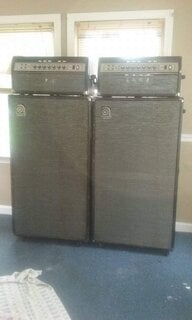
20220502_162929.jpg
 
I will not dispute the accuracy of the numbers, but rather offer something to contemplate for a minute or two...
Given the ENORMOUS improvements in engineering, and even more so in applied technology and manufacturing, we can now, decades later not even AFFORD to set up a production line for a century old product? Think about it.
We do very short series production, successfully and profitable, for countless other products. Never before has odd size car tires been so cheap, special series consumer products as affordable, custom designed building elements like glass door sections etc as available. Or plastic and rubber parts for vintage cars cost a fraction compared with what they did decades ago. (Special size glass shets, and extruded parts in alu, plastic and rubber.)

But some things will never be cheap, and probably we can no longer afford to set up a tube production line.
And I am not sarcastic.

The manufacturing costs (tooling, raw materials, etc.) would be one set of numbers, but then, you'd have to pass who knows how many environmental hurdles in terms of industrial waste(s) from the process, which could add a whole 'nother set of costs, which I'm assuming could be another part of the exonomics being just wrong for the volume production expected.
 
I'd suggest that for Sir Paul, or anyone with deep enough pockets for a living room full of MacIntosh gear, whatever tubes cost is of utterly no concern, and his roadies and the Mac parts department have no shortages at those prices.

And it may be troubling to some that a lot of tubes are Russian production, or constrained because of it due to the various governmental moves during the Ukrainian conflict. I'd once read the Russians stuck to tube electronics in weapons platforms that may face EMP effects as they felt tubes weren't near as succeptible to failue in those events. Who knows?

Somewhere, deep in a Siberian bunker, a Russian missile silo maintenance tech is smacking the side of a control panel to get an output meter to light up.
 
Last edited:
Everyone I know of is recording and touring with old heavy tube amps. The only exceptions I see in that regard--old/made 30+ years ago--are newer Ampeg SVT VRs and CLs. From what I've seen there are other solid state bass amps on stages more commonly, GK 800RBs for example.

I've yet to see an Aguilar on a stage. Haven't seen one yet.

//Not taking sides, just telling what I see.


I've never even seen an Aguilar in person.
 
  • Like
Reactions: MarshallAC50Stack
I'd suggest that for Sir Paul, or anyone with deep enough pockets for a living room full of MacIntosh gear, whatever tubes cost is of utterly no concern, and his roadies and the Mac parts department have no shortages at those prices.

And it may be troubling to some that a lot of tubes are Russian production, or constrained because of it due to the various governmental moves during the Ukrainian conflict. I'd once read the Russians stuck to tube electronics in weapons platforms that may face EMP effects as they felt tubes weren't near as succeptible to failue in those events. Who knows?


You buy a McIntosh and that will most likely be the last amp you ever buy unless you're a millionaire but not because of the price, because of the sound, I had one years ago and it was the most beautiful sounding 30 watts I've ever heard. I still hope to get an MC275 power amp, they're expensive but not crazily so, you can get them second hand for 4 -5 grand. I agree with you about Russian tubes, that's a conundrum. JJ's aren't made in russia though and I've always had good luck with them in my SVT's. There are rumors that the U.S government has some Collins R-390A tube receivers stored away somewhere in case of 'problems' They're about the best ever made.


upload_2023-4-9_12-20-34.jpeg
 
Ok... I'm not an electrical engineer. Now that thats out of the way... Question: I know what a transformer does but why does a tube amp need those heavy transformers to put out 300 watts when a class D can put out 800 watts without a power transformer. Is it the high voltages required for the tubes? Can that be accomplished using class D logic? Please be gentle with me in your response ;)
Good question.

Switchmode power supplies in class D amps do in fact have POWER transformers, but they are much smaller than line frequency transformers because the frequency that an SMPS operates at is much higher. The size of the core of a transformer is inversely proportional to the operating frequency.

One large benefit of a smaller core and higher frequency is that the number of turns on the primary decreases, which means that the number of turns on the secondary also decreases for the same voltage ratio. This means that the length of the wire decreases which means that the losses in the wire decrease and the performance improves.

The difference is in the OUTPUT transformer, a tube amp must use an output transformer because the output stage impedance is about 100x higher than the output stages of either a solid state class AB or class D output stage impedance. Because the output transformer is expected to operate down to about 30Hz (necessary when post-transformer feedback is applied around the output stage to prevent LF oscillation, aka "motorboating"), the core will be bigger.

Sure, any amp could be designed with an output transformer in mind, but generally it's an unwanted element because of the inherent limitations on performance. It's just a necessity with tube output stages.
 

Latest posts