
I'm not a huge Eden fan, but I quite liked the NC200 combo I had for about a month last year until I bought my Markbass combo. For $250 you couldn't beat it. Never got to stack it on its side, though. I sold it before I "discovered" it.

TalkBass has been independent since 1998. Add your voice.
Create a free account to reply to discussions, view embedded media, and browse with fewer display ads.
Join free Log in
Want zero display ads or expanded classifieds tools? Compare plans.
The horizontal angle of dispersion is inversely proportional to the width of the source, but varies with frequency. Side by side tens with the frames touching have a radiating plane (cone edge to cone edge) about 18 inches across. 18 inches is one wavelength at about 750 Hz. Below that off-axis response will be good. Above that the dispersion angle narrows, getting narrower the higher you go. With the tens vertical the radiating plane is about 8 inches across, and the zone of wide dispersion goes up to 1.7 kHz.This is a good question. I have noticed a lack of high end off axis when using a 410. I haven't really noticed any low end cancellation, but it could be that I'm not off axis enough to notice.

Here's my question, though I know I can use trial-and-error. I've got a pair of Eden D112XLTs.
Three possible ways to go; all have woofs and tweets in their own vertical lines.
http://www.talkbass.com/forum/attachment.php?attachmentid=93906&d=1213301494
1. Both cabs in horizontal orientation.
2. Both cabs vertical, ports up.
3. Both cabs vertical, ports down.
Bill, what would you go with first? I've only used the "wide" stack, though the vertical stacks should help get the sound closer to my ears.
Comb filtering.How about using #1 with the top cab with the horn on the opposite side, mirroring each other.

First time I ever saw anyone mic a cab with a tom mic. What is it and how's it sound?

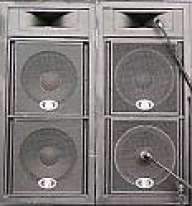

I'm having issues with the verticality of my new stack. On their ends or on their sides - just doesn't seem to make a difference ...


A crapshoot. Every speaker/driver has its own unique phase response. When you combine different cabs/drivers their differing phase responses will compliment each other at some frequencies, fight each other at some frequencies, and the result is totally unpredictable. Well engineered speaker systems always use a crossover to assign frequency bandwidths to the various drivers in the system. Well engineered systems also don't mix drivers of similar sizes, there's no advantage to having less than a 2:1 cone size ratio and many disadvantages.Perhaps my idea of stacking the D210T with the D112(s) might not be such a good idea?

I've read through the whole topic... What about the PORT placing? the port works at the same frequencies as the woofer, so should it be UNDER the woofer? to eliminate comb filtering effect.
so slot porting is better then one or more tubes on the side?
Combing occurs when the acoustic centers of the sources are over one wavelength apart. The shortest wavelength radiated by a port is about ten feet.
Combing occurs when the acoustic centers of the sources are over one wavelength apart. The shortest wavelength radiated by a port is about ten feet.

YesPlease excuse my ignorance here Bill
Does that mean that it's OK to flip and stack cabs on their sides as long as the drivers of the same dimensions and horns are in the same vertical axis, and it doesn't matter whether the ports are oriented on the bottom or sides of the cabs?
Yes. The wavelengths sourced by the ports are so long that they can literally go anywhere.The 10's are in axis vertically, as are the horns, and the ports are all lined up vertically along the right hand side.
Is that port orientation OK?

Yes
Yes. The wavelengths sourced by the ports are so long that they can literally go anywhere.


