I agree with the nostalgia aspect of instruments and what people will pay. Every generation wants what they couldn't have as a kid.I’ve been playing since ‘64 and some of the instruments some might call vintage I owned back then. Guitar players are usually more nostalgic about instruments from the 50s through the 70s and pay stratospheric prices for them. I have lots of experience with so-called vintage instruments and although there are some of them that feel or sound good, it’s mostly hit or miss because their makers simply didn’t have the precision tools and manufacturing methods that nearly all companies now use. If older instruments have anything going for them it’s just that the wood that was available decades ago was slightly better than newer wood. Don’t fall into the mindset that if it’s older it’s better - your chances of getting a good instrument are much better now thanks to modern manufacturing. For the cost of some instruments you can buy something that is much better

Enjoy the benefits of a premium membership!
Upgrade Account
-
TalkBass has been independent since 1998. Add your voice.
Create a free account to reply to discussions, view embedded media, and browse with fewer display ads.
Join free Log in
Want zero display ads or expanded classifieds tools? Compare plans.
You are using an out of date browser. It may not display this or other websites correctly.
You should upgrade or use an alternative browser.
You should upgrade or use an alternative browser.
Vintage basses: Exchange Value vs. Use Value
- Thread starter Green Knight
- Start date
More options
Who Replied?
I sometimes link this video in the vintage bass threads, so that folks don't get too starry-eyed about those pre-CBS Fenders. Nostalgic, absolutely and worth the money to an aficionado/collector, absolutely. But also important to keep in mind what you're doing if you're going to shell out the family farm to buy one:
L
interesting video. you get the idea everything was hand crafted back then but leads to the question about quality control. thanks for posting.
Picasso could make a masterpiece with a no 2 pencil and SRV could play a masterpiece with a cheap ukulele. its all in the fingersAll instruments have limitations. $’s don’t factor in. It’s what the artist does with it.
as gigging musician, you probably have a heck of a lot more say about vintage instruments than the collector. you build your own gear?I'm a gigging musician. There's a shop in my city with a ton of vintage basses - some of which cost more than my car. I've played a lot of them, and....I just don't get it. The ones I've played are just not very good musical instruments - at least I wouldn't want to use any of them for that. Some are decent, but not much more than that. If they work for you, go for it, but I'll stick with the instruments that I build.
You can't pick up an antique and expect it to be the best you've ever held. You have to understand / feel the value in the history. Wondering where has it been, who played it, where? When I took my '78 Musicmaster apart I found the electronics hilarious. The previous owner didn't own a soldering iron and had twisted wires together....the ground was literally wrapped around the terminal post. I thought it was great.... how long had it been like that? Heck.... are those even the original parts? Maybe not cause mine sounds good. Not the best I've owned. It is... what it is. Now I gotta "rock it"

Picked up a 64 Telecaster in a music store one day with permission, and I played it for about five minutes put it back and the store owner (a friend) asked me what I thought and I replied "well I guess I can say I played on a 64 Telecaster..." There was nothing special about it at all. He agreed.
There's more if us on the same trail, or have been. Horse trades, pawn shop deals of yore, the one that got away. I'm getting ready to edit the closet again! I sometimes trade for non-instruments just to keep the flow going, or trade for types of instruments such as violins, violas... things that move when some brands or types of guitars/basses aren't doing so well in the marketplace. We all figure what we have into it, do some weird math back several trades, whatever it takes to justify that little something different. Ahhh a 1968 Vox Cougar... been there.
There's more if us on the same trail, or have been. Horse trades, pawn shop deals of yore, the one that got away. I'm getting ready to edit the closet again! I sometimes trade for non-instruments just to keep the flow going, or trade for types of instruments such as violins, violas... things that move when some brands or types of guitars/basses aren't doing so well in the marketplace. We all figure what we have into it, do some weird math back several trades, whatever it takes to justify that little something different. Ahhh a 1968 Vox Cougar... been there.
I dont quite follow this Master build thing from the likes of Fender. Plenty of stories of them being a parts bass/gtr using what was left over in the bin on the day.
Same as wood, some light, some heavy but a total lottery by accounts.
The other thing I'd offer is if they survived the skip, chances they were decent.
What pushes up value is rarity in very good order, i.e, not modded/refinned.
My mates 62 P was delaquered...as everyone looked at that in the 70's for a limited value bass.
Bad move 40 plus years later and no one really knows how much 'value' has gone on selling price?
Same as wood, some light, some heavy but a total lottery by accounts.
The other thing I'd offer is if they survived the skip, chances they were decent.
What pushes up value is rarity in very good order, i.e, not modded/refinned.
My mates 62 P was delaquered...as everyone looked at that in the 70's for a limited value bass.
Bad move 40 plus years later and no one really knows how much 'value' has gone on selling price?
Stomp boxes tooWestone were big up here in Canada.... back in the day every music store seemed to have a range of them

as gigging musician, you probably have a heck of a lot more say about vintage instruments than the collector. you build your own gear?
I build my own basses - starting with Warmoth wood, i do some customizing of bodies, headstocks, etc, I do my own finishes, and the circuits in my basses are...not quite like anything on the market. They still sound like bass guitars, but go a bit outside the "box" of what other folks do in their circuits. I designed pro audio gear for 4 decades, and what I learned there informs my bass circuits.
At this point, I really can't buy basses off the rack. Even a Fodera, I look at a picture of one, and...yeah, I'd swap that, that'd have to go, I'd completely rewire the thing, etc.....
Last edited:
interesting video. you get the idea everything was hand crafted back then but leads to the question about quality control. thanks for posting.
The QC of vintage basses was actually notorious. And there is really very little glamour to them, just by seeing how they were made, with what tools, supplies and materials.
It's just something to keep in mind if you want to plunk down 10 large on a pre-CBS Fender. Especially if you have stars in your eyes about how it's going to play and sound.....
I'm old enough that I remember when the pre-CBS Fenders were just starting to become collectible (late 70's), but there were still enough of them around that you could go to a music store and try one out. I got to play several and my bubble was definitely burst at the ones I tried out. Can you say weighed a ton, you could drop picks into the neck/body gap, washtub-bass-giant-rubber-band tone etc....
All I can say is, despite the runaround I had with the QC on my current Fenders, when I finally got the non-defective ones in, there's really no comparison. The new ones are the hands-down choice if my goal is to use them as a player.
Even the G&L MIA's, which retain a lot of the same building practices as the pre-CBS Fenders, are just worlds better in every way. Even though they let a fair amount of stuff get through too - you should have seen my first '99 L2000. Multiple problems. And my current L2000 even has "concerns" - the truss rod turns really really tight, shifts with a little "pop" in the neck when I flex it and the G string saddle still can't be lowered quite enough.
All the evidence of a hand-made instrument, for both better and worse. Of course, it's a keeper, kind of like a 21st century pre-CBS Fender suped up by Leo Fender himself. But that's just how it is with a mass-produced hand-made instrument.
Again, not knocking the nostalgia of vintage basses. Just remembering what they really are in actual reality...
L

When I purchased my Maton (guitar), last century, several friends had very similar models, one was identical, Compared to mine, the others were so, so. That was their assessment, not mine, they all preferred to play mine. I still have it, but it really needs a bit of work on it now. I've played Fender Strats and would rather my Ibanez Blazer, Have yet to try a P or J Bass, but have played a few brands, (cheapies) and none have spoken to me yet. Even tried a Rick early in the piece and did not like it back then, (1975) but would love to try another one, one day, but only if I could part with the cash to own it, that is, if I like it.

The vintage Fenders are obvious I think. The ones I often think about are the basses exploding in value before my eyes in real time. Five years ago, a Musicmaster did not cost 1700 no matter what condition it was in; same goes for certain Gibsons, like the Triumph. Even a Peavey G-Bass couldn't fetch more than 500 five years ago; now I see people looking to trade them for Stingrays. A 58 P at least has historical value!
This. Whenever I have more than one bass, all but one sit idle for months. I know pros often need two or three--the J, the P, the fretless, the fiver, etc.--but my hobby band certainly doesn't care what bass I play so long as it sounds good and I sound good playing it. Even though I know this, I have trouble acting on it ... that is, not acting at all when I see something old and shiny.People like you said the same thing about 70s basses back in the 90s. So I wouldn’t rule that out.
As for me, I never cared about vintage. Still don’t. Many of them are gorgeous, many of them are fantastic players. But I can say that about basses made at any time. It just doesn’t mean much to me. Every bass I own sits on the stand waiting for me to play it. If I play well, it’s a great sounding bass. If I don’t, then it might as well be a Glarry.

A matter of perspective, IMO.
While all of my basses, guitars and amps would be considered to be "vintage" in the current marketplace, none of them was bought solely because of that fact. If I don't enjoy the way the instrument plays and the sound of it, "vintage" - or any other - tag on it is outright meaningless to me. There's a few boatloads of "vintage" gear out there that I have zero interest in for a variety of reasons.
Having said that, I prefer the way my "old" stuff sounds and plays compared to most of the current market offerings, but I've always been a weird duck...
Obviously, YMMV.
While all of my basses, guitars and amps would be considered to be "vintage" in the current marketplace, none of them was bought solely because of that fact. If I don't enjoy the way the instrument plays and the sound of it, "vintage" - or any other - tag on it is outright meaningless to me. There's a few boatloads of "vintage" gear out there that I have zero interest in for a variety of reasons.
Having said that, I prefer the way my "old" stuff sounds and plays compared to most of the current market offerings, but I've always been a weird duck...
Obviously, YMMV.
26365255[/URL], member: 357449"]I agree with the nostalgia aspect of instruments and what people will pay. Every generation wants what they couldn't have as a kid.
I think it’s also re-living your mid-spent youth for some folks. Once us boomers are gone, that part of the market for old basses will go with us. Will your old Fender continue to appreciate? I wouldn’t bet on it.
If I wanted to play an old looking bass on gigs (I’d have to get past the need for that pesky 5th string), I’d absolutely get a roadworn before I’d pay a premium for an old Fender.

Anyone have or have had a vintage bass that they think is getting way too expensive for what you get?
Similar experiences to you. I passed on a few Musicmasters and EB-0s when they were still selling for $200. I later bought a blue (they also came in red and white) Kalamazoo KB-1 (essentially a bolt-on EB-0) for about $300 in the late 90s but found it wasn't very useful as a gigging bass. I got rid of a Supro/Airline Pocket Bass because finding 25" bass strings was impossible at the time and 30" strings were too floppy. I own two Danelectro/Silvertones, a single cut bass and single cut guitar thay I paid $65 and $10 for respectively. Today I see ones selling for around $1000 and would never pay that much.
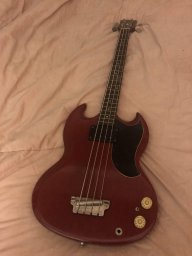
My early 60’s Gibson EBO doesn’t leave the closet often. It’s a mudbucker, has neck dive, and my modern basses kick it’s short scale butt all day. ( It IS very light and I’m getting older…) Use value? To me, almost none. Exchange value? Probably not enough to warrant giving it up. So in the closet it stays.

I think INDIVIDUAL basses can be worth the crazy asking prices if they are, in fact, "special". But just being old does nothing for me and doesn't make a bass "special" at all.
^ This. I do not have much experience with vintage basses. Maybe once my '89 is considered vintage, i'll be able to say "Ohhhhh yeah, im all about the vintage basses." I do, however, have repeated experience with just how different the same brand/model can be even in the same year run. Even if they look the same, IME every bass has its own unique personality.
My hit or miss experience with basses in general would make me VERY leery of vintage basses. Would suck to drop stupid money for year alone and get a dud that would lose value if modded.


Best comment ever.I am its limitations.
Latest posts
-

-
-
 The Bartolini BH2: Why Does It Sound So Dark? My EHB1265MS Experiments
- Latest: groovaholic
-
