can you elaborate on your designs?
I have done that quite a number of times on Talkbass - they're designed with a couple repeating themes:
1) Like any good audio design engineer would do things, you make the source low enough in impedance that small changes in the cable aren't going to make significant changes in the sound of the device. Microphones can be used with cables that are hundreds of feet long, and they sound fine, a guitar or bass will, if you change from a 10 to a 20 foot cable, sound quite different. My designs aren't quite as good as microphones, but they're better than the usual stuff by a fair margin.
2) My basses are generally wired with a "mode" switch and a couple of tone circuits. Most basses, you have a switch or two, and some knobs, and ...off you go, figure out how to make a sound you like with these controls. When you switch pickups, the low end may go away, or bet much louder, if you're switching from a neck to a bridge pickup, etc. When I get called to play bass, my job is (in large part) to supply low end - whatever I do, I should be changing the amount of low end, just because I want a different sound. As such, both modes have to be designed to maintain low end - switching pickups won't cut it for that. On most (not all) of my instruments, one mode is neck only, the other involves the bridge pickup in combination with the neck. But at low frequencies, it's the neck pickup only - there's a crossover circuit of some type (there are a few ways to do this) that mixes the pickups in a frequency dependent fashion, and..voila....different sounds, but the low end stays put. The tone circuits have loading capacitors (determines the sound when the tone control is fully "up", a potentiometer (duh), a tone capacitor (often very different values for the different modes), and whatever other parts are need to tweak things (often a damping resistor or two). The net result of all of this is.....
3) When you play a jazz bass, if you want a different sound, you have two volumes and a tone, and all 3 may have to move to dial in what you want - turning 3 knobs all at once, in a precise fashion in a fraction of a second....yeah, that doesn't work too well in a live situation. With my basses, you have two sounds dialed up, and literally at the fliick of a switch, you can go from one dialed in sound to another.
I don't go into publishing schematics on these things, because...even though I've done a few dozen wirings (for myself and others) every time I do one, I learn something, and the clients I have worked with all want something a bit different - I have literally never done 2 basses with the same schematic. My avatar is a bass I wired for a client that has 4 modes (that thing was a beast to wire). The whole point of what I do is not to make a new "standard" bass wiring - it's to do precisely what someone (me or a client) wants their instrument to do. It's a custom wiring shop that goes well outside the box of what most people limit their thinking to.
Leo was...frugal is the nice word. He came up with the simplest circuit that might work, and that folks in general can understand. In the case of the P, it does. In the case of the J, I'd argue it's got a lot of compromises. The circuits I do are more complex (they cost more). I don't use the cheapest parts available - I use parts that will last and work for a very long time (pots that don't get scratchy, capacitors that don't change value over time, etc.)
That's the nutshell version of it. The next level of the deep dive is a book, so I'll stop here.



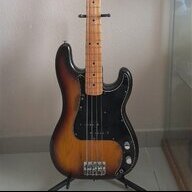





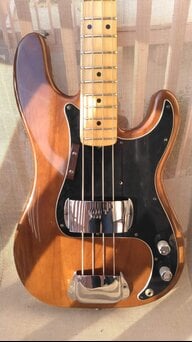

 I bought my first vintage bass in my late twenties cause I couldn't afford one on my paper route gig.