• TalkBass has been independent since 1998. Add your voice.
    Create a free account to reply to discussions, view embedded media, and browse with fewer display ads.
    Join freeLog in
    Want zero display ads or expanded classifieds tools? Compare plans.

Wal Bass Club.

PEEXPrh.gif

Good response. ;)
 
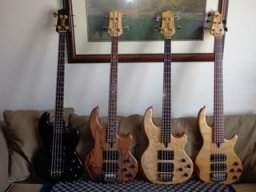
I'm trying to figure out when the string tree/harness went from 2 pieces down to one piece, I believe it was sometime in or after 1986. Does anyone know?
going through some of my archive pictures of Wals, W2931, Aug 87 appears to have the two piece (which is the only one i see of that year)......but i see more of a mix of 86 with a single piece and two piece.
 

Attachments

  • Walfront.jpg
    Walfront.jpg
    40.2 KB · Views: 137
Hmmm, so it seems like 85-86 was a transitional year for the string tree, I wonder if that Aug 87 W2931 was perhaps a situation that they had some leftover gold that they found, or maybe the customer specifically requested the two piece...
 
So, the '92 MkI I bought from j.kernodle had its neck pickup fail while I was playing one night. I thought, surely a coil pickup doesn't just "go bad". As it turns out, it seems to be an issue with the (lack of) driving voltage to the TAB1043 OP-AMP C-non-inverting input from that pickup on the Volume board. Although I've dropped in a smaller resistor to allow more current into the that input, I've got a whole kit of precision parts on order to fix electronics issues that may crop up. That said, I've located and ordered Qty:5 TAB1043 Quad OP-AMPs, the ones people has feared were no longer made. I've also ordered ON-brand M549 NPNs (where I think the problem might be), and a swath of the film caps the pre-amp uses, albeit these new caps will be 5% tolerance vs. the 10% Pete/Ian used.

Although Paul is more than happy to repair the onboard electronics of the Wals at an affordable price, I like knowing the technology, so I'll post here what I find out and whether I fixed it or not. Plus, I'd rather Paul work on Jim's Wal, not mine. :)
 
I've had to replace 4.7uf caps on two of my older Wals. one arrived dead, the other was pretty weak. My other '86 had already been done at sometime, and I still need to just do the other '90 as preventive maint.
I believe my new era MkII has 5% tol film caps compared to all my older basses, but I'd love to know what other resistors Paul would typically update.
 
oh no.... that completely sucks. it would've broken my heart if that happened while it was with me. I'm sorry you're dealing with that, buddy. is it going to be a big hassle to get it fixed?

It's fixed. One of the first-stage CE BC549 NPN transistors was bad. Replaced, and it's back up and running! Even snuck it into our set last night....like an idiot. Punk shows aren't for something this valuable, but MAN it roasted the room! I think there's still some ruins left from the show. heh.:bassist:
 
That is great news, glad that you were able to fix it, can you show some pictures of what you replaced?

Oh, NOW you had to ask that after I put the darn thing back together! :D

Disclaimer: This is the older pre-amp before, say, 1998. Some changes in the board layout and components have changed over the years, it seems.

The best way to describe the NPN I replaced, if you have both PCB's out of the bass, and viewing the component side, not solder-side of the board that holds the volume knob, right next to the black (or white) "mystery" box mounted to that board are two black tiny transistors. The outer one was the one I replaced (Motorola BC549)

Where the signal comes in from the neck pickup, you can trace the signal across each of the resistor/cap connections, which couple all the coils to one solder trace. That trace goes through one of the tweakable pots. On the other side of that pot, there's a solder trace that runs back across the board to the back side of the "mystery" box (on the side of the board that sits lowest in the electronics cavity). The trace goes all the way under the TAB1043 chip (the Quad OP-AMP), but it ends in an R/C filter. I could see the signal on that trace.

Before the trace ends with that filter, if you look closer to the "mystery" box (which, looks to serve the XLR output), you can see the pair of transistors. The BASE (pin 2) of one of them connects to this outer edge solder trace. The pin closest to the mystery box is the Emitter. That should have no signal. The pin closest to the volume knob is the Collector. There should be an inverted and boosted copy of the signal at the Base. Silence. After replacing the transistor, the signal is now there, and we're in biz!

To use an OP-AMP, it's better to first use a "pre" stage to reduce noise, since OP-AMPs are not typically noiseless for tiny signals. I initially swapped the TAB1043 chips between the two boards. When this didn't change the symptom, I could guess that at least one input to the OP-AMP was dead. That led me to look at the first stage "pre" before the OP-AMP.
 
The mystery box is the transformer for the XLR.

Yeah, I figured as much, I just didn't want to open it.

btw, I have spare BC549 transistors, and five of the elusive TAB1043 chips on order from overseas. If you guys have a Quad OP-AMP go bad, when I get these in, I'll try to keep 'em in stock. I also have stock of many of the film and tantalum caps, as well as stock of the 1% metal-film resistors.

the only things I don't have are the XLR transformer, and any of the pots.