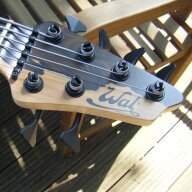
yup.... getting tempted myself
Well it seems silly not to stop in and check it out as I'll be walking past anyway.

TalkBass has been independent since 1998. Add your voice.
Create a free account to reply to discussions, view embedded media, and browse with fewer display ads.
Join free Log in
Want zero display ads or expanded classifieds tools? Compare plans.
yup.... getting tempted myself
Well it seems silly not to stop in and check it out as I'll be walking past anyway.
I'd be staring longingly at it, perchance to dream... Rob, it is your duty as a minstrel to seek this beauty, go now and it shall never be mentioned that this heinous act of snubbery ever occurred.
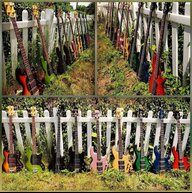


Here it is again!!!!
Bass-ic Setup of a Wal
Originally Posted by Paul H@electricwood
The setting up of basses can be very different from player to player but we
do have some starting points/guidelines that may help you:
Neck relief - measured by fretting at both the 1st and 21st frets to create a straight edge with the string - you may want to use a capo to hold the 1st fret down to help you with this. Relief can now be checked by looking at the gap between the top of the 8th fret and the bottom of the string on both
the E and G strings - anywhere from 0.3mm(business card thickness) to 0.8mm(credit card thickness) approx is acceptable depending on your preference.
Nut height - this will be affected by the neck relief but should ideally be as low as possible without buzzing when playing the open string. Compare the
string height over the 1st fret when played open with the height above the 2nd fret when fretting the 1st fret. It should be just very slightly higher. If the nut is too high, it will not only feel harder to play but also not play in tune. If too low it will rattle when playing open strings.
String height(action) - if both the above are set, the final action can now be set. This is measured from the top of the 12th fret to the bottom of the E and G strings. An low to medium action would measure 2mm-2.6mm on the E
string and 1.6mm-2.1mm on the G string approx. The action should taper from E to G so as the strings get lighter to action becomes slightly lower.
Pickup heights - individual pole pieces for the E and G strings should be set just proud of the pickup cover. The A and D string pole pieces slightly higher to follow the camber of the strings you have set. The overall pickup
heights are measured whilst holding down(fretting) the E and G strings at the 21fret. The distance between the top of the pickup pole piece and the
bottom of the string should be 6mm on the E string and 5.5mm on the G string approx.
Raising the pole piece height will not only increase the volume of that particular string but also give a more compressed darker sound - lowering gives a brighter more open sound with less volume.
All the adjustments above affect each other plus fret condition and of course playing style need to be taken into account so some experimentation may be needed. Hope the info helps and let me know how you get on.
So I followed this and things went pretty well until now. I am quite curious about an intonation problem. When I play an open A it's in perfect tune. When I play the 12th fret harmonic on the A it's also in perfect tune. From what I read this is how to set the intonation. Since the open string as well as its 12th fret harmonic were both in perfect tune I figured everything was good to go. However, when I fret the 15th fret on the A string the C is pretty flat. I moved up and fretted the 17th fret on the A string and the D is pretty flat. Any suggestions how to address this problem?

If you fret the 12th fret is it in tune or flat as well?
response to musicman...
The harmonic and the open note will always be in tune with each other, that's just a function of physics of a moving string. If notes higher up the neck are flat, you need to shorten the vibrating length of the string. Do this by adjusting the bridge so that the saddle moves closer to the neck a little. Your test is whether or not the 12th fret harmonic and the 12th fret fretted note match pitch.
Thanks man!


