• TalkBass has been independent since 1998. Add your voice.
    Create a free account to reply to discussions, view embedded media, and browse with fewer display ads.
    Join freeLog in
    Want zero display ads or expanded classifieds tools? Compare plans.

What about your bass playing makes you special?

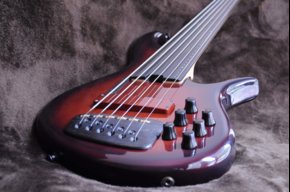
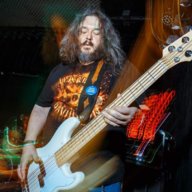
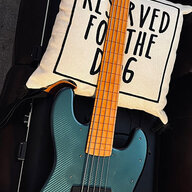
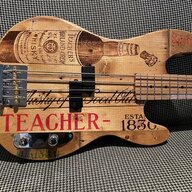
Nice bass! I'm sure you could get a gig just showing up with it! Seriously, that is a really nice piece of art and I'll bet is play=yes and sounds great!
Thanks for the comments.

In fact, I had a hard time making it sound like I wanted.

I wanted an extra light bass at first so went with a 3.5 pounds body made of sycamore wood. Then put a non-reinforced maple neck and guess what ? Neck dive ! Compensated with a high mass bridge, bass is now balanced and final total weight is 7.5 pounds !

For the pickups, I used the famous quarter pounder as I wanted a heavy sound without an exaggerated output. I had to try 5 different strings until I put the right ones, some SIT nickel rounds medium light.

The luthier that made the final adjustments phoned me saying : Come grab your bass, it's on fire !

Played with it for 3 hours in a row with my band mates last weekend and everybody agreed it was punchy and full body from bottom to top notes so mission accomplished for me.
 
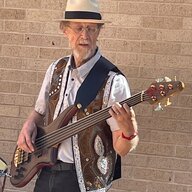
I played rhythm guitar for almost fifty years, I was often told that I should play bass because I have good tempo and feel, but I didn't want to be encumbered by a big electric bass guitar, forget a double bass. Then in mid 2013 I switched to ukulele and joined a group of about 35 uke players. A year later the leader asked if anyone would like to take up the bass to fill in their sound.

One other guy volunteered and I got online and discovered bass ukes that were 21" to 23" scale with polyurethane fat strings. I went to a store and played one, hey, this feels really good. I bought it and took lessons from Denny Croy at McCabe's Music Shoppe in Santa Monica. Turns out the other bass player in the group also took lessons from him. Since then the bass became my primary instrument, trading off with the other bass player. I take holding the tempo for the group very seriously.
 
I am not the flashiest player and do not have amazing chops for speed or slap, but in the groups I have played with, ranging from Praise and Worship to blues and Progressive Jazz (this was the most challenging), I have been told I am solid and that my overall musicality is what keeps me in demand. Serving the song and understanding theory and song structure. Basic for sure, but has been invaluable for me when playing with others.
 
The question of what makes a good bassist can be answered by asking yourself, what makes a good [insert instrument] player. In bands, for a good guitarist, I'll take reliability, preparedness and selflessness over technical wizardry. The same applies to bassists. Trust me, the other musicians are not looking for the world's best slap bassist to play towering good slap bass all through the gig. A band is a collective, usually not a democracy, dedicated to performing as the band that it is. Each musician should be contributing toward that goal. Baseline talent is a requirement of course, and your singer(s) better be good, but there can't be a band where every member is the superstar.
 
I enjoy creating my own bass lines, I can make a $200 bass play like a $2000 carrot, and I am forever chasing the perfect tone.

Other than that, I have stubby sausage fingers with nerve damage, I still can't read bass sheet music, and I get easily distracted by shiny things.
 
  • Like
Reactions: BassHappy
For me, it's knowing my role and providing a good solid rhythmic foundation for the other musicians to do their stuff. Keeping it simple and steady..
I've been called "a solid bassist" a "human metronome" and "a better bassist than I think I am".
 
  • Like
Reactions: BassHappy