
So I was bored at work during some downtime yesterday, and I'm kinda enthusiastic about astronomy and cosmology, so I did some surfing around on the internet to see what I could read about, and learned that there is a limit to the size of structures in the universe, and that while, for all we know, the universe does go on "forever", the things/groupings of things within it only get so big.
So we've got galaxies, right? We're all familiar with them. Usually, that's the biggest "thing" that people assume there is in the universe. Well, those conglomerate into galaxy clusters, which can then turn into even huger masses of galaxies that form strings, filaments, and literal walls of galaxies. Well, when you keep "zooming out", you end up with an impossibly huge network of galaxy strings, walls, and giant voids in between these structures (voids in the diameter range of many millions of light years). This is considered one, single structure, called the Cosmic Web, and it literally looks just like a spider web, except spanning the entire visible universe. Here's a snippet of a simulation of the data that we've collected on it, so that you can get a better idea of what this looks like.
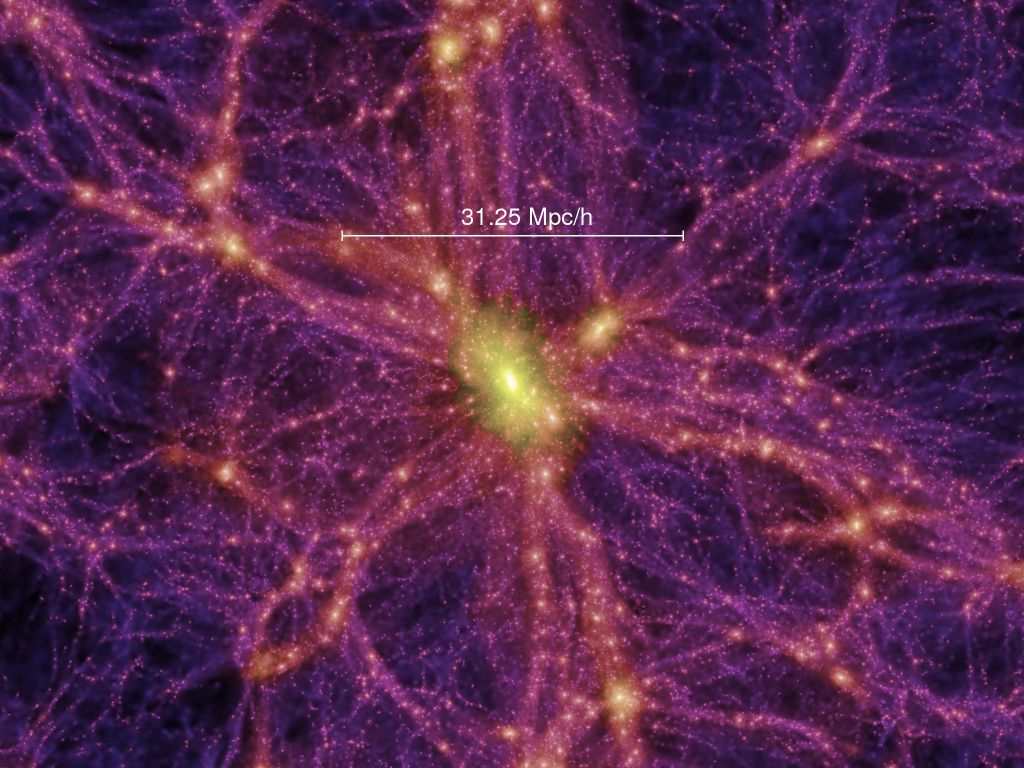
A parsec is equal to about 3.26 light years (31 trillion kilometers or 19 trillion miles). A megaparsec (the unit of measurement used in the above image) is 1 million parsecs. Each of those tiny, individual dots is a representation of an entire galaxy, most containing millions to trillions of stars in their own rights. The purple framework is the dark matter that all of the universe hangs on, like a lattice.
Now here's the above image, in full.
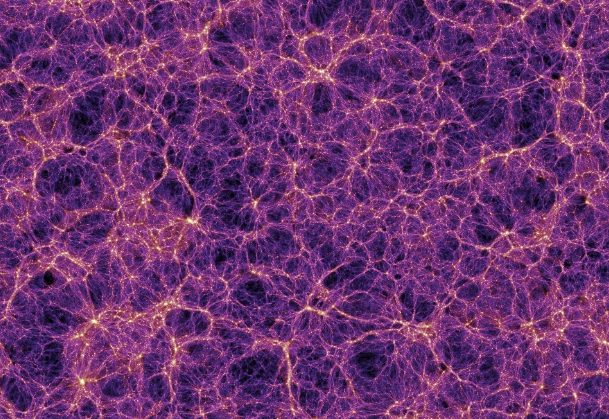
Kind of mind blowing, right? The scale is just totally incomprehensible. And that's just a representation of a single section of the OBSERVABLE universe. Since the universe has only been around for 13 billion years and change, we can only see out to a certain distance, since light has only had those 13ish billion years to travel, meaning that it could keep going on and on, way outside of our visual, time-constrained range.
If you were to keep zooming out of the above image, you'd find that there are no larger structures to be had. The universe becomes a mostly uniform wash of galactic webs and voids. This phenomena is known as the End of Greatness, since there's seemingly nothing more to the universe's structure at these large scales, at least as understood by our current models.
Sorry for the wall o' text, this was just something that I had found incredible fascinating, and thought you here might as well. Isn't science grand?
So we've got galaxies, right? We're all familiar with them. Usually, that's the biggest "thing" that people assume there is in the universe. Well, those conglomerate into galaxy clusters, which can then turn into even huger masses of galaxies that form strings, filaments, and literal walls of galaxies. Well, when you keep "zooming out", you end up with an impossibly huge network of galaxy strings, walls, and giant voids in between these structures (voids in the diameter range of many millions of light years). This is considered one, single structure, called the Cosmic Web, and it literally looks just like a spider web, except spanning the entire visible universe. Here's a snippet of a simulation of the data that we've collected on it, so that you can get a better idea of what this looks like.
A parsec is equal to about 3.26 light years (31 trillion kilometers or 19 trillion miles). A megaparsec (the unit of measurement used in the above image) is 1 million parsecs. Each of those tiny, individual dots is a representation of an entire galaxy, most containing millions to trillions of stars in their own rights. The purple framework is the dark matter that all of the universe hangs on, like a lattice.
Now here's the above image, in full.
Kind of mind blowing, right? The scale is just totally incomprehensible. And that's just a representation of a single section of the OBSERVABLE universe. Since the universe has only been around for 13 billion years and change, we can only see out to a certain distance, since light has only had those 13ish billion years to travel, meaning that it could keep going on and on, way outside of our visual, time-constrained range.
If you were to keep zooming out of the above image, you'd find that there are no larger structures to be had. The universe becomes a mostly uniform wash of galactic webs and voids. This phenomena is known as the End of Greatness, since there's seemingly nothing more to the universe's structure at these large scales, at least as understood by our current models.
Sorry for the wall o' text, this was just something that I had found incredible fascinating, and thought you here might as well. Isn't science grand?