• TalkBass has been independent since 1998. Add your voice.
    Create a free account to reply to discussions, view embedded media, and browse with fewer display ads.
    Join freeLog in
    Want zero display ads or expanded classifieds tools? Compare plans.

What did you learn today?

11 Facts About the Ambidextrous


10 Fascinating Facts You Never Knew About Ambidextrous People


Ambidexterity often comes hand-in-hand with synesthesia
The brains of ambidextrous people tend to be pretty symmetrical—a trait they share with people who have synesthesia. If you’ve ever heard about people being able to hear colors, feel physical sensations that other people are feeling, or even associate numbers with personalities, all of those sensations are variations of synesthesia. This fascinating brain condition triggers more than one of the five senses at once. A person with synesthesia is far more likely to be left-handed or ambidextrous than the average person is.
 
  • Like
Reactions: FilterFunk

Still cherry-picking today with the non-omicron bivalent SPIKEVAX sinister side. (SPIKEVAX! There's a band name;)) Coming good:)

Should share something interesting. …

The sun's on fire and it's playing havoc with my bits.
 

Worming its way was a waterway, and down it went, worming its way beyond way back wonders, ancient world wonders, in their day, under the same sun, before they became mysterious.

Desert? What desert?

For nearly a millennium, starting around 4,700 years ago, the Egyptian pyramid fields between Giza and Lisht were built along the edges of what is now the Western Desert, part of the Sahara. However, sedimentary evidence indicates that the Nile River had a much higher discharge during that period, with multiple branches splitting off from the main river.
Why Were Egyptian Pyramids Built Along Long-Lost Ahramat Branch Of The Nile? - Ancient Pages
The landscape of the northern Nile Valley in Egypt, between Lisht in the south and the Giza Plateau in the north, was subject to a number of environmental and hydrological changes during the past few millennia[…]. In the Early Holocene (~12,000 years before present), the Sahara of North Africa transformed from a hyper-arid desert to a savannah-like environment, with large river systems and lake basins[…] due to an increase in global sea level at the end of the Last Glacial Maximum (LGM).
The Egyptian pyramid chain was built along the now abandoned Ahramat Nile Branch | Communications Earth & Environment
 

Revisiting the histories again, looking at 'pennies from Heaven'.​


'Don't you know each cloud contains pennies from heaven' has a different ring to it, these days:) Beyond the song, I first got an inkling of this phenomenon via Dennis Potter who had a hand in a few gems in his time, including brimstone and treacle.

Arthur, a sheet music salesman, has an ear for the hit tunes, but nobody will trust it. And his imagination often bursts into full song, building musical numbers around the greatest frustrations in his life. He meets an innocent young school teacher, Eileen, who seems to hear the same music, but when Eileen learns that he's married, and that she's pregnant with his child, she runs away. Arthur gives up everything to find and protect her, but fate and the music haven't finished with Arthur Parker.
from imdb

These pennies from Heaven are pop songs. Pop songs as they first materialized in our neck o' the woods. Many had a purpose beyond entertainment. They'd cost a penny, usually (the penny drops:)), and would often be played on a piano. Many had one in their homes. Few other means of music production existed, for us plebs. Recordings were written, printed on paper, and needed to be performed. Anything else was a pipe dream back then.

Some pertinent details come to light.​

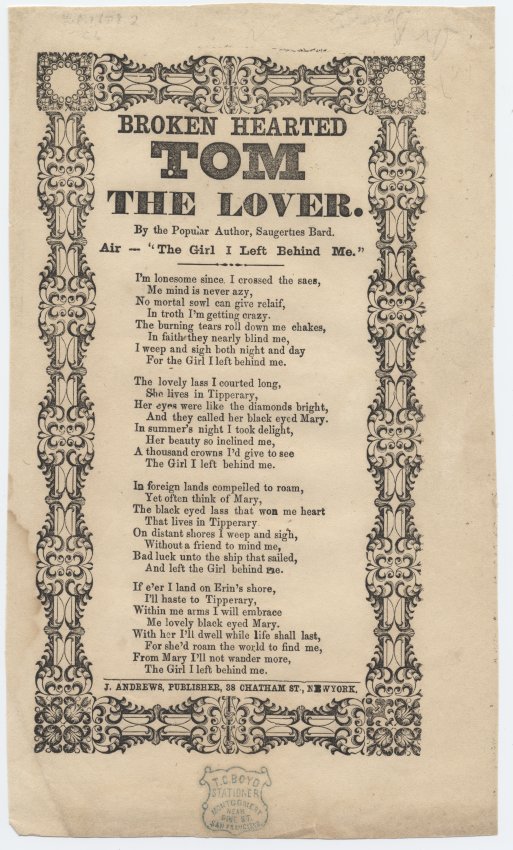
IFPB00003.JPG

Broadsides, sometimes called penny ballads, are single sheets of paper with printing normally on one side only. Broadside ballads were popular songs, sold for a penny or half-penny in the streets of towns and villages around Britain between the sixteenth and early twentieth centuries. These songs were performed in taverns, homes, fairs, or wherever a group of people gathered to discuss the day's events or to tell tales of heroes and villains.
from Broadsides and Penny Ballads (1600s - 1800s)

Penny for your thoughts:)
 
Last edited:
  • Like
Reactions: RedVee
This and I am a fan :)
The Spork
ADKq_NZOFK8X1qT7IWqji1EezVsMOsF3mj6pz0AejnkbVE6yAa0lZsZhU2XkJvU40TvDqiBXAq0gNSdn-QDWdqfkc63rhUQHpfhA_q5Q80cCCuSYw20LO-_38drGuc6KvsDkRfx1=s0-d-e1-ft

Today's Object
Do you ever wonder who first thought of The Spork?
Combination utensils are surprisingly old! Medieval diners used double-ended utensils called sucket forks to eat candied fruits — each one had a spoon on one end for gathering the syrup and tines on the other end for spearing the sweetened fruits. In the 1800s, diners ate turtles using terrapin forks and enjoyed ice cream with ice cream forks — both utensils were made of silver and featured a shallow bowl that extended into tines. However, credit for the first spork generally goes to a Rhode Island doctor named Samuel W. Francis, who filed a patent for his creation in 1874. It was entitled “Combined Knives, Forks and Spoons” and featured a spoon with tines on the front and a blade attached to one side. However, Francis’ invention didn’t catch on. Later, another 3-in-1 utensil called the splayd was created by an Australian named William McArthur, who introduced it to the public at his wife’s Sydney café in the 1940s. It was later mass-produced in the 1960s and became a popular wedding gift because it was frequently used at buffets and barbecues. The word “spork” first came into the lexicon in the early 1900s, but it wasn’t trademarked by an American company until 1970. From there, the spork — this time manufactured from plastic rather than metal and featuring a simple spoon-with-tines structure — finally took off. It became popular at fast-food joints, school lunch counters, and even in prisons, in part because it was simultaneously affordable to produce, lightweight, versatile, and conveniently disposable. Today, the spork is a well-known utensil that most people have encountered, and interestingly, it has even come full circle, as metal versions similar to Francis’s original creation are now manufactured for camping and other outdoor pursuits.
 
  • Like
Reactions: RedVee
This and I am a fan :)
The Spork
ADKq_NZOFK8X1qT7IWqji1EezVsMOsF3mj6pz0AejnkbVE6yAa0lZsZhU2XkJvU40TvDqiBXAq0gNSdn-QDWdqfkc63rhUQHpfhA_q5Q80cCCuSYw20LO-_38drGuc6KvsDkRfx1=s0-d-e1-ft

Today's Object
Do you ever wonder who first thought of The Spork?
Combination utensils are surprisingly old! Medieval diners used double-ended utensils called sucket forks to eat candied fruits — each one had a spoon on one end for gathering the syrup and tines on the other end for spearing the sweetened fruits. In the 1800s, diners ate turtles using terrapin forks and enjoyed ice cream with ice cream forks — both utensils were made of silver and featured a shallow bowl that extended into tines. However, credit for the first spork generally goes to a Rhode Island doctor named Samuel W. Francis, who filed a patent for his creation in 1874. It was entitled “Combined Knives, Forks and Spoons” and featured a spoon with tines on the front and a blade attached to one side. However, Francis’ invention didn’t catch on. Later, another 3-in-1 utensil called the splayd was created by an Australian named William McArthur, who introduced it to the public at his wife’s Sydney café in the 1940s. It was later mass-produced in the 1960s and became a popular wedding gift because it was frequently used at buffets and barbecues. The word “spork” first came into the lexicon in the early 1900s, but it wasn’t trademarked by an American company until 1970. From there, the spork — this time manufactured from plastic rather than metal and featuring a simple spoon-with-tines structure — finally took off. It became popular at fast-food joints, school lunch counters, and even in prisons, in part because it was simultaneously affordable to produce, lightweight, versatile, and conveniently disposable. Today, the spork is a well-known utensil that most people have encountered, and interestingly, it has even come full circle, as metal versions similar to Francis’s original creation are now manufactured for camping and other outdoor pursuits.
I guess I need to get out more. I've only used a spork at Taco Bell, when ordering a side of refried beans.
 
This and I am a fan :)
The Spork
ADKq_NZOFK8X1qT7IWqji1EezVsMOsF3mj6pz0AejnkbVE6yAa0lZsZhU2XkJvU40TvDqiBXAq0gNSdn-QDWdqfkc63rhUQHpfhA_q5Q80cCCuSYw20LO-_38drGuc6KvsDkRfx1=s0-d-e1-ft

Today's Object
Do you ever wonder who first thought of The Spork?
Combination utensils are surprisingly old! Medieval diners used double-ended utensils called sucket forks to eat candied fruits — each one had a spoon on one end for gathering the syrup and tines on the other end for spearing the sweetened fruits. In the 1800s, diners ate turtles using terrapin forks and enjoyed ice cream with ice cream forks — both utensils were made of silver and featured a shallow bowl that extended into tines. However, credit for the first spork generally goes to a Rhode Island doctor named Samuel W. Francis, who filed a patent for his creation in 1874. It was entitled “Combined Knives, Forks and Spoons” and featured a spoon with tines on the front and a blade attached to one side. However, Francis’ invention didn’t catch on. Later, another 3-in-1 utensil called the splayd was created by an Australian named William McArthur, who introduced it to the public at his wife’s Sydney café in the 1940s. It was later mass-produced in the 1960s and became a popular wedding gift because it was frequently used at buffets and barbecues. The word “spork” first came into the lexicon in the early 1900s, but it wasn’t trademarked by an American company until 1970. From there, the spork — this time manufactured from plastic rather than metal and featuring a simple spoon-with-tines structure — finally took off. It became popular at fast-food joints, school lunch counters, and even in prisons, in part because it was simultaneously affordable to produce, lightweight, versatile, and conveniently disposable. Today, the spork is a well-known utensil that most people have encountered, and interestingly, it has even come full circle, as metal versions similar to Francis’s original creation are now manufactured for camping and other outdoor pursuits.

That all sounds plausible and well researched. But from the name, it is obviously Swedish in origin.
 
This and I am a fan :)
The Spork
ADKq_NZOFK8X1qT7IWqji1EezVsMOsF3mj6pz0AejnkbVE6yAa0lZsZhU2XkJvU40TvDqiBXAq0gNSdn-QDWdqfkc63rhUQHpfhA_q5Q80cCCuSYw20LO-_38drGuc6KvsDkRfx1=s0-d-e1-ft

Today's Object
Do you ever wonder who first thought of The Spork?
Combination utensils are surprisingly old! Medieval diners used double-ended utensils called sucket forks to eat candied fruits — each one had a spoon on one end for gathering the syrup and tines on the other end for spearing the sweetened fruits. In the 1800s, diners ate turtles using terrapin forks and enjoyed ice cream with ice cream forks — both utensils were made of silver and featured a shallow bowl that extended into tines. However, credit for the first spork generally goes to a Rhode Island doctor named Samuel W. Francis, who filed a patent for his creation in 1874. It was entitled “Combined Knives, Forks and Spoons” and featured a spoon with tines on the front and a blade attached to one side. However, Francis’ invention didn’t catch on. Later, another 3-in-1 utensil called the splayd was created by an Australian named William McArthur, who introduced it to the public at his wife’s Sydney café in the 1940s. It was later mass-produced in the 1960s and became a popular wedding gift because it was frequently used at buffets and barbecues. The word “spork” first came into the lexicon in the early 1900s, but it wasn’t trademarked by an American company until 1970. From there, the spork — this time manufactured from plastic rather than metal and featuring a simple spoon-with-tines structure — finally took off. It became popular at fast-food joints, school lunch counters, and even in prisons, in part because it was simultaneously affordable to produce, lightweight, versatile, and conveniently disposable. Today, the spork is a well-known utensil that most people have encountered, and interestingly, it has even come full circle, as metal versions similar to Francis’s original creation are now manufactured for camping and other outdoor pursuits.
Yes, I remember the Splayd’s in the 70s
 
The history of
Zippo Lighters
ADKq_NYFAGeZzPcYuTRPSiOOHCpdLhSNFCUCjL-2-VHwq11yj22p6wv3qtKZKFoz5bQ7NloMxEyr-ivLMiAI4rBJN31nHbXpYMKRunEMlOdcrqFaxXC5oB10AWSAkwAxzyHLh4k9XDKYa0NQ3d8=s0-d-e1-ft

Today's Object
Do you ever wonder who first thought of Zippo Lighters?
Zippo founder George G. Blaisdell was playing golf at the Bradford Country Club in Bradford, Pennsylvania in the early 1930s when he noticed his friend struggling to use an Austrian lighter. Blaisdell noted that the lighter functioned well in the wind due to its high chimney, but that the design was cumbersome and the casing was easily damaged. In 1932, he created his own lighter based on the Austrian design. He made a new rectangular case with a hinged lid, which allowed the lighter stay protected and to be used with one hand, but he kept the original chimney design that he had admired. He called his creation “Zippo” because he liked the sound of the word “zipper” and thought “Zippo” was a modern-sounding variation on it. The first Zippo lighter was produced in 1933. The new pocket lighter retailed for $1.95 and was backed by Blaisdell’s now-famous lifetime guarantee. Blaisdell was later granted a patent for his creation in 1936. During World War II, Zippo shifted all production to making Zippo lighters with a black crackle finish for the U.S. military. Millions of American soldiers carried the lighters into battle, which helped popularize the brand globally and made for a loyal customer base when the war ended. After the war, Zippo once again began producing for the consumer market and in 1947, the iconic Zippo Car (a lighter that was made to resemble an automobile) was released. The standard Zippo lighters were also updated around this time — on August 1, 1950 a second patent was issued and the design has remained essentially unchanged up to today. In the mid-1950s, date codes were stamped onto the bottom of every Zippo lighter; originally meant to help with quality control, the dates are now utilized by collectors. In 1956, Zippo released the Slim lighter. Intended to appeal to women, it turned out to be an overall crowd-pleaser. In the 1960s, it became a trend for fans at concerts to raise their Zippo flames as a salute to their favorite artists or songs. Over time, many companies also began advertising on specially printed Zippos. The lighters also became culturally relevant in other ways, too — they were featured in over 2,000 movies, plays, and TV shows, and the characteristic Zippo click has been sampled in songs. Many other companies have copied the design over the years, so to help combat counterfeiters, the company obtained a trademark registration for the lighter’s shape in 2002. In the 2010s, the Zippo line was expanded to include hand warmers and other outdoor gear. Today, Zippo lighters are still in use for many purposes and there is also a passionate community of avid Zippo collectors.