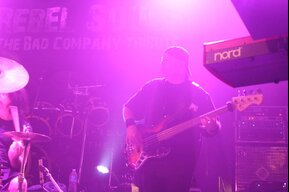
Unfortunately your gear says something about you even before you play. I was once judged as a player before I was heard because the equipment I owned, (still do). I was using old Acoustic 370 and they had never heard of it, and didn't want to give me the time of day. I have more up to date stuff now, but I was new on the scene and that was the way it was. I have proven myself as a player and have the equipment to do the shows I get. My old 370 with cabinet is still my baby, but I don’t get to use it much. I was told by one of those people from back then that they didn't know I could play.
+1 about gear saying something about you.
"Pro gear" as a prerequisite for a band will typically
1) Weed out new players. Typically, musicians don't upgrade until they have a little time under their belt, or run into a situation where they're forced to (like needing to have "pro gear" to play in a band.

)
2) Demonstrate that you're committed to playing since you're investing in pricier gear and in theory will wish to recoup some of that cost.
3) Demonstrate that you're financially more viable to the expenses that bands will accrue -- you've come up with money once, in theory you'll be able to do it again.
As for what "pro gear" is. It's going to be relative to the gigging situation. I agree that there're going to be some common factors though:
a) It's reliable, preferably with a contingency plan or two to back it up when even the most reliable amp, instrument, etc. fails.
b) It's properly suited to the volume needs of the band.
c) It achieves tonal levels desired by the gig, which is going to change from artist to artist.
d) It fits with the image of the band you're auditioning for. Again, very subjective, but still a requirement. Going back to
Woody357's post, the right look is important for any live performer, and typically they'll want someone congruous with the rest of the band's image. We've had guitarists audition for us who apologized for having certain brands of head because of the genre stigmas associated with it, and realizing that it may limit their viability in terms of having "pro gear" outside of that narrow genre the brand was known for. For instance, a guitarist who came in for an audition with a Krank head and a 7 string was incredibly talented (and we almost picked up) but he was avoiding using both (and trying to ditch the head for a Marshall) because of the pigeon hole that it had on his playing opportunities.






 ). Lower-end gear, in my experience, often is not consistent through the frequency spectrum, often emphasizing more ugly frequencies that may be impossible to dial out. As well, lower-end gear usually lacks the fidelity and note definition of higher end gear and can often be very flabby sounding. Not all lower-end gear introduces extraenous noise into the signal, but the chance of higher-end gear adding noise is less likely unless there's a manfacturing defect in the product that slipped past QC.