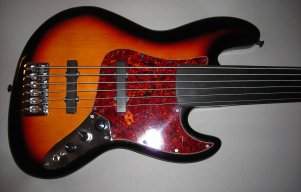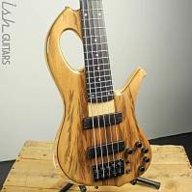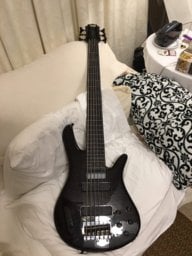
Since mid 1980's and beyond , most radio oriented hits employ a 5-string for the use of the low B string, which gives you the octave below open D, as well as below B and C, C# on A string.
Earlier use may have been the70's radio hit, "Angry Eyes", to play the low D. Also, some guitarists choose to tune flat; if you stay in standard, then a low B is a must.
Most contemporary County, Urban, Jazz, Rock and Metal recordings employ a 5 string.
High C as well as low B on 6 strings offers a benefit of using higher range as well without playing higher on neck; you stay in one position much longer. Some 6 string users employ tapping technique; play a melody on D,G,C strings with right hand and pedal the bass on B,E, A strings. Some 6'ers play chords and chord melodies on higher strings.
Doesn't take long to adjust from 4 to 5, however, I still find my 6 challenging.
Better to own a 5'er and not need the B string than to explain why you don't own one.
Thankfully today, many choices of reasonable/ giggable quality in many $$ ranges for 5 & 6 string basses.
If you stay with a 4 string you have most of the early recordings in history in genres of : Country, Classic Rock, Soul, Funk to choose from and play, as well as some contemporary hits.
Some bands eschew the use of a 5 or 6 string. I have met that prejudice also. As in previous posts, a 5 string [ low B] enables you to play in a higher position with a richer tone in some circumstances, when using B string.
If you buy a 5, don't get rid of your 4 unless you need to sell it; better to own more basses when you can reasonable afford to, in my opinion and experience.
Earlier use may have been the70's radio hit, "Angry Eyes", to play the low D. Also, some guitarists choose to tune flat; if you stay in standard, then a low B is a must.
Most contemporary County, Urban, Jazz, Rock and Metal recordings employ a 5 string.
High C as well as low B on 6 strings offers a benefit of using higher range as well without playing higher on neck; you stay in one position much longer. Some 6 string users employ tapping technique; play a melody on D,G,C strings with right hand and pedal the bass on B,E, A strings. Some 6'ers play chords and chord melodies on higher strings.
Doesn't take long to adjust from 4 to 5, however, I still find my 6 challenging.
Better to own a 5'er and not need the B string than to explain why you don't own one.
Thankfully today, many choices of reasonable/ giggable quality in many $$ ranges for 5 & 6 string basses.
If you stay with a 4 string you have most of the early recordings in history in genres of : Country, Classic Rock, Soul, Funk to choose from and play, as well as some contemporary hits.
Some bands eschew the use of a 5 or 6 string. I have met that prejudice also. As in previous posts, a 5 string [ low B] enables you to play in a higher position with a richer tone in some circumstances, when using B string.
If you buy a 5, don't get rid of your 4 unless you need to sell it; better to own more basses when you can reasonable afford to, in my opinion and experience.